When you're watching someone you love struggle with addiction, the feeling of helplessness can be overwhelming. Staging an intervention is often the step you take when all other conversations have failed. It’s not about confrontation or placing blame; it's a structured, deeply compassionate conversation where a small group of loved ones comes together to break through the wall of denial.
The whole point is to present a unified front, sharing specific examples of how their behavior is causing harm and offering a clear, immediate path to treatment. You've got to have a plan, a supportive team, and a professional treatment option ready to go before you even start the conversation.
Key Takeaways
- Professional Guidance is Key: Hiring a professional interventionist significantly increases the chances of success by providing structure, de-escalation skills, and an unbiased perspective, especially in complex situations involving mental health issues or potential aggression.
- Plan Meticulously: A successful intervention is not spontaneous. It requires careful planning, including choosing the right team, writing thoughtful letters, selecting a neutral time and place, and having a pre-arranged treatment plan ready for immediate acceptance.
- Lead with Love and Specifics: Use "I feel" statements and concrete examples of behavior to express your concern. This approach avoids blame and helps your loved one understand the real-world impact of their addiction without feeling attacked.
- Boundaries are Non-Negotiable: The entire team must agree on and commit to specific consequences if the person refuses help. These boundaries are not punishments but loving actions to stop enabling the addiction and protect everyone's well-being.
Is an Intervention the Right Next Step?
Making the decision to hold an intervention is a massive step, one that comes from a place of genuine love and profound concern. This isn't a spontaneous argument or an ambush. A successful intervention is a meticulously planned process designed to help someone finally see the severity of their substance use.
The goal is singular and incredibly focused: to motivate your loved one to accept professional help right now.
When Is It Time for an Intervention?
So, how do you know if you've reached that point? An intervention is usually the right move when all the softer, less formal conversations have gone nowhere. If your attempts to talk about the problem have been brushed aside, ignored, or met with outright denial, it’s probably time for a more structured approach.
Look for these signs that an intervention might be your necessary next step:
- Worsening Behavior: Their substance use is escalating, leading to more significant health problems, financial crises, or run-ins with the law.
- They Can't Quit Alone: They’ve tried to stop on their own, maybe even multiple times, but always relapse. This is a clear sign that professional help is needed.
- Deep-Seated Denial: Despite the mountain of negative consequences staring them in the face, they still can't or won't admit how bad things have gotten.
- Collateral Damage: Their actions are causing real emotional, financial, or even physical harm to the people around them—family, friends, and coworkers.
What’s the Goal and What Should You Expect?
Before you even think about who to invite or what to say, your group needs to agree on one, unified goal. For 99% of interventions, that goal is to get the person to accept a pre-arranged treatment plan on the spot. This meeting is not the time to rehash old arguments, settle scores, or demand an apology.
The primary objective is to bridge the gap between denial and acceptance. Your collective voice aims to make the reality of the situation undeniable, creating a moment of clarity that can inspire the decision to seek help.
This is going to be emotionally draining for everyone in the room. You have to manage your expectations. There's no guarantee of success, and your loved one might still refuse help. Being mentally prepared for that outcome is just as crucial as preparing for a "yes."
Before jumping into the planning phase, take a moment with your team to reflect on a few core questions. This ensures everyone is aligned and understands the stakes.
Key Questions Before You Plan an Intervention
Here's a quick-reference guide to the foundational questions you need to answer before moving forward.
| Question to Consider | Why It's Critical | Your Next Action |
|---|---|---|
| Have we exhausted all other options? | An intervention is a serious step. It’s vital to confirm that simpler, direct conversations have already been tried and failed. | List the previous attempts to talk to the person and the outcomes. |
| Who is on our "intervention team"? | The group must be small, supportive, and non-judgmental. Anyone with unresolved anger or who might enable the person should not be included. | Create a shortlist of 3-5 core family members and friends. Consider hiring a professional interventionist. |
| What is our single, unified goal? | Everyone must agree on the desired outcome—typically, immediate entry into a specific treatment program. | Identify and contact a treatment facility. Confirm they have a bed available on the day of the intervention. |
| What are the consequences if they say no? | Each team member must decide on a specific boundary they will enforce if the person refuses help (e.g., "I will no longer give you money"). | Have each participant write down their consequence and commit to upholding it. |
Answering these questions honestly as a group provides the solid foundation you'll need for what comes next.
Navigating this process is tough, and families often need their own support system. As you prepare, it can be incredibly helpful to explore recovery resources for families to better understand the road ahead. This focus on long-term healing for everyone involved is what gives an intervention its true power.
Building Your Compassionate Support Team

The real power of an intervention isn’t about overwhelming someone with a crowd. It’s about the focused, united voice of a small group of people speaking from a place of deep love and concern. You're not assembling an audience; you're hand-picking a team that can stay calm and centered on one single objective: convincing your loved one to finally accept help.
This isn't the time for airing old grievances. Each person in that room needs to be 100% committed to the process, ready to share their worries constructively. Think of this team as a bridge to recovery, not a jury.
Who Should Be in the Room
Choosing the right people is probably the most important decision you'll make when you plan how to stage an intervention. The ideal team is small and intimate—usually between three and six people. Any more than that, and you risk making your loved one feel cornered.
Every person there should have a genuine, meaningful relationship with the person you're trying to help.
Good candidates often include:
- Close Family Members: Think parents, a spouse, siblings, or adult children who have seen the impact firsthand and can speak from the heart.
- Trusted Friends: A best friend or a longtime confidant—someone whose opinion your loved one truly respects.
- Respected Mentors: This could be a pastor, a former coach, a boss, or a family elder. Their words often carry a different kind of weight.
The non-negotiable rule is that everyone involved must be able to stick to the plan and express themselves calmly, without anger or blame.
Who Should NOT Be Invited
Knowing who to leave out is just as critical as knowing who to include. The wrong person can completely derail the conversation, turning a moment of support into a painful confrontation. An intervention is already an emotional powder keg; you have to protect the environment.
It’s best to exclude anyone who:
- Has Unresolved Anger: If someone is likely to use this as a chance to unload old resentments, they shouldn't be there.
- Is an Enabler: This is anyone who has a history of making excuses, giving money, or otherwise supporting the addiction. Their message will be mixed at best.
- Cannot Control Their Emotions: A person prone to hysterics or emotional outbursts will only escalate the tension.
- Your Loved One Dislikes: Inviting someone your loved one already has a fraught relationship with is a recipe for disaster. It immediately puts them on the defensive.
Sometimes, a person who can't be in the room can still contribute. They can write a letter expressing their love and concern, and a member of the team can read it aloud. This keeps their voice in the conversation without risking the delicate balance of the meeting itself.
Your intervention team must be a circle of trust and strength. The goal is to create a safe space where your loved one feels the depth of your collective concern, not the weight of judgment.
The Value of a Professional Interventionist
While you can stage an intervention on your own, I almost never recommend it. A trained, professional interventionist is so much more than a moderator. They are a neutral guide who brings structure, de-escalation skills, and a wealth of experience to the table. Their presence alone can significantly increase the chances of a "yes."
Hiring a professional is especially important if your loved one:
- Has a history of violence or aggression.
- Struggles with co-occurring mental health issues, like depression or bipolar disorder.
- Has ever threatened self-harm.
- Is prone to manipulation or has a history of twisting situations.
A good interventionist helps you prepare, rehearse your letters, and stay on track when emotions run high. They are masters at navigating denial, anger, and fear, and can pivot the strategy in real-time if things go off script. Think of them as the calm anchor in an emotional storm, making sure the focus always returns to the one thing that matters: getting your loved one the help they deserve.
Writing a Letter That Inspires Change

The letters read during an intervention are its emotional core. These aren't just scripts; they are carefully crafted messages of love, concern, and genuine hope for a better future. The words you choose can either build a bridge for your loved one to cross toward help or a wall that pushes them further away.
This is your moment to break through the denial by sharing your truth in a way that can finally be heard. The tone you're aiming for is firm yet loving, factual yet compassionate. Each letter should be a personal, heartfelt plea that focuses on the behavior, not the person you love.
The Power of “I Feel” Statements
If there's one tool that will make or break your letter, it's the "I feel" statement. This simple shift in language is incredibly powerful. It transforms a potential accusation into a personal truth that simply cannot be debated. It’s the difference between pointing a finger and opening your heart.
Think about it. An accusatory "you" statement like, "You always ruin family gatherings," will immediately put anyone on the defensive. They'll shut down before you even get to your point.
But when you reframe it, the dynamic changes entirely. "I feel sad and anxious at family gatherings because I'm worried about your drinking." See the difference? This isn’t an attack; it’s an honest expression of your emotional reality.
Ground Your Letter in Specific Examples
General complaints feel like character attacks, and honestly, they're easy for someone to dismiss. Vague statements like, "Your addiction is tearing this family apart," are just too broad to land with any real impact. To be effective, you have to connect your feelings to specific, factual events.
Think of a concrete moment in time. What happened? How did it directly impact you?
- Instead of: "You're so unreliable."
- Try: "I felt scared and alone when I couldn't reach you for two days last month after you lost your phone."
- Instead of: "You don't care about your kids."
- Try: "I felt heartbroken when you were too high to come to Timmy’s championship game, and I had to explain to him why you weren't there."
These specific examples make the consequences of the addiction tangible. They aren't just abstract stories; they are clear evidence of the pain the disease is causing. Your loved one might argue with your interpretation of an event, but they can't argue with the fact that it happened or how it made you feel.
The purpose of sharing these moments is not to shame your loved one, but to illustrate the undeniable impact of their actions. It's about saying, "This is what happened, this is how it hurt me, and I'm sharing this because I love you and I want things to change."
Structuring Your Intervention Letter
While every letter needs to be deeply personal, following a simple structure will help you stay focused, compassionate, and effective. A good letter is concise—you should be able to read it calmly in just a few minutes.
Here is a simple, four-part framework to guide your writing:
- Start with Love and Affirmation: Before you get into the hard stuff, remind them how much you care. "You are my brother, and I love you more than words can say. I’ll never forget how you looked after me when we were kids."
- State Your Concern with a Specific Example: This is where you use that "I feel" formula. "That’s why I was so terrified last week when I got a call that you had been in an accident. I felt sick with worry when the police officer told me it was alcohol-related."
- Clearly State the Goal: This is your direct "ask." "I can’t watch this disease hurt you anymore, which is why I'm asking you to accept the help we have arranged for you today."
- Outline the Consequence: Explain the boundary you will enforce if they refuse help. This isn't a threat; it's a necessary and loving act of self-preservation. "If you decide not to go to treatment, I will no longer be able to lend you money or let you stay at my house. I cannot enable this behavior any longer."
This structure keeps your message clear and loving. Practicing your letter with the intervention team is also a critical step. It helps you prepare to manage your own emotions and ensures everyone’s message is aligned and supportive—an essential part of knowing how to stage an intervention that works.
Nailing Down the Plan and Setting the Boundaries
With your support team in place and your letters written, it's time to shift gears to the practical side of things. How you plan the actual meeting can make or break the entire effort. A well-thought-out plan creates a calm, controlled environment where your message of love and concern has the best possible chance of being heard. Honestly, this logistical work is every bit as critical as the emotional prep you've already done.
Success often comes down to two simple things: when and where. You need a setting that’s private, feels neutral, and is free of easy distractions or escape routes. A living room can work, as can a trusted friend’s home or even a professional’s office. The main thing is that it feels safe for everyone, but doesn’t give your loved one a simple way to walk out.
Choosing the Right Time and Place
Timing is everything. You absolutely have to schedule the intervention for a time when your loved one is most likely to be sober. For a lot of people, that means first thing in the morning before they have a chance to use.
Try to avoid high-stress times, like right before a holiday or immediately after a big fight. The whole point is to lower the emotional temperature in the room, not crank it up. Make sure every single person on the team commits to being there on time—it shows just how serious this moment is.
Preparing for Difficult Reactions
No matter how perfectly you plan, you can’t predict exactly how your loved one will react. You might see shock, relief, sadness, or intense, explosive anger. Being ready for any of these is a non-negotiable part of the process.
- Denial: The classic "I don't have a problem." This is precisely why your letters, with their specific, factual examples, are so powerful.
- Anger: They might lash out, start blaming people, or get aggressive. It's crucial for the team to stay calm and refuse to get pulled into an argument. A professional interventionist is a lifesaver here, trained in de-escalating these exact situations.
- Bargaining: Get ready for promises to just "cut back" or try a less intensive option. The team must gently but firmly hold the line on the treatment plan you've already decided on.
This flow diagram breaks down the essential steps for setting up the intervention.
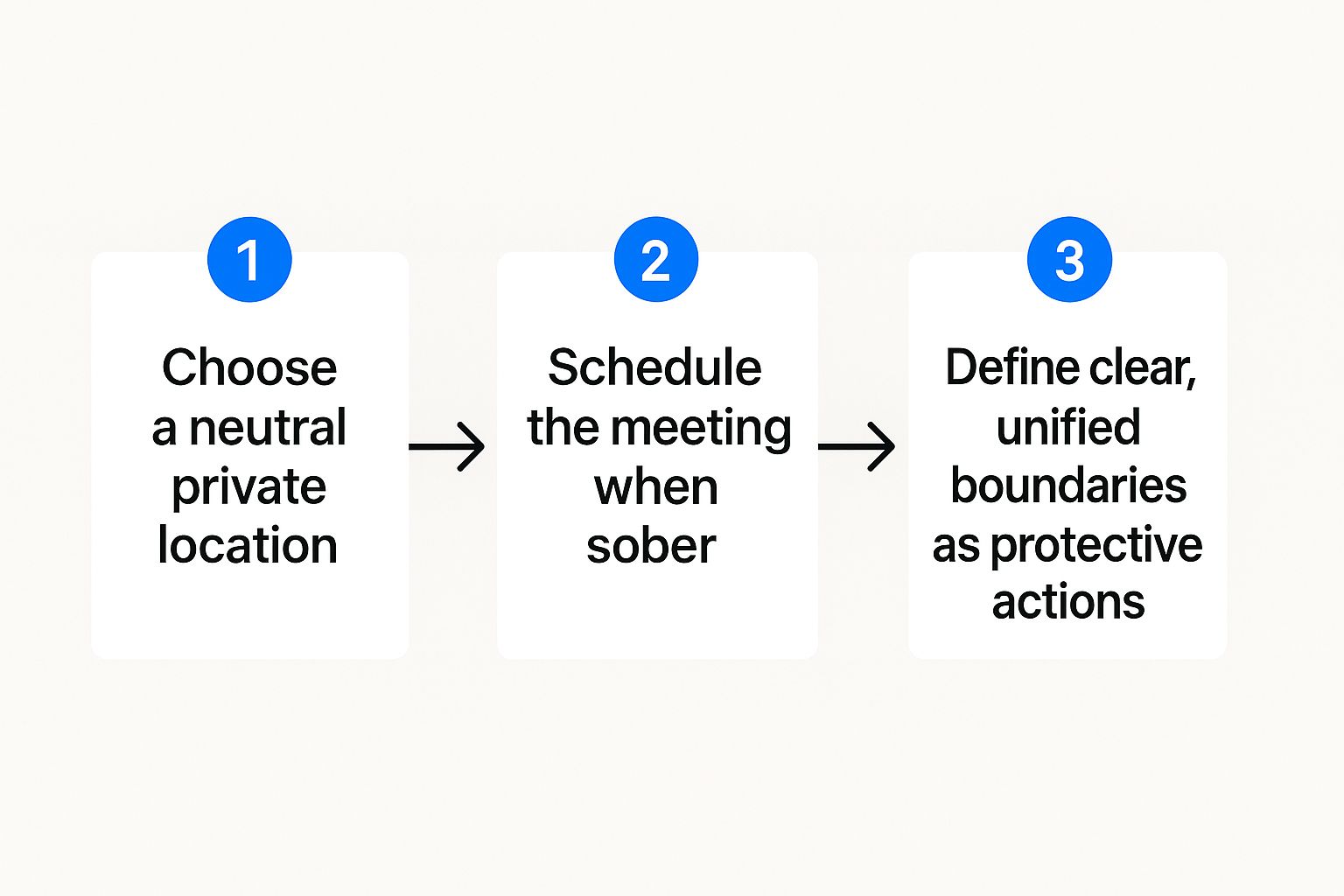
As you can see, a successful plan moves from securing a safe space to defining the non-negotiable outcomes. This structured approach, moving from the physical to the emotional, keeps the meeting focused and effective.
Defining Clear and Loving Boundaries
This might be the hardest part of the whole planning process: setting boundaries. Think of these not as threats or punishments, but as protective, loving actions that each person will take if your loved one refuses help. These consequences are your final, unified message that the current situation cannot continue.
Your boundaries have to be specific, actionable, and something you are 100% prepared to follow through on immediately.
Here are some real-world examples of firm boundaries:
- "If you choose not to go to treatment today, I can no longer give you any money or pay your bills."
- "I love you, but for the safety of the children, I cannot let you be around them while you are actively using."
- "If you refuse this help, you will need to move out."
Deciding on these consequences beforehand is what allows the team to present a firm, united front. This isn't about giving ultimatums; it's about breaking the cycle of enabling and protecting the well-being of everyone involved—including the person you're trying so desperately to help.
The power of a methodical plan is well-documented. Take global health, for example. Research from the World Health Organization on programs like immunizations shows that clear, structured implementation saves millions of lives. Those same principles—deliberate planning and clear messaging—are what make a personal intervention work.
Guiding the Conversation and Next Steps
This is the moment all your planning has led to. The day of the intervention requires a calm, steady hand to guide a deeply emotional conversation toward a single, life-affirming goal. All that preparation is your anchor now, keeping the meeting focused on love and solutions, not blame and chaos.
The first step is simply getting your loved one to the pre-arranged location. It’s absolutely critical to do this without deception. Luring them there under a false pretense, like a surprise party, will shatter trust before you even begin.
Be direct but gentle. Something as simple as, "Some people who love you are here and want to talk. It's really important," is all you need.
Opening the Conversation with Purpose
Once everyone is together, the leader or professional interventionist needs to take the reins. Their immediate job is to set a calm, respectful tone and clearly state why everyone is there. This isn't a trial; it's an expression of profound concern from the people who care most.
A good opening might sound something like this: "We're all here today because we love you. We've each seen how [the substance] is hurting you, and we want to help you find a way forward." This immediately frames the conversation around support, not accusation.
From there, you begin reading the letters. The order is intentional, designed to build a compassionate narrative. You'll often start with the person who has the least emotional intensity and build toward the person with the most significant relationship, like a spouse or parent. This structure gives your loved one a chance to gradually absorb the weight of everyone's concern.
Navigating the Two Possible Outcomes
After every letter has been shared, the moment of truth arrives. The leader will present the pre-arranged treatment option as the clear, immediate next step. Your loved one's response is going to fall into one of two categories: a "yes" or a "no." You have to be completely prepared for both.
Surprisingly, a positive outcome is more common than many people think. Hearing the unified concern of their family and friends is often the catalyst for an individual to finally accept help.
Data from the television show "Intervention," which documented over 276 formal interventions, showed that an incredible 98.7% of individuals agreed to enter treatment. This high acceptance rate shows what's possible when a team works together with a solid plan.
If They Say Yes
A "yes" is a monumental victory, but it demands immediate action. Any delay creates a window for doubt and second thoughts to creep in. This is exactly why having all the logistics handled beforehand is non-negotiable.
- A bag should be packed and ready. Have their essentials waiting by the door.
- Travel needs to be arranged. You should know exactly how they are getting to the facility.
- The treatment center is expecting them. Their admission should be confirmed for that same day.
The transition has to be seamless. A member of the intervention team should go with them to the treatment facility to make sure they arrive safely and feel supported every step of the way.
If They Say No
Hearing a "no" is heartbreaking, but it is not a failure. If your loved one refuses help, the most loving and effective response is to calmly end the meeting and immediately enact the boundaries you all agreed upon.
This is not a punishment. It is the fulfillment of a promise to stop participating in the patterns that enable the addiction. Sticking to these consequences is the only way to protect your own well-being and create an environment where your loved one may eventually reconsider their choice.
This is an incredibly difficult step that requires immense strength and unity from the entire team. The techniques used in motivational interviewing can be a valuable resource for families in this position, as they focus on fostering a person's own motivation for change rather than forcing it on them.
Staying firm on your boundaries sends the most powerful message possible—one that says, "We love you enough to let you feel the full weight of your choices."
Wrapping It Up: The Cornerstones of a Successful Intervention
When you're trying to figure out how to stage an intervention, all the planning and details can feel overwhelming. But when it comes down to it, a successful outcome really hinges on a few core ideas. Think of these as your final checklist—the principles that will keep you grounded and focused on what truly matters: helping the person you care about.
The single most powerful tool you have is a united front. When every person in the room delivers the same message of love, concern, and clear boundaries, it’s incredibly difficult for your loved one to ignore or argue away the reality of their situation.
Your Final Checklist
Here are the non-negotiables that can make all the difference:
-
Lead with Love, Not Blame: Make sure the entire conversation is framed with care and support. You're not there to win an argument or point fingers; you're there to open a door to recovery.
-
Bring in a Professional: An interventionist isn't just a moderator; they're an expert in managing high-stakes emotions, keeping the conversation on track, and de-escalating tension. Their guidance can truly be the difference between a yes and a no.
-
Have Treatment Ready to Go: This is a big one. If your loved one agrees to get help, there can't be any delays. You need to have the treatment facility confirmed, bags packed, and travel arrangements sorted out before the intervention even begins.
-
Boundaries Protect Everyone: Setting and holding firm consequences isn't about punishment. It's about protecting the family's well-being and stopping the cycle of enabling. Sometimes, facing those consequences is the final push someone needs to accept help.
The intervention itself is just the beginning of the journey. What happens afterward is just as important, which is why having a strong relapse prevention plan template is a critical next step for the whole family to work on together.
Frequently Asked Questions About Interventions
When you're planning something as emotionally charged as an intervention, a million questions and "what-ifs" are bound to come up. That's completely normal. Let’s walk through some of the most common concerns so you can move forward with confidence.
What if they just get mad and walk out?
This is a valid fear, but an angry reaction does not mean the intervention has failed. If they leave, the plan shifts. The leader should calmly end the meeting, and the team must immediately begin enforcing the pre-agreed boundaries. This unified action sends a powerful message that the enabling has stopped, which can sometimes be the catalyst for them to reconsider treatment later.
What does a professional interventionist cost?
The cost for a professional interventionist can range from $2,500 to over $10,000. The price depends on the professional's experience, the complexity of the case, and travel requirements. While it is a significant investment, you are paying for expertise in managing a volatile situation, navigating denial, and de-escalating conflict—skills that dramatically increase the likelihood of a positive outcome.
Can we do an intervention without a professional?
While it is possible, it's highly discouraged, especially if your loved one has a history of violence, co-occurring mental health disorders (like depression or bipolar disorder), or has threatened self-harm. A professional provides a neutral, calming presence that is nearly impossible for an emotionally invested family member to replicate. Their guidance is essential for safety and effectiveness in high-risk situations.
What happens after the intervention?
The intervention is just the start. If your loved one accepts help, the family's healing journey begins. This often involves family therapy and support groups like Al-Anon to address unhealthy dynamics. If they refuse help, the family must hold firm to their boundaries. This is not a punishment, but a necessary step to stop enabling the addiction and protect your own well-being. The hope is that facing these consequences will eventually lead them to seek help.
Navigating addiction feels overwhelming, but you aren't on this path by yourself. At StartDrugRehab.com, we're here to offer the resources and support your family needs to start healing. Explore treatment options and support for your family on StartDrugRehab.com.