When we talk about evidence-based addiction treatment, we're talking about a clinical approach that relies on scientifically proven methods to help people recover from substance use disorders. It's not about guesswork or old traditions; it's about integrating the best available research, a therapist's professional experience, and—most importantly—the patient's own unique values and goals to build a truly effective care plan.
Key Takeaways
- Evidence-Based Treatment is a Three-Part Approach: It combines the best scientific research, the therapist's clinical expertise, and your personal values and preferences to create the most effective plan.
- Proven Therapies are the Core: Methods like Cognitive Behavioral Therapy (CBT), Dialectical Behavior Therapy (DBT), and Medication-Assisted Treatment (MAT) are used because they have been scientifically proven to work.
- Treatment is Personalized, Not One-Size-Fits-All: A core principle is tailoring the treatment plan to your specific needs, goals, and life circumstances. You are an active partner in your recovery.
- Quality Care Can Be Vetted: You can find high-quality programs by looking for accreditations, asking specific questions about their methods and staff credentials, and watching out for red flags like "guaranteed cures."
What Evidence-Based Addiction Treatment Really Means
Think of it like this: if you were having a bridge built, you wouldn't want the engineers to just guess at the design or the materials. You'd expect them to use proven principles of physics and engineering to ensure that bridge is safe, strong, and built to last. That's exactly the logic behind evidence-based addiction treatment.
Instead of relying on anecdotal success stories or unproven theories, this model puts its trust in strategies that have been rigorously tested and shown to work through extensive scientific research. It’s a commitment to using what works.
But this doesn't mean treatment is a rigid, one-size-fits-all formula. Far from it. Genuine evidence-based care is a flexible process that weaves together three critical elements to create a complete picture of healing.
The Core Components of This Approach
The power of this framework is how it combines multiple sources of wisdom to produce the best possible outcome. These components ensure treatment is not only effective but also deeply respectful of each person's individual journey.
-
Best Research Evidence: This is the bedrock. It means using therapeutic methods and interventions that have been validated through countless clinical trials and peer-reviewed studies. Therapies like Cognitive Behavioral Therapy (CBT) are a perfect example, as decades of data confirm their effectiveness in treating addiction.
-
Clinical Expertise: Research on its own isn't the whole story. A skilled therapist brings their professional judgment, experience, and intuition to the table, knowing how to adapt proven methods to a specific person's life and struggles. They understand how to apply the science of recovery to the very human art of connection and healing.
-
Patient Values and Preferences: This might be the most crucial piece of the puzzle. Your personal goals, cultural background, beliefs, and unique life circumstances are placed at the very center of the treatment plan. After all, a plan is only going to work if it actually resonates with you and feels achievable in your life.
This collaborative approach makes you an active partner in your own recovery. It shifts away from a top-down, "doctor knows best" model and empowers you to help create a path forward that is both scientifically sound and personally meaningful. That partnership significantly boosts the chances of long-term success.
Ultimately, evidence-based addiction treatment is the gold standard because it offers a reliable, data-driven roadmap for recovery. It answers the most important question—"Does this actually work?"—with a confident, "Yes, and here's the proof."
By choosing a program built on these principles, you're giving yourself or your loved one the best possible shot at building a lasting, healthy future. It’s a promise of quality care rooted in science, expertise, and a profound respect for the individual.
The Three Pillars of Effective Treatment
Evidence-based addiction treatment isn't some rigid, one-size-fits-all formula. It’s better to think of it as a flexible framework built on three core pillars. Each one is essential, and together they create a treatment plan that's personal, effective, and deeply human.
I like to use the analogy of a three-legged stool. If you kick one of the legs out, the whole thing topples over. For recovery to have a stable foundation, all three of these pillars need to be working together.
This infographic breaks down how these pillars intersect to build a solid, comprehensive approach.
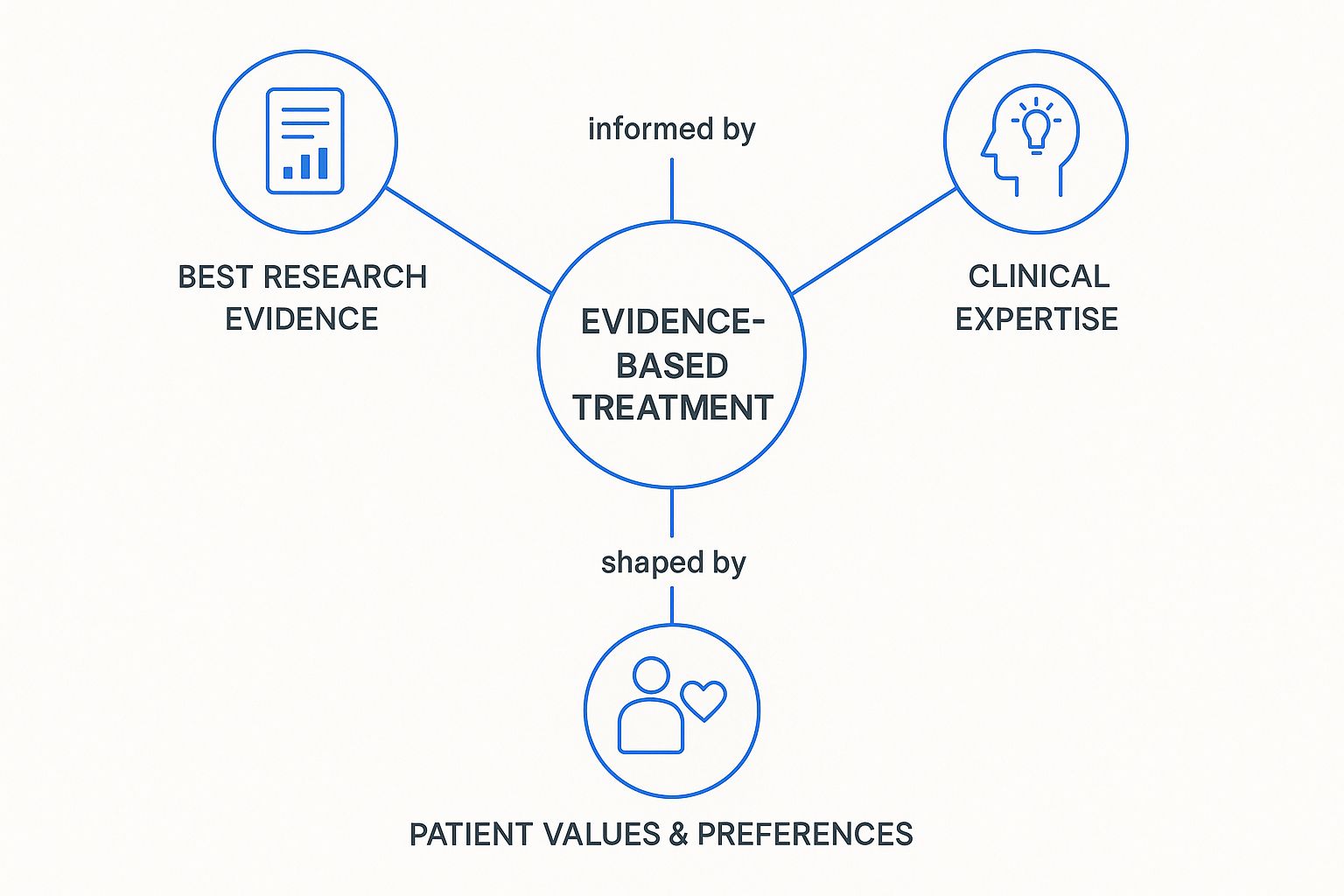
As you can see, the sweet spot for effective treatment lies right where scientific data, a professional's judgment, and your own personal needs overlap.
Pillar 1: Best Research Evidence
The first pillar, the very bedrock of this approach, is the best available research evidence. This is what grounds everything in solid science. It means that every decision is backed by data and proven results, not just tradition, guesswork, or someone's gut feeling. The therapies and interventions used have been put through the wringer—tested in clinical trials and scrutinized in peer-reviewed studies.
For instance, a rehab program might use Cognitive Behavioral Therapy (CBT). Why? Because decades of research have shown, again and again, that it works. It's a proven method for helping people spot and change the destructive thought patterns that fuel substance use. This commitment to science ensures the treatment has the best possible chance of success.
This pillar is especially crucial when you consider the scale of the crisis. Substance use disorders contribute to over 3 million deaths worldwide every year. Here in the United States, an estimated 48.5 million people had a substance use disorder in 2023, but the overwhelming majority never get help. You can dig into more detailed 2025 statistics on substance use disorders from TherapyRoute to see the full picture.
Pillar 2: Clinical Expertise
But research on its own isn't the whole story. The second pillar is clinical expertise—the hands-on experience, skill, and professional judgment of the therapist and their team. A truly great clinician is an expert at taking what a study says and applying it to the messy reality of a real person's life.
They're the ones who can properly assess your unique situation, spot co-occurring conditions like anxiety or depression, and then thoughtfully adapt a proven therapy to fit your personality and your specific challenges. This is where the "art" of medicine meets the "science."
A great therapist acts as a skilled translator. They take the language of scientific research and translate it into a practical, compassionate, and effective plan that makes sense for you.
Their expertise is what makes the process feel personal and responsive, not like you're just another number being pushed through a cookie-cutter program.
Pillar 3: Patient Values and Preferences
The final, and you could argue most important, pillar is you. Your patient values, preferences, and circumstances are central to the entire process. This pillar guarantees that treatment revolves around your life, your goals, and what you hold dear. It respects your cultural background, your personal beliefs, your family dynamic, and your past experiences.
This is where the collaborative spirit of evidence-based treatment really comes to life. Your input isn't just a nice-to-have; it's a non-negotiable part of the equation.
After all, a treatment plan is useless if you aren't willing or able to stick with it. This pillar makes sure the plan actually fits your life.
- Personal Goals: What does recovery mean to you? Is it getting your job back? Rebuilding relationships with your kids? Finding a new sense of purpose?
- Cultural Context: Your background and community are huge sources of strength and identity. Good treatment honors and incorporates these elements instead of ignoring them.
- Life Circumstances: Practical things matter. A plan has to account for your job, your living situation, and your family commitments to be sustainable in the real world.
When these three pillars come together, something powerful happens. You get a plan that combines what science has proven to work, what a skilled professional knows from experience, and what you know to be true for yourself. This balanced approach is what makes lasting recovery not just a possibility, but a reality.
Exploring Core Evidence-Based Therapies

It’s one thing to understand the science behind evidence-based addiction treatment, but it's another thing entirely to see how these methods actually work in a real person's life. That's where confidence in the recovery process truly begins.
These therapies aren't just abstract ideas from a textbook. They are practical, hands-on tools designed to help people reclaim their lives from the grip of addiction. Each one offers a structured, proven path for changing destructive behaviors, managing tough emotions, and building a solid foundation for a future free from substance use.
Let's walk through four of the most effective and widely used therapies in the field. Think of them as different specialists on a medical team—each one brings unique expertise to the table, and they often work together to create a comprehensive and deeply personal treatment plan.
Cognitive Behavioral Therapy (CBT)
Cognitive Behavioral Therapy, better known as CBT, is a true cornerstone of modern addiction treatment. The core idea is surprisingly simple yet incredibly powerful: our thoughts, feelings, and behaviors are all linked. If you can change your negative thought patterns, you can change your actions.
Imagine a vicious cycle. A stressful day at work triggers the thought, "I can't possibly deal with this without a drink." That thought sparks intense anxiety, which in turn drives the behavior of reaching for a substance. CBT gives you the tools to step into that cycle and break it. You learn how to catch, challenge, and reframe those harmful thoughts before they ever have a chance to lead to a relapse.
In a typical CBT session, you and your therapist might work on:
- Identifying Triggers: Pinpointing the exact situations, people, or emotions that spark cravings.
- Challenging Automatic Thoughts: Learning to question the "truths" your mind tells you to justify using.
- Developing Coping Skills: Practicing new, healthy ways to navigate stress and other difficult feelings.
Dialectical Behavior Therapy (DBT)
While CBT is all about changing your thoughts, Dialectical Behavior Therapy (DBT) introduces another vital ingredient: acceptance. DBT was originally created to treat borderline personality disorder, but it has proven to be a game-changer for addiction, especially for those who also struggle with intense, overwhelming emotions.
The "dialectic" in its name is about finding the balance between two ideas that seem like opposites—acceptance and change. DBT teaches you that it's okay to accept yourself exactly as you are in this moment, while simultaneously working hard to change your behaviors for the better. This is incredibly freeing for people whose powerful emotions often trigger substance use.
DBT operates on a simple premise: you can't change what you don't first accept. By learning to sit with distress without judging yourself, you create the mental space you need to make a healthier choice instead of just reacting on impulse.
The skills you learn in DBT—like mindfulness, distress tolerance, and emotion regulation—are like a toolkit for life, helping you navigate challenges without falling back on old habits.
Motivational Interviewing (MI)
Let's be honest: not everyone walks into treatment fired up and ready to change. That’s where Motivational Interviewing (MI) comes in. It’s a gentle, collaborative counseling style designed to help a person find their own motivation to change. It’s not about a therapist lecturing or confronting you; it’s about a guided conversation that helps you resolve your own mixed feelings.
An MI-trained therapist acts more like a co-pilot than a boss. They use open-ended questions, affirmations, and careful listening to help you see the gap between your current life and the life you truly want. This process builds motivation from the inside out, which is always more powerful and lasting than pressure from the outside. To see how this client-centered approach works in detail, you can learn more about Motivational Interviewing and its techniques in our dedicated guide.
Medication-Assisted Treatment (MAT)
Medication-Assisted Treatment (MAT) is a comprehensive approach that combines FDA-approved medications with counseling and behavioral therapies. It’s particularly effective for opioid and alcohol addiction, treating the whole person—not just their habits.
Here’s a helpful way to think about it: therapies like CBT and DBT help rewire the brain's "software" (your thoughts and behaviors). MAT, on the other hand, helps stabilize the "hardware" (your brain chemistry). Medications can quiet down relentless cravings and ease withdrawal symptoms, which makes it so much easier for a person to show up and fully engage in the therapeutic work. Research consistently shows that this combined approach significantly boosts recovery outcomes and, crucially, reduces the risk of a fatal overdose.
Comparing Evidence-Based Addiction Therapies
To make these distinctions even clearer, the table below breaks down the primary focus and goals of each therapeutic approach. While they have different methods, they all share the same ultimate goal: to equip you with the skills for long-term recovery.
| Therapy | Primary Focus | Best For Treating | Key Skills Learned |
|---|---|---|---|
| CBT | Changing negative thought patterns and behaviors. | A wide range of substance use disorders and co-occurring conditions like anxiety. | Identifying triggers, challenging thoughts, developing coping strategies. |
| DBT | Balancing acceptance with change to manage intense emotions. | Addiction with co-occurring emotional dysregulation, self-harm, or trauma. | Mindfulness, distress tolerance, emotion regulation, interpersonal skills. |
| MI | Strengthening a person's internal motivation to change. | Individuals who are ambivalent or resistant to starting treatment. | Self-motivation, goal setting, resolving internal conflict. |
| MAT | Stabilizing brain chemistry to reduce cravings and withdrawal. | Opioid Use Disorder and Alcohol Use Disorder. | Medication management, sustained engagement in therapy, relapse prevention. |
Each of these therapies offers a proven pathway toward healing. The best treatment plans often integrate elements from several of these models, creating a program that feels tailored specifically to your needs and circumstances.
Why Proven Interventions Are More Crucial Than Ever
The world of addiction is always changing, bringing new challenges and a growing need for care that actually works. As we continue to face public health crises like the opioid epidemic, the call for treatment methods with reliable, measurable results has become urgent. This is precisely why evidence-based addiction treatment is now front and center.
We're up against a massive public health problem. A huge gap exists between the number of people who desperately need help for a substance use disorder and those who actually get high-quality, science-backed care. It's not enough to just offer some kind of treatment; we have to focus on the approaches proven to be effective.
The Soaring Costs of Ineffective Treatment
When addiction is left untreated or managed with unproven methods, the fallout spreads far beyond the individual, impacting families, communities, and our economy. The costs are staggering and show up in ways we don't always connect directly to the source.
Think about the ripple effect:
- Overloaded Healthcare Systems: Substance use contributes to a constant flow of emergency room visits, hospital stays for overdoses, and the long-term management of related chronic health problems. This puts an immense strain on our medical resources.
- Lost Economic Productivity: Addiction often leads to missed work, lower on-the-job productivity, and unemployment. This not only affects a person's financial well-being but also chips away at the broader economy.
- Strained Social Services: The justice system, child welfare services, and housing programs frequently intersect with untreated addiction, creating deep-seated social issues that demand enormous public funding to address.
Putting money into scientifically validated treatment isn't just about compassion—it's the smart, financially responsible thing to do. Every dollar invested in effective addiction care brings a significant return by cutting down on future healthcare costs and lost productivity.
A Growing Market Reflects a Pressing Need
The global demand for real solutions is impossible to ignore, and you can see it reflected in economic trends. The international market for addiction treatment is expanding quickly, fueled by a greater understanding of substance use disorders and the critical need for interventions that work.
The market was valued at roughly USD 9.97 billion in 2025 and is expected to climb to around USD 16.22 billion by 2034. This isn't just a number; it shows a worldwide commitment to adopting methods that have been put to the test.
While North America currently leads this market, its rapid growth in other parts of the world signals a global shift toward viewing addiction as a treatable health condition that requires scientific solutions. You can dive deeper into these trends by exploring more about the future of the addiction treatment market.
This economic momentum highlights a simple truth: as a society, we are finally investing in what works. We're moving away from guesswork and toward a future where everyone seeking help can find evidence-based addiction treatment. Making these proven methods widely available isn't just a good idea—it's our best strategy for building healthier, stronger communities for generations to come. This has to be a public health priority if we truly want to turn the tide.
How to Find and Vet a Treatment Program

Knowing what makes for effective, evidence based addiction treatment is half the battle. Now comes the hard part: finding a program that actually puts those principles into practice. It can feel overwhelming, but with a solid plan and the right questions, you can cut through the noise and find genuinely high-quality care.
Think of yourself as an investigator. You wouldn’t hire a contractor for a major home renovation without checking their references and seeing their past work. You need to bring that same level of diligence to choosing a partner for your recovery journey.
Starting Your Search with Trusted Resources
Before you even think about picking up the phone, start your search with organizations that have already done some of the heavy lifting. Reputable groups that accredit or certify treatment centers are your best first stop. A fantastic place to begin is the Substance Abuse and Mental Health Services Administration (SAMHSA), which runs a national helpline and offers a free online treatment locator.
Accreditation is another huge indicator of quality. Keep an eye out for centers accredited by independent bodies like The Joint Commission or the Commission on Accreditation of Rehabilitation Facilities (CARF). This certification is a signal that the facility has passed a rigorous evaluation of its patient care, safety, and operational standards.
Critical Questions to Ask Any Provider
Once you have a shortlist of programs, it's time to become a journalist. A good provider will welcome your questions and be transparent in their answers. If you get vague responses or a dismissive attitude, consider that a major red flag.
Here are the essential questions you need to ask:
-
Which specific evidence-based therapies do you use?
You want to hear them name specific methods like "Cognitive Behavioral Therapy (CBT)" or "Medication-Assisted Treatment (MAT)." If they lean heavily on generic terms like "holistic" or "our unique proprietary method" without mentioning proven therapies, push them for concrete details. -
How do you create an individualized treatment plan?
One-size-fits-all doesn't work. Ask about their intake and assessment process. How, exactly, does that initial evaluation shape the specific therapies, session frequency, and overall goals for each person? -
How do you measure a patient's progress?
A program that relies on data will have clear ways to track success. They should be able to tell you how they monitor progress and, just as importantly, how they adjust a treatment plan when something isn’t working. -
What are the credentials of your clinical staff?
Don't be shy about asking for specifics. Who will be providing the care? Look for licensed and certified professionals, such as a Licensed Alcohol and Drug Counselor (LADC) or a Licensed Clinical Social Worker (LCSW). -
What does your aftercare planning involve?
Recovery is a long-term process that continues long after someone leaves the facility. A great program will have a structured plan for ongoing support, helping you connect with resources to prevent relapse.
Making the right choice also involves understanding the different levels of care available. Our guide on inpatient vs. outpatient rehab is a great resource for figuring out which environment might be the best fit for you or your loved one.
Red Flags to Watch Out For
Knowing what to look for is critical, but knowing what to avoid is just as important. Unfortunately, the treatment industry has its share of providers who use slick marketing to mask ineffective—or even harmful—practices.
Be extremely wary of any facility that guarantees success or promises a quick "cure." Addiction is a complex chronic health condition. Recovery is an ongoing journey, not a one-and-done event. Ethical providers are honest and set realistic expectations.
You should immediately steer clear of programs that:
- Rely on unproven methods: If a center’s main selling points are activities like "equine therapy" or "wilderness excursions" without being grounded in proven clinical therapies, be careful. These activities can be beneficial supplements, but they are not a substitute for evidence-based care.
- Use high-pressure sales tactics: You should never feel rushed or pressured to make a decision. Aggressive follow-up calls or "special offers" that expire soon are signs of a business that puts profits before patients.
- Lack transparency about costs: A reputable center will be upfront and clear about all costs. They should help you understand your insurance coverage and any out-of-pocket expenses before you commit.
By arming yourself with this information, you shift from being a passive patient to an empowered advocate for your own health. You'll be ready to confidently vet programs, spot quality care, and choose a provider who will guide you on a proven path to recovery.
Overcoming Common Barriers to Getting Help
Knowing that effective, evidence-based addiction treatment is out there is one thing. Actually getting it is another. For many people, the road to care is filled with very real roadblocks that can feel impossible to get past, like cost, stigma, or just not knowing where to even start.
The good news? For every barrier, there’s a way around it. Recovery isn't just for a select few; it’s possible for anyone. By breaking down these challenges into smaller, manageable pieces, the journey becomes much less daunting. Our guide on the first steps to recovery can give you more practical advice on this.
Navigating Financial Hurdles
Let’s be honest: cost is often the first and biggest hurdle people see. The fear of sky-high bills can stop someone from even looking for help. But you likely have more resources at your disposal than you realize.
Thanks to federal laws like the Mental Health Parity and Addiction Equity Act (MHPAEA), most health insurance plans are required to cover substance use disorder treatment just as they would any other medical condition. This means they can't impose harsher limits on addiction care than they do for, say, surgery. The first step is always to call your insurance provider and get a clear picture of what your specific plan covers.
Bridging the Distance with Technology
What if the right facility is hundreds of miles away? Or what if you simply can't leave your job and family for residential treatment? This is where telehealth has completely changed the game, tearing down geographic walls and bringing care right into your living room.
Using secure video calls, you can meet with licensed therapists and counselors from home. This flexibility not only solves the travel problem but also offers a degree of privacy that helps many people feel more comfortable opening up and committing to their treatment.
Dismantling Stigma and Finding Support
Shame is a powerful, silent barrier that keeps far too many people from reaching out. The fear of being judged by coworkers, friends, or even family can be paralyzing. But this is exactly why finding a supportive community is so crucial.
A striking mismatch exists between the global burden of drug addiction and the availability of evidence-based treatment. In 2023, an estimated 316 million people used drugs, but only 8.1% of those with drug use disorders accessed treatment. Discover more insights from the 2025 World Drug Report and see why closing this massive treatment gap is so critical.
When you connect with a support group—whether online or in your town—you quickly realize you are not alone. Hearing from others who have been where you are breaks down that sense of isolation that addiction feeds on. Always remember, asking for help isn't a sign of weakness. It's a profound act of strength.
Frequently Asked Questions (FAQ)
Taking that first step toward recovery is a huge deal, but it naturally comes with a lot of questions. Getting clear on what evidence-based addiction treatment really means can give you the confidence you need to move forward. Let's break down some of the most common things people ask.
How Long Does Evidence-Based Treatment Take?
There’s really no one-size-fits-all answer here, and that’s a good thing. The length of your treatment is completely tailored to you—your history, the specific substance involved, and whether you're also dealing with mental health challenges like anxiety or depression.
Think of it less like a race with a finish line and more like a journey. For some, a few months of focused therapy might be enough to build a solid foundation. For others, a longer-term approach with ongoing support is what really makes sobriety stick. It's all about what gives you the best chance at lasting recovery.
Does Evidence-Based Treatment Mean I Have to Take Medication?
Not at all. While medications can be incredibly helpful, they're just one tool in the toolbox. Medication-Assisted Treatment (MAT) is a proven approach, especially for opioid and alcohol addiction, because it helps rebalance brain chemistry and reduce cravings. This makes it much easier to focus on the psychological work of therapy.
However, many people achieve lasting recovery using behavioral therapies alone. Approaches like Cognitive Behavioral Therapy (CBT) and Dialectical Behavior Therapy (DBT) are powerful, evidence-based methods that don't involve medication. The right path for you is a decision you'll make with your clinical team, based entirely on your unique needs.
Is This Type of Treatment Covered by Insurance?
The short answer is: often, yes. Thanks to laws like the Mental Health Parity and Addiction Equity Act (MHPAEA) in the U.S., most insurance plans are required to cover addiction and mental health care at the same level they cover physical health care.
This means you shouldn't run into special limitations for addiction treatment that you wouldn't for, say, managing a chronic illness. That said, every insurance plan is different. It is absolutely essential to call your insurance provider and speak with the admissions team at any treatment center you're considering to confirm your exact coverage before you start.
How do I know if a treatment center is truly evidence-based?
The best way to know is to ask direct questions. Inquire which specific therapies they use (e.g., CBT, DBT, MAT) and ask about the credentials of their clinical staff. Look for accreditations from bodies like The Joint Commission or CARF. Reputable, evidence-based centers will be transparent and welcome your questions about their methods and success metrics. Be wary of programs that rely on vague terms or promise a "cure."
Finding the right help begins with having the right information. At StartDrugRehab.com, we're committed to giving you the resources to understand your options and connect with high-quality, evidence-based care. Explore our guides and find your path forward at https://startdrugrehab.com.