When you find out someone you love is struggling with addiction, your world can feel like it's been turned upside down. It's natural to want to jump in and fix everything right away. But the first, most important thing to remember is that your role is to support, not to control. This journey is a marathon, not a sprint, and it's often a winding road.
The best way to start is by learning as much as you can about the disease of addiction, approaching your loved one with compassion, and being realistic about what recovery truly looks like.
Key Takeaways
- Addiction is a Disease: Approach your loved one with compassion, not judgment. Understanding that addiction is a complex brain disease, not a moral failing, is the first and most crucial step.
- Boundaries are Essential: Setting clear, healthy boundaries is not about punishment; it's about protecting yourself and stopping the cycle of enabling. This is one of the most loving and effective things you can do.
- Support, Don't Control: Your role is to offer support and encourage professional help, not to manage their recovery for them. You cannot force someone to change, but you can create an environment that encourages it.
- Prioritize Self-Care: You cannot pour from an empty cup. Taking care of your own mental and emotional health through support groups like Al-Anon or therapy is non-negotiable for being a consistent support system.
Your Compassionate First Steps in Addiction Support
Discovering a loved one's addiction is a heavy blow. Your gut reaction might be panic, anger, or a desperate need to take charge. Before you do anything, take a breath. The single most crucial shift you can make is to understand that addiction is a complex brain disease. It's not a moral failing or a sign of weakness. Seeing it this way changes everything.
You can't force someone to get better. You can't manage their recovery for them. What you can do is create a supportive, stable environment that makes it easier for them to choose help. That means getting yourself ready for what's ahead and focusing on actions that are genuinely helpful, not just reactive.
The Foundation of Effective Support
Before you can be a rock for someone else, you need to be on solid ground yourself. This starts with moving away from feelings of blame or frustration and toward a place of understanding. How you begin this process can set the tone for everything that follows.
Here’s where to focus your energy first:
- Do your homework. Learn about the specific substance they're using, the common signs of addiction, and what the recovery process actually entails. This knowledge helps you see the disease, not just the person.
- Lead with compassion. Your loved one is probably drowning in shame and feels incredibly alone. Every conversation you have should come from a place of empathy. It can be a lifeline.
- Keep your expectations in check. Recovery isn't a straight line. There will be good days and bad days, steps forward and steps back. Bracing for this reality will help you avoid burnout and disappointment.
Your most powerful tool is perspective. Viewing addiction as the health crisis it is—a recognized medical disease that literally changes brain chemistry—is the only way to begin offering real help.
This infographic lays out a simple, powerful way to think about these first steps.
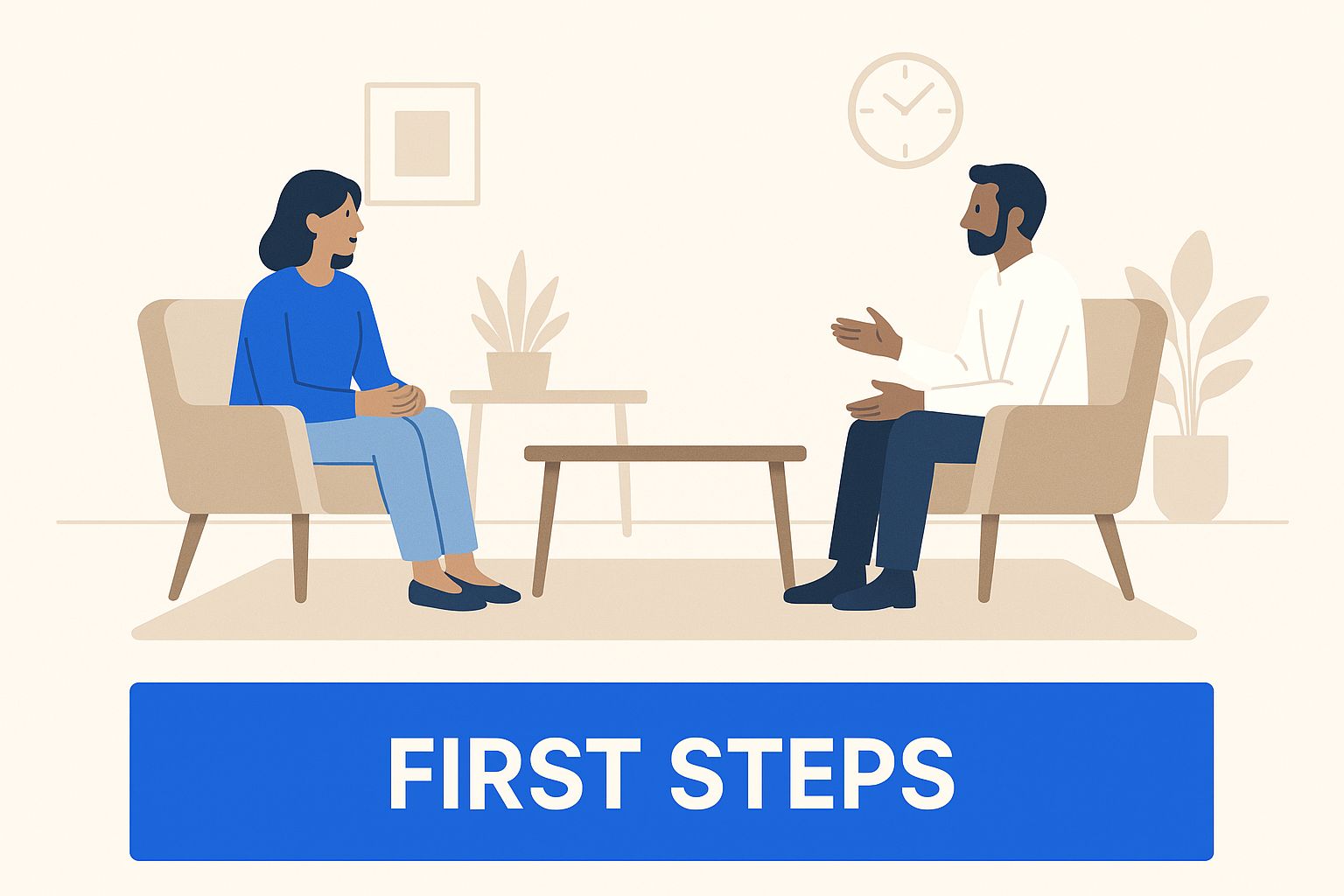
As the graphic shows, a calm and supportive approach opens the door for a real conversation. A confrontation just slams it shut. As a family member, you're a huge part of their support system, and you need support, too. Take some time for understanding recovery resources for families; they can give you the tools and community you'll need.
It's easy to get caught up in the chaos and react in ways that feel right at the moment but ultimately make things worse. Here's a quick look at what helps versus what hurts.
Initial Actions vs Counterproductive Reactions
| Helpful Initial Action | Common Counterproductive Reaction |
|---|---|
| Expressing your concern and love calmly. | Lecturing, shaming, or threatening. |
| Listening without interrupting or judging. | Making excuses or enabling their behavior. |
| Offering to help them find professional support. | Trying to "fix" the problem all by yourself. |
| Setting clear, healthy boundaries for yourself. | Ignoring the problem and hoping it goes away. |
Seeing it laid out like this makes it clear: your own reactions are the one thing you have complete control over. Focus on a supportive stance, not on ultimatums or attempts to manage their every move.
Don't forget about yourself in all this. Your well-being isn't just a side note—it's absolutely essential. You simply cannot pour from an empty cup.
Taking care of your own mental and emotional health isn't selfish when you're supporting someone through addiction. It's a non-negotiable requirement for being the consistent, healthy support they need.
By grounding yourself in these principles, you build a stable foundation from which you can truly help your loved one find their way to recovery. Your goal isn't to be the hero who "fixes" them. It's to be the steady, loving presence that helps them find the courage to fix themselves.
Getting to Grips with What Addiction Really Is
If you're going to help someone struggling with addiction, the first thing you have to do is toss out the old, outdated ideas about it. It’s so easy to fall into the trap of seeing it as a moral failing or a lack of willpower, but that’s just not what the science tells us. We now know that addiction is a chronic disease, one that physically changes how the brain’s reward system and decision-making centers work.
Think of it this way: when someone uses a substance over and over, their brain chemistry actually adapts. It gets to a point where it doesn't crave the substance for a high anymore, but just to feel normal. This creates an intense physical and psychological loop that is nearly impossible to break on your own. Seeing it from this perspective helps you separate the person you love from the disease they're fighting.
And they are not alone in this fight—not by a long shot. The problem has ballooned into a true public health crisis. In the United States, an estimated 48.5 million people aged 12 or older had a substance use disorder in the past year alone. That means millions of other families are walking this same road. You can find more of these eye-opening addiction statistics from TherapyRoute.com to understand just how widespread this is.
How Addiction Changes the Brain
At its core, addiction rewires the brain’s most basic survival instincts. Normally, things we need to live—like eating, or bonding with people we care about—trigger a release of a chemical called dopamine. It’s the brain’s way of saying, "Yes, that was good, do it again." Drugs and alcohol completely overwhelm this system, flooding it with so much dopamine that the brain learns to prioritize the substance above everything else.
This process also weakens the part of the brain that’s in charge of good judgment and self-control, the prefrontal cortex. So when people say, "Why can't they just stop?" the answer is that their ability to do so is genuinely damaged. It’s not about willpower; their own brain is working against them.
Addiction is a disease of compulsion, not character. The person you love is still in there, but their brain's wiring has been altered in a way that makes rational choice incredibly difficult. Recognizing this is key to offering non-judgmental support.
The Connection to Mental Health
It’s also critical to understand that addiction rarely happens on its own. More often than not, it’s tangled up with other mental health struggles like depression, anxiety, or past trauma. In the medical world, this is called a dual diagnosis or a co-occurring disorder.
- A Way to Cope: Many people start using substances to self-medicate the pain of an untreated mental health issue. That bottle of wine quiets the anxiety, or the pills numb the depression. The temporary relief makes it a hard habit to break.
- Making Things Worse: Over time, substance use almost always makes mental health symptoms worse. Alcohol, for instance, is a depressant and can pull someone deeper into a depressive episode. Stimulants can crank up anxiety to unbearable levels.
When you're trying to support someone, you have to look at the whole picture. Real, effective treatment has to tackle both the substance use and the underlying mental health condition at the same time. This integrated approach is the only way to give someone a real shot at lasting recovery.
Opening a Constructive Conversation About Addiction
The idea of bringing up their addiction can be terrifying. You worry about saying the wrong thing, starting a huge fight, or pushing them even further away. But a well-planned, compassionate conversation can be the very thing that opens the door to recovery.
The goal isn't to confront them with an angry intervention. Instead, think of it as an invitation to talk.
Here's how to set the stage for a conversation that helps, not hurts:
- Find the right time and place. Never bring this up when they're under the influence, when you're angry, or when you’re in a hurry. Choose a private, neutral space where you both feel safe and have plenty of time.
- Use "I" statements. This is a classic for a reason. Instead of saying, "You're always drinking," try, "I feel scared when I see you drinking so much, and I'm worried about your health." This keeps the focus on your feelings and avoids sounding accusatory.
- Be specific. Vague complaints are easy to argue with. Stick to concrete, recent examples. Say, "I was concerned when you missed a family dinner last week because you had been drinking."
- Have a clear "ask." Be ready with a next step. Don't just list problems; offer a solution. You can say, "I've found a few local therapists who specialize in this. Would you be willing to let me make a call with you?"
- Stay calm. They will likely get defensive, angry, or try to deny everything. Your job is to remain the calmest person in the room. If things get too heated, it's okay to pause and say, "I can see this is upsetting you. Let's take a break and talk about it again tomorrow."
This approach is all about removing blame and focusing on concern. It's rooted in the principles of Motivational Interviewing, a method that focuses on helping people discover their own internal motivation to change.
The goal is dialogue, not a monologue. A successful conversation is one where your loved one feels safe enough to be honest, even if they aren't ready to agree with you. Your job is to listen just as much as you speak.
By carefully planning your approach and using compassionate language, you give this conversation the best possible chance to be a turning point. It's often the first step, but it’s a massive one on the long road to helping someone you love.
Drawing a Line: How to Set Healthy Boundaries

When you love someone struggling with addiction, the line between helping and hurting can get incredibly blurry. You want to support them, but you end up enabling their behavior instead.
Setting clear, healthy boundaries isn't about punishing them. It's an act of self-preservation, and honestly, it’s one of the most powerful things you can do to create a space where recovery becomes possible.
Enabling is anything you do that protects your loved one from the real-world consequences of their choices. It feels like you're helping, but it just keeps the cycle going. Support, on the other hand, empowers them to take responsibility.
Think of it this way: giving them cash for "rent" when you know it's going to drugs is enabling. Offering to drive them to a treatment center is support. That distinction is everything.
Figuring Out Your Non-Negotiables
So, where do you start? You have to figure out your own limits first. What are the behaviors you simply cannot tolerate anymore? This isn’t about controlling them—it’s about controlling what you’re willing to be a part of.
You need to decide what’s off-limits for you.
Some common (and effective) boundaries look like this:
- No more money. This is often the toughest one, but it’s critical. You can say, "I love you, and because I love you, I can't give you any more money."
- Stop making excuses. No more calling their boss to say they’re “sick” or covering for them when they miss a family event. Let them manage their own fallout.
- Your home is a safe zone. It's completely reasonable to insist that no drugs or alcohol are allowed in your house. Period.
- Protect your own peace. You have every right to walk away from a conversation that turns manipulative or abusive. You can say, "I'm not going to talk about this when you're yelling at me. We can try again when you're calm."
Setting a boundary is really just saying, "I care about you too much to watch you self-destruct, and I won't participate in it anymore." It’s a loving way to shift the dynamic from managing their addiction to protecting your sanity and encouraging their recovery.
The key is to communicate these boundaries calmly and stick to them. Don't do it in the heat of an argument. Wait for a quiet moment, state your new rules clearly, and explain that you're doing this for both of you.
The Crucial Difference: Helping vs. Enabling
Getting this right is a game-changer. We enable from a place of love and fear, trying to soften the blow. But in doing so, we prevent the very thing that often motivates change: hitting rock bottom.
Think of it as the difference between throwing someone a life preserver and jumping in to drown alongside them.
Here’s a quick breakdown of what that looks like in the real world:
| Supportive Actions (Helping) | Counterproductive Actions (Enabling) |
|---|---|
| Listening without judgment. | Believing their excuses for using. |
| Offering to help them find a detox or a meeting. | Paying off their debts or legal fees. |
| Encouraging them to join you for a healthy activity. | Cleaning up their messes, literally and figuratively. |
| Consistently enforcing the boundaries you set. | Making threats you never follow through on. |
Letting your loved one face the natural consequences of their addiction feels harsh. I get it. But it's often the kindest and most effective push you can give them toward finally accepting the help they desperately need.
Finding the Right Treatment and Professional Support
So, your loved one has finally agreed to get help. That’s a huge, courageous step. But it often leads directly into a new and confusing maze: the world of addiction treatment.
You’ll quickly discover there’s a vast landscape of different philosophies, programs, and levels of care. It’s completely normal to feel overwhelmed. Just remember the goal here—it's not about finding a one-size-fits-all solution, but about finding the right fit for their specific situation.
This isn’t just about picking the first facility that shows up in a Google search. It’s about understanding the different pathways to recovery. The addiction treatment market is growing fast, which is good, but it also means you need to be a careful, informed consumer. The global market is projected to hit $16.22 billion by 2034, but major hurdles like cost and stigma still block access for many. You can read the full research on the addiction treatment market to get a better sense of the industry.
Your role is to help cut through the noise and find a program that’s both reputable and genuinely suitable for your person.
Understanding the Levels of Care
A 30-day inpatient stay isn't the only option, and it's not always the right first step. Treatment exists on a spectrum, and where someone should start depends on a few key things: the severity of their addiction, their physical health, and what their home environment is like.
Here’s a quick look at the most common options, from most to least intensive:
- Medical Detox: This is almost always the starting line, especially for alcohol or benzodiazepines where withdrawal can be medically dangerous. It provides a safe, supervised place to get through the physical challenges of withdrawal.
- Inpatient or Residential Treatment: This is what most people picture when they think of "rehab." Your loved one lives at a facility for a set period, usually 30-90 days, in a structured environment away from daily triggers. It provides 24/7 support.
- Outpatient Programs (PHP & IOP): These are great step-down options or for those with strong support at home. Partial Hospitalization (PHP) and Intensive Outpatient (IOP) offer structured therapy for several hours a day, a few days a week, while the person continues to live at home.
- Individual & Group Therapy: This is the bedrock of long-term recovery. Ongoing counseling helps get to the root causes of the addiction and teaches essential coping skills for life.
Recovery isn't a straight line, and the "best" treatment is one that's built around the individual. It has to account for their substance use history, any co-occurring mental health issues, and their unique life circumstances.
Asking the Right Questions
When you start vetting facilities or therapists, you’re acting as an advocate. Don't ever feel shy about asking the tough, direct questions. You're trying to find a quality program that you can trust.
Here are some of the most important things to ask:
- What is your core treatment philosophy? Do you use evidence-based addiction treatment methods?
- Are you fully licensed and accredited by the state and any national organizations?
- How do you create treatment plans? Are they truly individualized for each person?
- What is the staff-to-client ratio? Can you tell me about the credentials of your clinical staff?
- Do you also treat co-occurring disorders, like depression or anxiety, at the same time?
Pinpointing the right professional support is one of the most powerful things you can do. It gives your loved one the structure and tools they desperately need to start building a new life. Your job is to research, support, and encourage them to show up and do the work.
You Have to Take Care of Yourself, Too
Finally, and this cannot be overstated, you must look after your own well-being. Walking alongside someone in the throes of addiction is emotionally and mentally exhausting. You cannot pour from an empty cup.
Make time for your own mental health. That could mean finding your own therapist, attending support groups for families like Al-Anon, or simply carving out time for hobbies that recharge your spirit. Taking care of yourself gives you the strength to continue being there for them in a healthy way.
Frequently Asked Questions (FAQ)
What if they get angry and refuse help?
This is a very common and painful reality. You cannot force someone to accept help. The most effective response is to calmly re-state your boundaries. For example: "I understand you're not ready, but as I said, I can no longer give you money or make excuses for you. I love you, and I will be here to help you find treatment the moment you are ready." This shifts the focus back to their choice while protecting yourself.
How can I tell the difference between a relapse and a slip?
A "slip" is a brief, one-time return to substance use, which the person regrets and quickly corrects by getting back into their recovery program. A "relapse" is a more significant return to old patterns of use and behavior. While any return to use is serious, a slip can be a learning opportunity. The key is how they respond: do they immediately seek help and recommit to recovery, or do they hide it and continue using?
Should I get rid of all the alcohol in my house?
If your loved one is in early recovery and either lives with you or spends significant time at your home, creating a sober environment is a powerful act of support. Removing temptations, especially in the beginning, eliminates unnecessary triggers and shows you are serious about supporting their new lifestyle.
What should I do if I suspect they are using again?
Avoid accusations. Instead, approach them with concern, using "I" statements based on specific behaviors you've observed. Say something like, "I've noticed you've been withdrawing again, and I'm worried because this reminds me of how things were before. How are you doing?" Encourage honesty and a return to their support system (therapist, sponsor, or meetings) without shaming them.
At StartDrugRehab.com, we know this journey is hard, and we're here to provide the guidance you need every step of the way. Explore our comprehensive guides and find trusted treatment options today.