Motivational Interviewing, or MI, isn't about lecturing someone or telling them what to do. At its core, it's a way of having a conversation that helps people tap into their own reasons for wanting to make a change. When we talk about motivational interviewing for substance abuse, we're looking at a powerful tool that helps individuals work through the classic "I want to, but I don't want to" tug-of-war they feel about getting sober.
Key Takeaways
- MI is a Partnership, Not a Lecture: Motivational Interviewing is a collaborative, person-centered counseling style for addressing the common problem of ambivalence about change. It avoids confrontation and instead guides individuals to find their own motivation.
- The "Spirit" of MI is Crucial: The approach is built on a foundation of Partnership, Acceptance, Compassion, and Evocation. This "spirit" creates a safe environment where individuals feel respected and understood, making genuine change possible.
- OARS are the Core Skills: The practical application of MI relies on four key communication skills: Open-ended questions, Affirmations, Reflective listening, and Summaries. Mastering these helps evoke "change talk" from the client.
- MI Works Best for Ambivalence: This technique is particularly effective for individuals who are uncertain or resistant to change. It gently explores their mixed feelings without judgment, helping them resolve their own internal conflict and move toward recovery.
What Is Motivational Interviewing for Substance Abuse
Think of a therapist practicing MI not as a director calling the shots, but as a skilled guide on a challenging hike. They're right there with you, pointing out different paths and helping you read the map, but you're the one who decides which way to go. Instead of saying, "You have to stop using," the conversation shifts to exploring, "What are some of the reasons you might want to?" It’s a fundamentally respectful approach, built on the belief that real change has to come from the inside out.
This is a game-changer in addiction counseling because the biggest hurdle is almost always that feeling of being stuck in the middle—what we call ambivalence. Someone might recognize the damage their substance use is causing, but at the same time, it provides a sense of comfort or escape. MI doesn't try to argue that feeling away; it leans into it without judgment. The goal is to help the person find their own voice and their own motivation to take a new direction.
The Guiding Spirit of MI
Every MI conversation is shaped by a philosophy known as the "spirit of MI." This isn't just a set of techniques; it's the heart and soul of the approach. It’s made up of four key ideas that create a safe, productive space for the client.
- Partnership: The therapist and client are a team. They're equals working on a problem together, ditching the old "expert and patient" dynamic.
- Acceptance: This is about unconditional positive regard. The therapist accepts the client exactly as they are, respecting their right to make their own choices.
- Compassion: The therapist is actively promoting the client's well-being. It's about having their best interests at heart, always.
- Evocation: The magic of MI is in drawing out the answers from the client, not imposing them. The belief is that the motivation and wisdom are already there, they just need to be uncovered.
"MI is a particular way of talking with people about change and growth to strengthen their own motivation and commitment."
This "spirit" is what turns a potentially confrontational topic into a supportive partnership. It's a fundamental shift away from trying to force someone to see the problem and toward walking beside them as they explore their own complicated feelings about it. This person-centered approach is vital for moving through the different phases of healing, which you can explore by understanding the stages of the recovery process. When the drive to change comes from within, it's infinitely more likely to last.
The 4 Principles That Guide MI Conversations
To really get a feel for how MI works in practice, we have to move beyond its general "spirit" and look at the four core principles that bring it to life. Think of these less as rigid rules and more as the guiding philosophies that shape every single interaction. They all work together, creating a space where someone feels safe enough to explore their own mixed feelings about substance use without being afraid of judgment.
You can picture these principles as the four legs of a sturdy chair. Each one is absolutely essential for providing the stable support a person needs to have a meaningful conversation about change. This framework is what makes motivational interviewing for substance abuse so powerful—it helps transform a clinical session into a real, human-to-human connection.
1. Express Empathy Through Listening
The first principle, Express Empathy, is the bedrock on which everything else is built. This is so much more than just saying, "I understand how you feel." True empathy is about showing that you understand through deep, reflective listening. The goal isn't just to hear the words, but to try and see the world through your client's eyes and let them know you’re genuinely trying to get it.
When someone struggling with substance use feels truly heard and accepted for who they are, their defenses naturally come down. They don’t have to waste energy arguing their case or justifying their behavior, because they don't feel like they're under attack.
- Client: "Everyone just tells me I need to quit, but it’s not that simple. It’s the only way I know how to unwind after a crazy week."
- Therapist: "So on one hand, you're getting all this pressure from people around you. But on the other, this is your go-to method for coping with stress. It sounds like you're really caught in the middle of a tough spot."
That simple reflection does something powerful: it shows the client their internal conflict is understood and validated. That builds the trust you need to go deeper.
2. Develop Discrepancy Gently
Once that foundation of empathy is there, the next step is to Develop Discrepancy. This is the subtle art of helping a person see the gap between their current actions and their deeply held values or their vision for the future. The key here is that the therapist doesn't create this gap or point it out like a flaw. They simply help the client see it for themselves.
The real magic of this principle is how non-confrontational it is. Instead of telling someone what's wrong, you ask questions that invite them to think about how their substance use fits—or doesn't fit—with the person they truly want to be. This internal tension is often the real engine for change.
The heart of motivational interviewing is helping people resolve their own ambivalence. The discrepancy between where they are and where they want to be is what fuels the entire process of change.
For instance, a therapist might ask, "You've talked about how important being a present and engaged father is to you. I'm curious how your drinking fits in with that vision?" This kind of question doesn't preach; it just holds up a mirror, allowing the client to be the one to examine their own inconsistencies.
3. Roll with Resistance Instead of Fighting It
Let's be real—resistance is a totally normal part of any conversation about making a big life change. A more traditional, confrontational approach might meet that resistance head-on, which usually just leads to an argument where nobody wins. MI takes a completely different route with the principle of Roll with Resistance. When a client pushes back, you don't push harder. You learn to "dance" with it.
This means you acknowledge the person's perspective without judgment and then use their statement as a chance to explore their feelings even more. In MI, resistance isn't seen as a roadblock; it's valuable feedback about what the person is thinking and feeling.
- Client: "Look, I don't think my drinking is that bad. I can handle it just fine."
- Therapist (instead of arguing): "It sounds like you feel pretty in control of it right now, and you're just not convinced it's a major problem. Maybe we could talk a bit about the parts of it that are working for you."
By refusing to get into a power struggle, the therapist keeps the tension low and preserves the collaborative partnership that's so crucial to the process.
4. Support Self-Efficacy to Build Confidence
The final piece of the puzzle is to Support Self-Efficacy. In simple terms, this is about building up a person's belief in their own ability to succeed. So many people dealing with substance use disorders feel hopeless, like they've failed too many times to even bother trying again. This principle is all about instilling hope and shining a light on their personal strengths.
A therapist actively looks for and points out a client's past successes, no matter how small they seem. They express genuine confidence in the client's ability to make changes, which helps shift the internal narrative from "I can't do this" to "Maybe I can." This sense of empowerment is the final ingredient that helps a person believe that change isn't just something they should do, but something they can do.
The Four Processes That Structure an MI Session
A powerful motivational interviewing conversation isn't just a friendly chat; it's a carefully structured journey that guides a client toward their own reasons for change. Think of it as a four-part roadmap. While the stages often blend and overlap, understanding this framework—Engaging, Focusing, Evoking, and Planning—is what turns a simple talk into a life-altering intervention.
This sequence is the engine that drives motivational interviewing for substance abuse. It ensures you start by building a real connection, then collaboratively zero in on a goal. From there, you help the client uncover their own motivation before, and only then, building a practical plan together.
This infographic breaks down how that journey unfolds, moving from initial rapport to a concrete, collaborative plan.
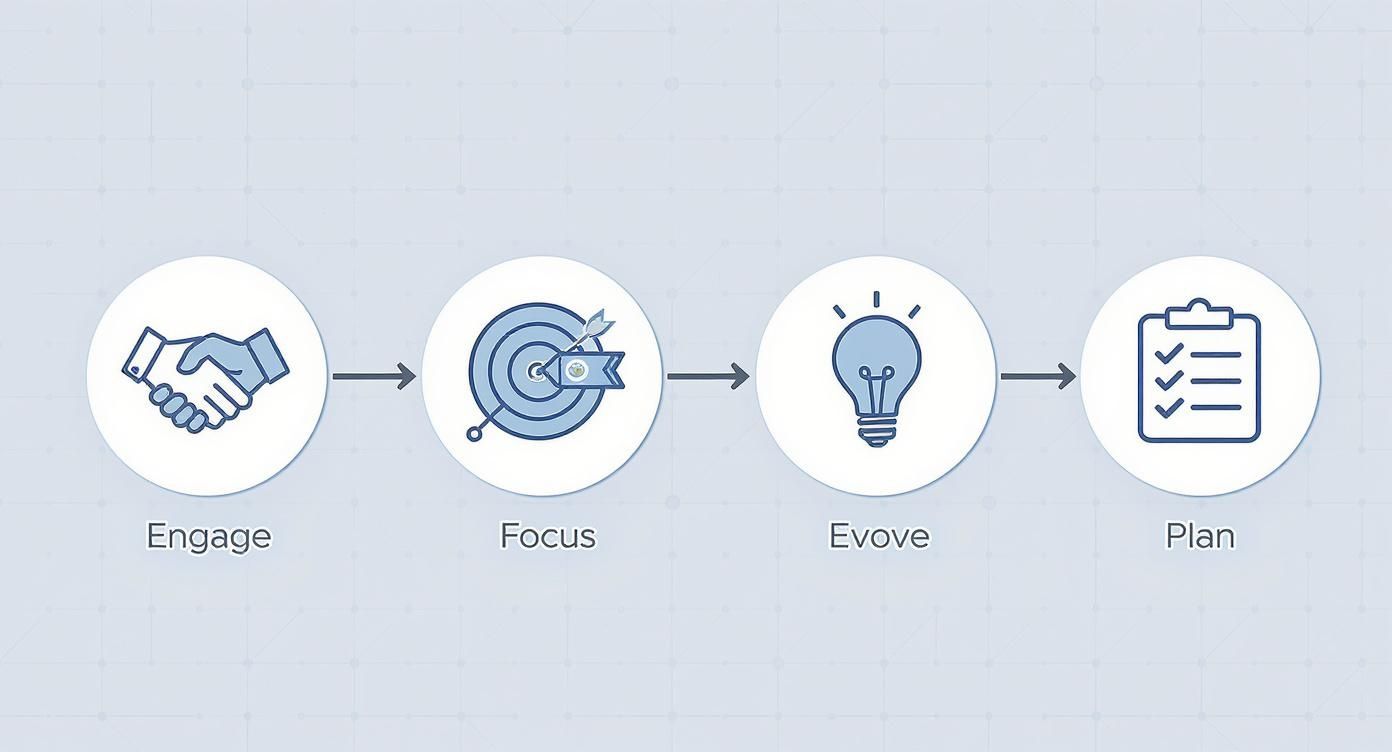
As you can see, each step naturally flows into the next, creating a solid foundation for real, sustainable change.
Engaging: The Foundation of Trust
First comes Engaging. This is all about building a genuine, trusting relationship. Before you can even begin to touch on the difficult subject of substance use, the client needs to feel safe, respected, and truly heard. This is where you put the empathetic spirit of MI into practice.
You aren't jumping into problems or solutions here. Instead, you're asking open-ended questions about their life, what makes them tick, and what brought them to you. Every reflection you offer shows you're listening, not just waiting to talk. Without this bedrock of trust, the rest of the conversation will go nowhere.
Focusing: Finding a Shared Direction
Once that connection is there, you can move into Focusing. The goal is to work together to find a clear, specific direction for the conversation. You and the client become partners in narrowing down the vast topic of "substance use" to a manageable behavior they're actually willing to explore.
This isn't about you setting the agenda; it's a negotiation. The focus might land on cutting back on drinking, looking at how drug use affects their family, or simply exploring their ambivalence.
The core task of the focusing process is to arrive at a mutual understanding of what the conversation will be about. This collaborative agreement is what keeps the session on track and prevents it from feeling aimless.
This step is critical. It ensures everyone is rowing in the same direction and gives the session a clear purpose. Practitioners often use various substance abuse assessment tools to help pinpoint these key areas of concern and establish a meaningful focus.
Evoking: Drawing Out the "Why"
The third process, Evoking, is the absolute heart of motivational interviewing. This is where you actively listen for and help the client voice their own arguments for change. Your job is to become a detective for "change talk"—any word or phrase the client says that hints at a desire, ability, or reason to do things differently.
You use thoughtful questions and reflections to help them dig deep. For instance, you might ask, "If you did decide to make this change, what would be some of the best parts about it?" This process guides them to build their own case for getting better, which is infinitely more persuasive than any lecture they could ever hear from someone else.
Planning: Collaborating on the "How"
Finally, after a client has expressed a genuine desire for change, the conversation can shift into the Planning process. This is where you work together on a concrete, actionable game plan. It's vital not to rush this step; you only move here when the motivation is already in place.
The best plans spring from the client's own ideas, with you acting as a supportive co-pilot. This might look like setting small, achievable goals, identifying potential roadblocks, or brainstorming healthy coping skills. Research consistently shows this approach works. A 2005 clinical trial, for example, found that clients who had MI-enhanced intake sessions showed significantly better treatment retention over 28 days. Explore the findings of this substance use study and you'll see how this structured yet collaborative approach makes a tangible difference, empowering clients to take ownership of their recovery journey.
Mastering The Core Skills of OARS
If the principles and processes of motivational interviewing are the engine, then the OARS skills are the actual tools you use to get it running smoothly. OARS is an acronym you’ll hear a lot, and for good reason—it stands for Open-ended questions, Affirmations, Reflective listening, and Summaries. Getting a good handle on these four skills is what turns the theory of motivational interviewing for substance abuse into a real, practical conversation that can spark change.
The great thing is, these aren't complex clinical techniques reserved for seasoned therapists. They're fundamental communication skills that anyone can learn. Think of them as the building blocks for creating a safe, non-judgmental space where someone feels truly heard and empowered to find their own way forward.
O for Open-Ended Questions
First up is the Open-ended question. This is your key to unlocking a real conversation. Unlike a closed question that gets you a simple "yes," "no," or a single fact, an open-ended question invites the person to tell their story and reflect more deeply.
For instance, asking, "Do you think your drinking is a problem?" can feel like an accusation and often shuts things down. But if you shift to, "What are some of the things that worry you about your drinking?" you open a door. It's a simple change, but it encourages the client to explore their own thoughts without feeling cornered.
These questions essentially hand the conversational reins over to the client, showing them that their experience is what truly matters here.
A for Affirmations
Next, we have Affirmations. These are genuine, positive statements that acknowledge a person’s strengths, efforts, and good intentions. When someone is struggling with substance use, they often carry an immense burden of shame and feel defined by past mistakes. Affirmations work directly against that negative self-talk.
An effective affirmation isn't just generic praise like, "You're doing great." It’s about noticing the small, real steps someone is taking.
"It took a lot of courage to come here today and talk about this. That shows how much you care about figuring things out."
A statement like this helps build a person's belief in their own ability to change. It shines a light on their inner resources, which is absolutely vital for building the confidence needed for recovery.
R for Reflective Listening
Reflective listening might just be the most important skill in the entire OARS toolkit. This isn't about just sitting back and hearing the words; it's an active process where you try to understand the underlying meaning and then gently offer that understanding back to the person.
When you offer a reflection, you're essentially making a thoughtful guess about what the person is really trying to say. This does two things: it shows you're working hard to get on their wavelength, and it gives them a chance to either confirm it or clarify what they meant.
- Client: "I know I should stop using, but my friends all do, and I don't want to be left out."
- Reflection: "So you feel torn between wanting to make a change for yourself and the fear of losing your social circle if you do."
This simple act validates their internal struggle and makes them feel deeply understood, which is the bedrock of a strong therapeutic relationship.
S for Summaries
Finally, we have Summaries. You can think of a summary as a collection of reflections strung together. Summaries are incredibly useful for pulling together key themes, highlighting the person’s own "change talk," and showing them that you’ve been paying close attention.
A well-timed summary can be a real turning point in a session. By gathering all the reasons for change a person has mentioned and presenting them back in a clear, organized way, you help them hear their own motivation out loud. It can create a powerful moment of clarity that strengthens their resolve.
To see how different this approach is, it helps to compare it directly with the more traditional, directive style that often proves counterproductive.
Directive Communication vs. MI OARS Techniques
This table shows the contrast between a typical expert-driven approach and the collaborative OARS techniques.
| Communication Goal | Traditional Directive Approach | Motivational Interviewing (OARS) Approach |
|---|---|---|
| To gather information | "How many drinks do you have a day?" | "Tell me a bit about a typical day for you and where drinking fits in." (Open Question) |
| To build confidence | "You just need to try harder." | "Even though it was tough, you managed to stick to your plan for three days. That shows real commitment." (Affirmation) |
| To show understanding | "I understand." (Nodding) | "It sounds like you're feeling really frustrated with this whole situation." (Reflection) |
| To transition topics | "Now, let's talk about solutions." | "So far, you’ve mentioned feeling worried about your health and your job, and you also said you miss how things used to be. Where should we go from here?" (Summary) |
By consciously weaving OARS into the conversation, you shift the entire dynamic. It moves from a one-sided interview to a true partnership, creating the ideal conditions for a person to find their own reasons and their own path to recovery.
Frequently Asked Questions
When you're exploring a new approach like motivational interviewing, a lot of questions pop up. It’s natural to wonder how it fits in with other therapies, who it works for, and what it looks like in practice. Let’s tackle some of the most common questions to give you a clearer picture of how MI works in the real world of substance abuse treatment.
How is MI different from CBT?
It's a great question, as both Motivational Interviewing (MI) and Cognitive-Behavioral Therapy (CBT) are cornerstones of modern addiction treatment. The simplest way to think about it is that MI deals with the "why" of change, while CBT focuses on the "how" of change.
MI is all about getting to the heart of a person's mixed feelings—their ambivalence—and helping them find their own internal drive to make a change. It's the conversation that gets the engine started.
CBT, on the other hand, provides the roadmap and the driving lessons. It's a structured, skills-based therapy that teaches people how to recognize and alter the negative thought patterns and behaviors that fuel their substance use. The two approaches are a powerful combination; MI builds the motivation, and CBT provides the tools to act on it.
Is MI effective for clients who don't seem to want to change?
This is exactly what motivational interviewing was built for. In fact, this is where it truly excels. The entire approach was developed to work with people who feel stuck, uncertain, or even outright resistant to the idea of changing.
Instead of seeing someone as "in denial," MI assumes that ambivalence is a perfectly normal part of the process. A skilled practitioner doesn't push or confront; they listen and explore the person's own reasons for and against changing.
By doing this without judgment, MI allows clients to uncover their own motivations. It’s a gentle process that often helps tip the scales from uncertainty toward taking that first step.
How long does an MI intervention take?
One of the best things about MI is its incredible flexibility. It’s not a one-size-fits-all therapy with a rigid timeline. Think of it less as a formal program and more as a style of communication.
An MI-informed conversation can be as short as a 15-minute chat during a medical check-in or it can be the foundation for a series of hour-long therapy sessions. This adaptability makes it incredibly useful for everyone from ER doctors and social workers to dedicated addiction counselors.
Can MI be used in group therapy?
Absolutely. While the dynamic is different from a one-on-one session, the core principles of MI translate beautifully to a group setting. In group MI, the facilitator's job shifts slightly. Instead of being the primary person evoking "change talk," they create a safe, supportive atmosphere where group members start to evoke it from each other. When people share their own struggles and successes, it becomes a powerful catalyst for everyone in the room. The group itself becomes a source of motivation, helping members see their own potential through the eyes of their peers.
At StartDrugRehab.com, our mission is to empower you with clear, reliable information about evidence-based approaches like motivational interviewing. We want you to feel confident in the decisions you make on the road to recovery. Explore our resources to understand your options and connect with the support you deserve. Find the help you need at https://startdrugrehab.com.