Dialectical Behavior Therapy (DBT) is a specific kind of therapy built for people who feel emotions with overwhelming intensity. It's less about abstract theory and more about providing a practical toolkit to help you navigate emotional storms. The core idea is to balance two concepts that seem to clash: accepting yourself exactly as you are in this moment, while also committing to building healthier ways of coping for the future.
Key Takeaways
- Balance is Central: DBT is built on the "dialectic" of balancing acceptance (validating your current feelings) and change (learning new, healthier behaviors).
- Skills-Based Approach: Therapy focuses on teaching four practical skill sets: Mindfulness, Distress Tolerance, Emotion Regulation, and Interpersonal Effectiveness.
- Structured and Comprehensive: A full DBT program includes individual therapy, group skills training, and in-the-moment phone coaching to provide robust support.
- Broad Applications: Originally for Borderline Personality Disorder (BPD), DBT is now a proven treatment for substance use disorders, eating disorders, PTSD, and other issues rooted in emotional dysregulation.
Unpacking Dialectical Behavior Therapy
Think of it like this: you're standing on the bank of a powerful, fast-moving river. One side of the river represents radical acceptance—the ability to look at the river's current and acknowledge its strength without judging it or fighting it. The other side represents the need for change—your deep desire to get across to the other bank.
DBT doesn't force you to pick a side. Instead, it teaches you how to build a sturdy bridge, piece by piece.
This "bridge" is made up of concrete, learnable skills that help you honor where you are right now while still moving toward where you want to be. This central idea, the "dialectic," is the synthesis of acceptance and change. It's a philosophy that validates your current struggles while also empowering you to make real, lasting changes. The fundamental belief is simple: you're doing the best you can, and you can learn to do better.
The Foundational Pillars of DBT
To really get what DBT is all about, we need to look at its four core components, or skill modules. These pillars form the heart of DBT training and provide a clear roadmap for creating a life that feels meaningful and worth living.
Each module focuses on a different set of practical skills that, when combined, create a powerful system for managing difficult emotions and situations.
| Skill Module | Core Goal |
|---|---|
| Mindfulness | To increase awareness of the present moment, allowing you to observe thoughts and feelings without being swept away by them. |
| Distress Tolerance | To get through crisis situations without making things worse, using skills to survive and accept reality as it is. |
| Emotion Regulation | To understand your emotions, reduce your vulnerability to painful ones, and change emotions you want to change. |
| Interpersonal Effectiveness | To build and maintain healthy relationships, communicate your needs effectively, and maintain your self-respect. |
These modules aren't just abstract concepts; they are collections of actionable techniques taught in a very structured, hands-on way.
Because of its practical nature, DBT has become a cornerstone of many successful recovery programs. Its focus on managing intense urges and emotional triggers makes it an essential part of effective evidence-based addiction treatment.
DBT was first developed back in the 1980s by Dr. Marsha Linehan, initially to help chronically suicidal individuals who had been diagnosed with Borderline Personality Disorder (BPD). Over the years, however, its incredible effectiveness has been demonstrated for a whole host of other challenges, including substance use disorders, eating disorders, and PTSD.
Ultimately, DBT goes far beyond just "thinking differently." It’s a comprehensive, skills-based therapy designed to give you the tools you need to handle life’s challenges, strengthen your relationships, and feel more in control of your own emotional world. It offers a clear path forward, helping you build resilience one skill at a time.
The Origins of DBT: A Story of Innovation
Every powerful therapy has a story, and the one behind Dialectical Behavior Therapy (DBT) is born from deep compassion and a relentless search for what works. It wasn't dreamed up in a quiet lab; it was forged in the trenches, driven by a need to help people who felt completely failed by the mental health system.
Our story starts with Dr. Marsha Linehan, a psychologist working in the 1980s.
Dr. Linehan was treating a group of clients—mostly women—who were trapped in a cycle of emotional pain so severe it led to chronic suicidal thoughts and self-harm. These were the very individuals who would later be diagnosed with Borderline Personality Disorder (BPD). But she quickly saw a disturbing pattern: the standard therapies of the day weren't just failing; they were often making things worse.
When the "Cure" Was Part of the Problem
The go-to treatment back then was Cognitive Behavioral Therapy (CBT). While CBT is a fantastic tool for many issues, its laser focus on changing negative thoughts felt deeply invalidating to her clients. Imagine being told that your agonizing pain is just "irrational thinking" that you need to fix.
This approach made them feel unheard and judged, causing many to get frustrated, shut down, or quit therapy entirely. It became painfully obvious that an approach built only on change was backfiring. Dr. Linehan knew she had to find a different way. Before she could ever ask her clients to change, she first had to radically accept them—and their suffering—right where they were.
DBT was born from a therapist's struggle to treat clients that no one knew how to help effectively. It was a direct response to the failure of existing models to validate and support individuals in extreme emotional distress.
This insight was the game-changer. Dr. Linehan started weaving together principles from Zen mindfulness and other acceptance-based practices with the concrete, evidence-based strategies of behavioral science. She was looking for a therapy that could hold two seemingly opposite ideas in perfect balance: acceptance and change.
The Birth of the "Dialectic"
This blend of opposites is the "dialectic" at the heart of DBT. A dialectic is all about finding the greater truth by integrating two opposing forces. In DBT, the core tension is between accepting reality as it is while simultaneously working like hell to make it better. This balance turned out to be the key.
Dr. Linehan officially developed Dialectical Behavior Therapy in the late 1980s as a specialized form of CBT specifically for individuals with BPD. By validating her clients' intense emotions while teaching them practical skills to build a better life, she created a therapy that finally felt both compassionate and effective. You can find more details about its development on the Redemption Addiction Treatment Center website.
This history matters because it shows that DBT is far more than just a set of techniques. It's a philosophy grounded in profound empathy, built on the promise of helping people create a life they genuinely believe is worth living.
Mastering Your DBT Skills: The Four Modules
Dialectical Behavior Therapy isn't about abstract theories; it’s about teaching concrete, life-altering skills. These skills are neatly organized into four modules, each one acting as a pillar to support your emotional well-being. Think of them less like lessons and more like practical tools for your mental toolkit—tools you can pull out and use every day to build a more stable and fulfilling life.
This is where the idea of balancing acceptance and change gets real. Each module tackles a different piece of the emotional and social puzzle. When you learn to use them together, they create a powerful framework for navigating just about anything life throws your way. Let's break down each one with some analogies to see how they work in the real world.
The following infographic gives a great visual of how Dr. Marsha Linehan brought together different fields—like Cognitive Behavioral Therapy (CBT) and Mindfulness—to create DBT for Borderline Personality Disorder (BPD).
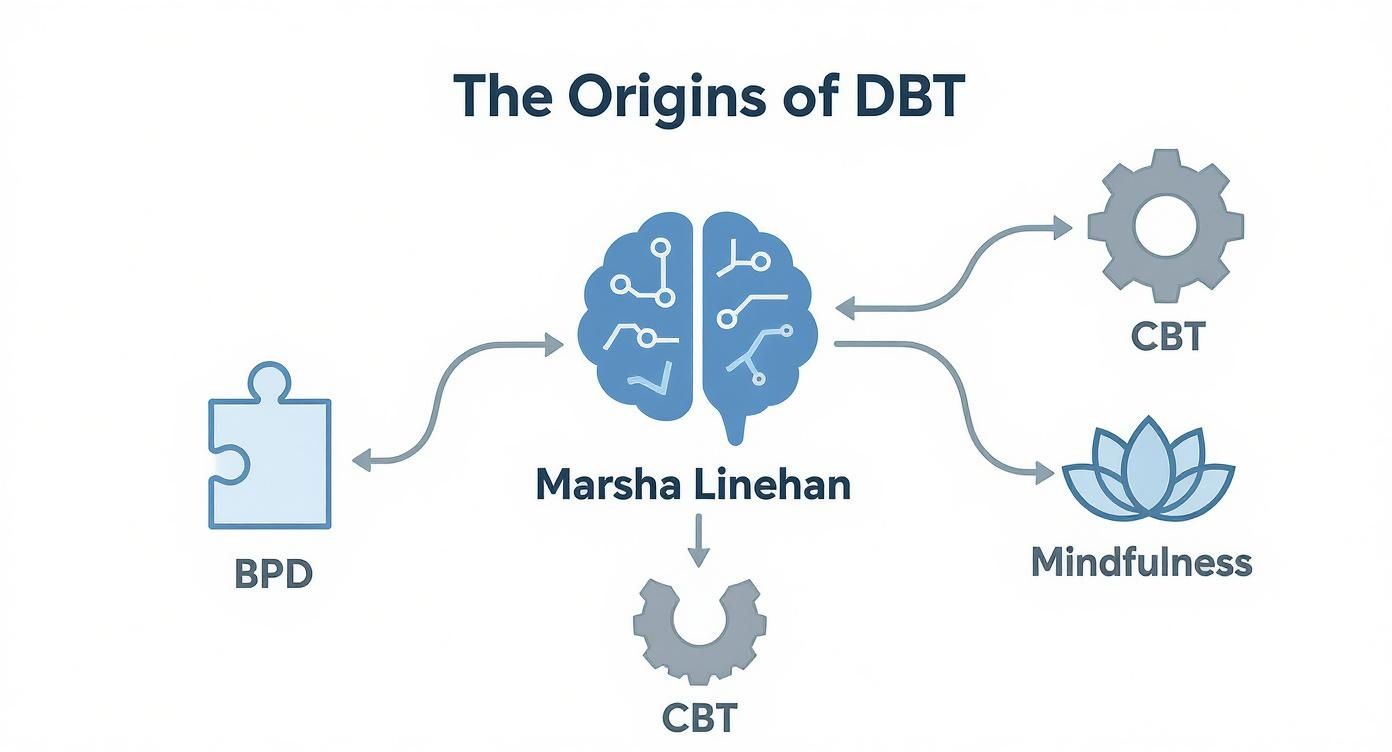
As you can see, DBT isn't just a single idea. It's a powerful combination of behavioral science and acceptance-based practices, designed from the ground up to address the complex needs of people struggling with intense emotions.
Mindfulness: Becoming the Emotional Weather Reporter
The first and most foundational module is Mindfulness. In DBT, mindfulness has nothing to do with emptying your mind or floating in a state of constant calm. It's about learning to be an impartial observer of your own inner world—kind of like an emotional weather reporter.
A weather reporter doesn't get mad at the rain or try to argue with a thunderstorm. They just observe, describe, and report: "It is currently raining." This module teaches you to do the same thing with your feelings and thoughts, noticing them without judgment and without getting swept away.
This skill is absolutely crucial. You can't change an emotion or a behavior until you can first see it clearly. Mindfulness is the simple practice of paying attention, on purpose, to what’s happening right now, which helps you get out of autopilot and back in the driver's seat.
Distress Tolerance: Your Emotional First-Aid Kit
Next up is Distress Tolerance, which is best described as your emotional first-aid kit. Life is full of painful situations and crises you can't just fix on the spot. This module isn't about making the pain vanish; it's about learning how to get through these moments without making them a whole lot worse.
These are the skills you reach for when your emotions are at a boiling point and you have that overwhelming urge to do something impulsive. Distress tolerance gives you practical, in-the-moment strategies to ride out the crisis until you're in a calmer state of mind.
Key skills include:
- Radical Acceptance: This means acknowledging reality for what it is, without fighting it or letting bitterness take over.
- Self-Soothing: Using your five senses to calm and comfort yourself during a tough time, like listening to calming music or smelling a favorite scent.
- Distraction: Intentionally shifting your attention away from the emotional pain to give yourself a much-needed break.
These aren't meant to be long-term solutions, but they are incredibly effective for stopping destructive behaviors in their tracks during a crisis. Mastering these techniques is a critical step in developing healthy coping skills for long-term recovery.
"Distress tolerance is based on the idea that if you can’t change a situation, you have two choices: you can accept it, or you can make things worse. These skills are designed to help you choose acceptance."
This practical focus is one reason DBT has spread across the globe. By 2025, DBT is practiced in over 40 countries and is recommended by major health organizations. Both the UK's National Institute for Health and Care Excellence (NICE) and the American Psychological Association (APA) endorse it as a first-line treatment for BPD, and its core principles are proving vital for positive outcomes across different cultures.
Emotion Regulation: Learning to Pilot Your Emotions
The third module, Emotion Regulation, teaches you how to become the pilot of your emotional life instead of just a passenger getting tossed around by turbulence. While distress tolerance is for surviving a crisis, emotion regulation is for managing your day-to-day emotional well-being.
This module helps you figure out what your emotions are, what purpose they serve, and how to dial them up or down. It’s not about stuffing your feelings down. It’s about making yourself less vulnerable to painful emotions and creating more opportunities for positive ones.
This involves skills like:
- Identifying and Labeling Emotions: Pinpointing exactly what it is you're feeling.
- Checking the Facts: Asking yourself if your emotional reaction actually fits the facts of the situation.
- Opposite Action: When an emotion is unhelpful, acting opposite to its urge (like approaching something you fear instead of running away).
- Building Positive Experiences: Proactively scheduling activities that bring you joy and a sense of accomplishment.
With these skills, you learn that while you can't always control the emotions that show up, you absolutely have influence over how intense they get and how long they stick around.
Interpersonal Effectiveness: Your Relationship Playbook
Finally, Interpersonal Effectiveness is your playbook for building and maintaining healthy relationships. Many people with intense emotions find their interactions with others are a struggle, often bouncing between being passive and getting aggressive. This module teaches you the middle path.
It gives you clear, step-by-step scripts for communicating what you need, setting boundaries, and handling conflict—all while keeping your self-respect and making your relationships stronger.
The goals here are straightforward. The skills help you:
- Ask for what you want effectively (Objective Effectiveness).
- Maintain or improve the relationship (Relationship Effectiveness).
- Keep your self-respect (Self-Respect Effectiveness).
These skills empower you to express yourself clearly and confidently. This cuts down on the misunderstandings and conflicts that so often come from emotional dysregulation. Ultimately, this module is about finding that sweet spot between getting your needs met and holding on to the important connections in your life. Together, these four modules offer a complete roadmap to emotional stability and a more rewarding life.
What a Standard DBT Program Involves

Starting any new kind of therapy can feel a bit like stepping into the unknown. What’s great about Dialectical Behavior Therapy is that it’s incredibly structured, so you know exactly what you’re signing up for. A standard DBT program is built on four core parts that all work together.
Understanding how these pieces fit together helps pull back the curtain on the whole process. Each one has a specific job to do, making sure you have the support you need—not just in the therapist's office, but out in the real world where it counts.
Individual Therapy Sessions
First up is your weekly one-on-one therapy. This is really the heart of the program, where you and your DBT therapist build a strong, working relationship. These sessions are much more than just a chance to talk; they're strategic meetings designed to keep you motivated and help you figure out how to apply DBT skills to your personal life challenges.
You and your therapist will track your progress, troubleshoot problems that pop up, and focus on specific behaviors that are holding you back from your goals. The main idea is to make sure the skills you're learning in group actually stick and make a difference day-to-day.
A key tool you'll use here is the diary card. It's basically a daily log where you'll track your emotions, urges, and the skills you practice. This little bit of self-monitoring gives you and your therapist a ton of useful information to guide your sessions and see where you're making real headway.
This dedicated time ensures the therapy is shaped around you and your needs. It's the safe space where you can tackle your biggest hurdles with an expert guide right there to help you navigate them with your new DBT toolkit.
Group Skills Training
The second crucial part of the puzzle is the weekly group skills training. It’s best to think of this as more of a class or a practical workshop than the kind of group therapy you might see in movies. In this setting, you’ll systematically learn the four main DBT skill sets: Mindfulness, Distress Tolerance, Emotion Regulation, and Interpersonal Effectiveness.
These group meetings usually run for about 2 to 2.5 hours and are led by a trained therapist. The whole session is very structured. You'll typically start with a mindfulness exercise, review homework from the past week, and then dive into learning new skills.
The group format is powerful for a couple of reasons:
- A Place to Practice: It gives you a dedicated space to learn and rehearse new skills before you're in the middle of a high-stress situation.
- Shared Experience: Being around others who get what you're going through is incredibly validating. It combats feelings of isolation and helps build a real sense of community.
This is where you stock your toolbox with all the practical "how-to" strategies of DBT.
In-the-Moment Phone Coaching
Life happens between appointments. That's why DBT includes a third, unique component: phone coaching. This feature gives you the ability to get brief, real-time coaching from your therapist when you need it most.
The idea isn't to have a full therapy session over the phone. It's more about getting a quick bit of guidance on how to use your skills when you're facing a crisis or a tough spot. When you feel that urge to fall back into old, unhelpful habits, a quick call can be just what you need to steer yourself back on course.
The Therapist Consultation Team
Finally, there’s a critical piece that you'll never see but that makes a huge difference: the therapist consultation team. Every therapist providing comprehensive DBT has to be part of a weekly meeting with other DBT clinicians. This isn't about supervising your case; it's about supporting the therapists.
This team approach helps keep therapists on their game, prevents burnout, and ensures they're delivering DBT the way it was designed to be. It's a built-in quality control system that holds them accountable. You can think of it as "therapy for the therapist," and it’s a cornerstone that keeps the entire program effective and strong.
Who Benefits Most From DBT
While Dialectical Behavior Therapy was originally developed for people with Borderline Personality Disorder (BPD), its powerful, skills-based approach has turned out to be incredibly helpful for a much wider range of issues.
At its heart, DBT is built for anyone who feels like their emotions are constantly overwhelming them, pushing them toward impulsive or self-destructive behaviors. If emotional intensity is the core problem, DBT provides a practical, hands-on solution.
Over the years, therapists and researchers have successfully adapted DBT to help with all sorts of conditions where emotional dysregulation is a key feature. We're talking about things like eating disorders, substance use disorders, PTSD, and even depression that hasn't responded well to other treatments. The common thread is always that struggle to manage intense feelings.
This is exactly what makes DBT such a valuable and versatile therapy. It doesn't just put a label on a diagnosis; it gets to the root of the struggle with emotions, making its skills useful for almost anyone trying to build a more stable and meaningful life.
Applications for Substance Use Disorders
When someone is battling a substance use disorder, cravings can feel like a tidal wave—an emotional surge that completely hijacks their ability to think straight. DBT offers a brilliant toolkit to navigate these high-stakes moments.
The Distress Tolerance skills, for instance, are like a psychological first-aid kit. They give you concrete, in-the-moment strategies to ride out a craving without giving in. This could mean using techniques like shocking your system with an intense physical sensation (like holding ice) or using self-soothing methods to calm your body down until the urge passes.
Beyond that, Emotion Regulation skills get to the why behind the substance use. By learning to recognize and manage feelings like anger, shame, or loneliness in healthier ways, people can start to break the deeply ingrained cycle of using drugs or alcohol to escape emotional pain.
Addressing Eating Disorders and PTSD
DBT has also shown incredible promise for treating eating disorders, particularly bulimia nervosa and binge eating disorder. These conditions are often fueled by a vicious cycle of emotional distress followed by harmful eating behaviors. Here, Mindfulness skills can be a game-changer, helping people learn to simply observe their urges to binge or purge without immediately acting on them. It creates that crucial pause between feeling and action.
At the same time, Emotion Regulation techniques help interrupt the shame and guilt that keep the cycle going. When you have healthier ways to cope with difficult feelings, the reliance on disordered eating as an emotional crutch starts to fade.
For those living with Post-Traumatic Stress Disorder (PTSD), DBT can be a lifeline. It helps manage the intense emotional flashbacks and hypervigilance that make the world feel like a constant threat. Distress Tolerance skills offer an anchor during moments of extreme panic, while Interpersonal Effectiveness skills help rebuild the supportive relationships that trauma so often fractures.
DBT has grown well beyond its original focus. Studies have shown it can slash bingeing and purging episodes in people with bulimia nervosa by more than 50% after just 20 weeks of treatment. A 2017 study also found that DBT led to a 40% drop in the frequency and severity of substance use for patients with co-occurring BPD, proving just how effective it can be across different challenges. You can read more about these findings and the history of DBT's applications on socaldbt.com.
Ultimately, DBT's success across these different areas points to a fundamental truth: if you can learn to manage your emotions, you can change your behavior. Whether the problem is addiction, disordered eating, or the echoes of trauma, learning to navigate emotional storms with skill and confidence is life-changing.
Frequently Asked Questions (FAQ)
What is the main goal of Dialectical Behavior Therapy?
The main goal of DBT is to help people build a "life worth living." It does this by teaching practical skills to manage overwhelming emotions, reduce self-destructive behaviors, improve relationships, and handle distress in healthier ways. It balances accepting yourself as you are with making the changes needed to reach your goals.
How is DBT different from CBT?
While DBT is a type of Cognitive Behavioral Therapy (CBT), they have a key difference. Traditional CBT focuses primarily on changing negative thoughts and behaviors. DBT incorporates this but adds a crucial first step: acceptance and validation. It blends change-oriented strategies with acceptance strategies like mindfulness, making it particularly effective for people who feel their intense emotions are often dismissed or invalidated by others.
How long does a typical DBT program last?
DBT is a comprehensive and structured treatment, not a quick fix. A standard program that includes individual therapy and a weekly skills group usually lasts from six months to one full year. This duration allows enough time to learn, practice, and integrate the four core skill modules into daily life.
Who is a good candidate for DBT?
DBT was originally created for individuals with Borderline Personality Disorder (BPD) who struggle with chronic suicidal ideation. However, it has proven highly effective for a wide range of issues rooted in emotional dysregulation, including substance use disorders, eating disorders (like bulimia and binge eating), PTSD, and treatment-resistant depression.
Can I learn DBT skills on my own without a therapist?
You can certainly learn about DBT skills through books, workbooks, and online resources, and this can be very helpful. However, comprehensive DBT is most effective within its intended structure, which includes an individual therapist to personalize the treatment, a skills group for learning and practice, and phone coaching for real-time support. This therapeutic relationship and structured support system are critical for making deep, lasting changes.
Here at StartDrugRehab.com, our goal is to give you clear, trustworthy information to help you navigate your path to recovery. We have resources that break down therapies like DBT and can connect you with treatment that truly fits your needs. You can explore our guides and find support by visiting us at https://startdrugrehab.com.