When you're looking at substance abuse treatment, the first big decision often boils down to one question: inpatient or outpatient? The core difference is simple but profound. Inpatient programs mean you live at the treatment facility 24/7, fully immersed in a supportive, structured environment. In contrast, outpatient programs let you live at home and attend therapy sessions on a set schedule.
The right choice hinges on what you need right now. Do you need to completely step away from your current environment to heal, or do you need a program that fits into your existing life?
Key Takeaways
- Inpatient Treatment is Immersive: Best for severe addiction or unstable home environments, inpatient care provides 24/7 medical supervision and a structured, trigger-free setting to build a strong recovery foundation.
- Outpatient Treatment Offers Flexibility: Ideal for milder substance use or for those with strong support systems, outpatient care integrates therapy into daily life, allowing you to maintain work, school, and family commitments.
- A Professional Assessment is Crucial: The most important first step is a clinical evaluation from an addiction specialist. They will recommend the appropriate level of care based on your specific needs, ensuring your treatment is safe and effective.
- Treatment is a Continuum: Recovery is a journey, not a single event. It is common and recommended to "step down" from inpatient to outpatient care as you gain stability, ensuring a gradual and supported transition back to everyday life.
Understanding Your Core Treatment Options
Choosing a path to recovery is one of the most important decisions you'll ever make, and it starts with understanding the fundamental options. Inpatient and outpatient models aren't just about where you sleep; they represent entirely different approaches to healing, each with its own structure, intensity, and support system.
Inpatient treatment is an all-in experience. By living at a residential facility, you get to focus completely on your recovery without the pressures, triggers, and distractions of the outside world. This is often the best fit for someone with a severe substance use disorder or anyone who needs constant medical care and supervision.
Outpatient treatment, on the other hand, is built for flexibility. It allows you to keep up with your job, school, or family life while getting the help you need. This approach is all about learning to apply recovery skills in your day-to-day life, which works well for people with strong support networks at home or those with less severe addictions. Both paths use proven, effective methods, and knowing how they differ is your first step. For a deeper dive into what makes a program successful, check out our guide on evidence-based addiction treatment.
Key Structural Differences
The American Society of Addiction Medicine (ASAM) defines several "levels of care," and inpatient and outpatient programs sit at different points on that spectrum. Inpatient is the more intensive option, offering medically supervised care around the clock. Outpatient care has its own levels, ranging from a few therapy sessions a week to more demanding intensive outpatient programs (IOPs).
The fundamental difference is the environment. Inpatient treatment removes you from your daily life to build a solid foundation for recovery. Outpatient treatment integrates therapy into your life, so you can practice those new skills in real time.
To make things clearer, here's a quick breakdown of how these two models stack up against each other.
Inpatient vs Outpatient Treatment at a Glance
This table helps visualize the primary distinctions between the two foundational treatment approaches.
| Feature | Inpatient Treatment | Outpatient Treatment |
|---|---|---|
| Living Arrangement | Reside at the treatment facility 24/7. | Live at home and travel to the facility for sessions. |
| Level of Intensity | High intensity with a structured daily schedule. | Lower intensity, with flexible scheduling. |
| Medical Supervision | Round-the-clock medical and clinical support. | Access to support during scheduled appointments. |
| Environment | Controlled, trigger-free, and immersive. | Integrates with daily life, including work and family. |
| Ideal Candidate | Severe addiction, co-occurring disorders, or unsupportive home environment. | Milder addiction, strong support system, or stepping down from inpatient care. |
Seeing the differences side-by-side makes it easier to understand which structure might align better with an individual's specific circumstances and recovery goals.
The Immersive Structure of Inpatient Rehab
Think of inpatient rehab as a total break from the world that so often feeds an addiction. It’s not just a place to sleep—it’s a carefully designed environment meant to strip away the external pressures and triggers, giving you the space to focus entirely on getting well. This all-in approach creates a secure, controlled setting where recovery is the one and only job.
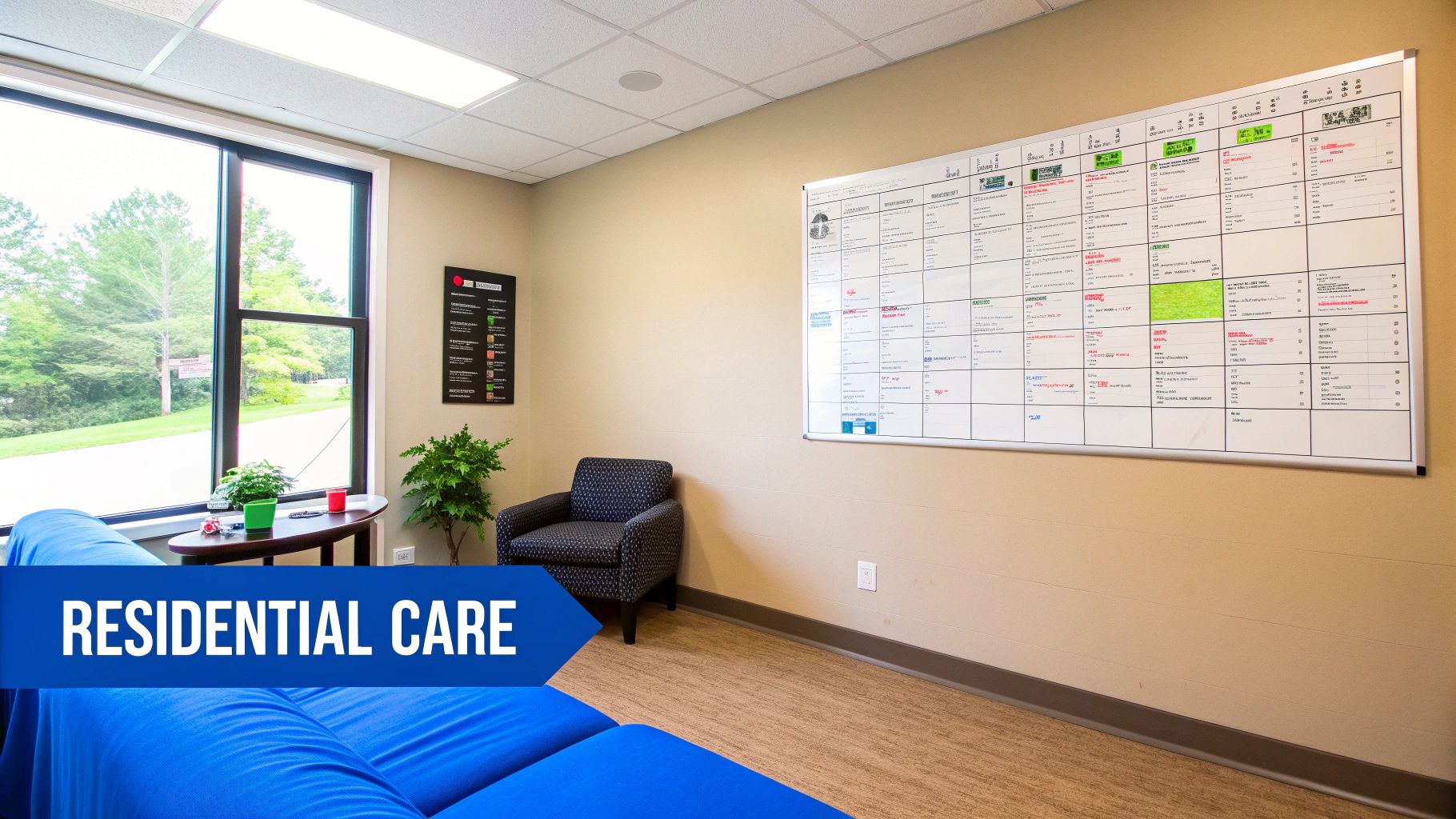
This level of care is absolutely critical for anyone facing severe addiction. Having medical and clinical staff on-site 24/7 means there's always someone to help during the toughest moments of withdrawal or early cravings. It provides a safety net that you just can't get anywhere else.
Inpatient care remains a cornerstone for treating substance abuse and serious mental health issues. With more than 1 billion people worldwide living with mental health disorders, this intensive, around-the-clock support is often a necessary step. You can discover more about these global health findings on who.int.
A Typical Day in Residential Care
Life inside an inpatient facility is all about structure. The goal is to replace the chaos of addiction with healthy, predictable routines that support recovery. While every program is a bit different, a typical day is a mix of sessions that work on the mind, body, and spirit.
A day usually starts early with breakfast, followed by back-to-back scheduled activities. You can expect things like:
- Individual Counseling: One-on-one sessions with a therapist to dig into the personal roots of the addiction.
- Group Therapy: Small group discussions with peers, which helps build a sense of community and reminds you that you aren't alone.
- Educational Workshops: Classes on practical topics like preventing relapse, developing coping skills, and understanding the science behind addiction.
- Holistic Activities: Things like yoga, meditation, art therapy, or gym time to help heal your whole self.
The schedule is intentionally packed. Keeping busy leaves little room for idle time, which helps manage cravings and keeps the focus where it needs to be: on getting better.
The real power of inpatient treatment is its ability to create a "therapeutic bubble." By stepping away from a triggering environment, you get the time and space needed to build a solid foundation for sobriety.
Who Benefits Most from Inpatient Treatment?
While many people can benefit, inpatient rehab is especially crucial for those in high-risk situations. Deciding between inpatient and outpatient care really boils down to how much support and structure a person needs to get a safe start on their recovery journey.
This intensive model is typically the right call for:
- Individuals with Severe Substance Use Disorders: People with a long history of addiction or who have tried less intensive programs without success.
- People with Co-Occurring Disorders: When addiction is tangled up with mental health conditions like depression, anxiety, or PTSD, the 24/7 integrated care of an inpatient setting is vital for treating both at once.
- Those Lacking a Stable Home Environment: If home is a place of chaos, triggers, or zero support, a residential facility offers a much-needed safe harbor to heal.
For certain addictions, like alcohol, the immersive setting is especially important during the medically supervised detox phase. To learn more about that process, check out our guide to inpatient alcohol rehab programs. This structured support is what gets people through the acute challenges of early recovery and sets them up for success down the road.
Outpatient Programs: Recovery in the Real World
Where inpatient rehab creates a protective, immersive environment, outpatient treatment is all about integration. The whole idea is to get professional, structured care while still living your life—going to work, sleeping in your own bed, and dealing with daily responsibilities. This is its core strength: you learn to navigate real-world triggers and challenges with therapeutic support right there with you, making recovery a practical part of your existing routine.
This model isn't a single solution, but rather a spectrum of care with different levels of intensity. Think of it as a dynamic system that can be dialed up or down depending on your needs. As you get stronger in your recovery, the treatment intensity can adapt. This flexibility is exactly what makes outpatient care a workable, sustainable option for so many people who simply can't press pause on their careers, education, or family life.
The Different Levels of Outpatient Care
It helps to think of outpatient treatment as a continuum, with intensity levels designed to meet you where you are. The American Society of Addiction Medicine (ASAM) actually outlines these levels to make sure people get the right amount of support. Generally, you'll come across three common structures: Partial Hospitalization Programs (PHPs), Intensive Outpatient Programs (IOPs), and standard outpatient therapy.
Each one asks for a different time commitment and provides a unique mix of services.
- Partial Hospitalization Programs (PHP): This is the most intensive outpatient option available. You'll typically spend several hours a day at the treatment center, up to five days a week, but you go home at night. It’s a fantastic step-down from inpatient care or for someone who needs a lot of structure without round-the-clock supervision.
- Intensive Outpatient Programs (IOP): IOPs are a step down in time commitment but still offer robust support. They usually require at least nine hours of therapy each week, often spread out over three or four days. This setup provides a solid foundation of individual, group, and family counseling while still allowing you to keep up with your job or school schedule.
- Standard Outpatient Therapy: This is the most flexible and least intensive option, often involving just one or two therapy sessions a week. It’s a great fit for people with milder substance use issues, those who have already completed a higher level of care, or anyone who needs ongoing support to maintain their recovery long-term.
This tiered system means your treatment plan can evolve right alongside you as you build confidence and develop new coping skills.
The real power of outpatient treatment lies in its real-world application. You learn a new coping mechanism in therapy on Tuesday and get to practice it when facing a trigger at work on Wednesday.
Who Is a Good Fit for Outpatient Treatment?
Deciding between inpatient and outpatient care really boils down to your specific situation. Outpatient treatment can be incredibly effective, but it does require a certain amount of personal stability and motivation to succeed.
This flexible approach often works best for:
- Individuals with Mild to Moderate SUDs: People whose substance use hasn't become severe and who can still manage their day-to-day lives without needing constant oversight.
- People with a Strong Support System: This is huge. A stable, sober, and supportive home environment is a massive advantage. When family and friends are on board and actively involved, the odds of success go way up.
- Those Transitioning from Inpatient Care: Outpatient programs are a vital "step-down" from residential treatment. After building a solid foundation in a 24/7 facility, an IOP or standard program helps you ease back into daily life while keeping your support system strong.
- Professionals or Students: If taking a 30, 60, or 90-day leave from a career or school just isn't an option, outpatient care provides the flexibility to get help without putting your life on hold.
By weaving recovery into the fabric of everyday life, outpatient programs help people build resilience and use their new skills where it counts—at home, at work, and in their community.
How To Choose Your Path To Recovery
Deciding on the right treatment is easily the most important step you'll take on your recovery journey. The choice between inpatient and outpatient care isn't about which one is "better"—it's about which one is the right fit for you and your life right now. To make the best call, you need to weigh a few key personal factors.
This isn't a decision to take lightly. It requires an honest, hard look at your life—the severity of your addiction, your mental health, your living situation, and your day-to-day responsibilities. There’s no cookie-cutter answer, only the path that gives you the strongest chance at lasting sobriety.
Evaluating Your Addiction Severity
The intensity of your substance use is the first thing to consider. If you're dealing with a mild substance use disorder (SUD) and can still manage your daily life, an outpatient program might be a great fit. It allows you to learn new coping skills and immediately apply them to your real-world situations.
On the other hand, a moderate to severe SUD usually demands a more structured approach. If you've tried to quit on your own and couldn't, or if you face serious withdrawal symptoms, the 24/7 medical supervision of an inpatient program is non-negotiable. It's about starting your recovery safely and with stability.
Assessing Co-Occurring Disorders
Substance use and mental health are often tangled together. When you're struggling with both an addiction and another condition like depression, anxiety, or PTSD, it’s known as a dual diagnosis. This kind of complexity needs comprehensive, integrated care.
Inpatient facilities are generally better set up for dual diagnoses. They provide round-the-clock access to medical and psychiatric professionals who can address both issues at the same time. Trying to manage a significant mental health challenge while attending outpatient treatment can be incredibly difficult without that kind of built-in, immersive support.
The most effective treatment is not the most intensive or the most flexible; it's the one that accurately matches your specific clinical needs, environmental realities, and personal readiness for change.
Considering Your Home And Social Environment
Your daily surroundings have a huge impact on your recovery. Outpatient treatment works best when you have a solid, stable, and sober support system at home. If your friends and family are genuinely cheering you on, that can be a massive advantage.
But if your home life is unstable, unsupportive, or full of triggers—like living with people who also use substances—an inpatient program becomes a necessity. It acts as a safe haven, pulling you out of a toxic environment so you can put all your energy into building a foundation for sobriety.
Balancing Professional And Personal Obligations
Let's be real: stepping away from your job, school, or family for a month or more can feel impossible. Outpatient programs were created for this very reason. They offer flexible schedules so you can get help without having to press pause on your entire life.
This is a huge plus for people with steady careers or those who are primary caregivers. But you have to be realistic. If your substance use is already damaging your job performance or relationships, taking a temporary leave for inpatient treatment might be the very thing that saves them in the end.
The infographic below breaks down the different levels of outpatient care, showing just how adaptable these programs can be.
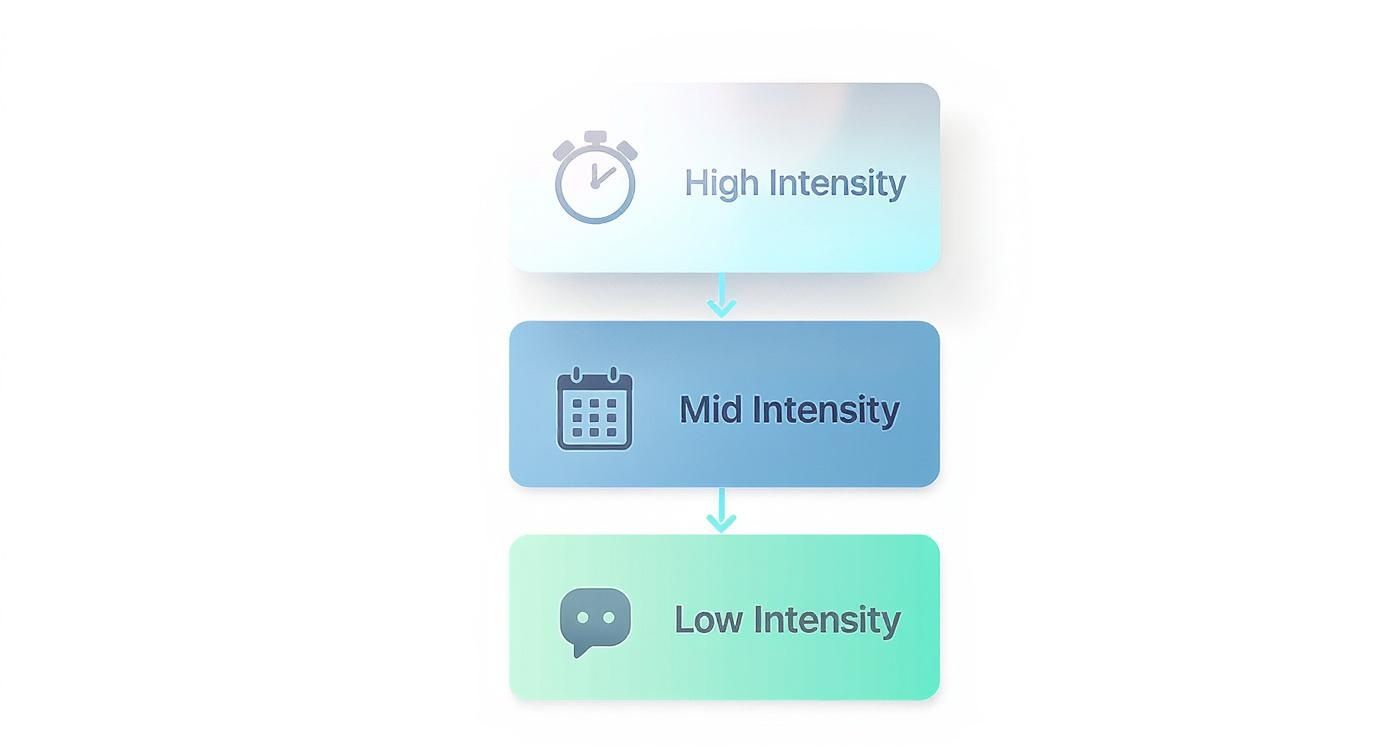
As you can see, "outpatient" isn't a one-size-fits-all term. It’s a spectrum of care that can be adjusted to meet you where you are in your life and recovery.
Inpatient vs Outpatient Decision Matrix
To pull all these pieces together, a decision matrix can be a game-changer. It helps you lay everything out and visually compare how inpatient and outpatient options stack up against your specific needs. Seeing the considerations side-by-side makes it easier to figure out which path offers the structure you truly need.
This kind of organized comparison shifts the decision from a purely emotional one to a more logical evaluation, empowering you to choose with confidence.
| Decision Factor | Inpatient Treatment Considerations | Outpatient Treatment Considerations |
|---|---|---|
| Addiction Severity | Ideal for severe SUDs, chronic relapse, or significant physical dependence requiring medical detox. | Best for mild to moderate SUDs where the individual maintains daily functioning and has high motivation. |
| Co-Occurring Disorders | Recommended for complex dual diagnoses needing integrated, 24/7 psychiatric and medical care. | Suitable for individuals with stable mental health conditions that can be managed with weekly therapy. |
| Home Environment | Necessary for those in unstable, unsupportive, or triggering living situations. | Requires a strong, sober, and encouraging support system at home from family and friends. |
| Professional Life | Requires taking a formal leave of absence from work, school, or major family duties. | Allows for continued work or school attendance with flexible scheduling around commitments. |
| Financial Resources | Higher upfront cost due to accommodation and 24/7 staffing, but often covered by insurance for medical necessity. | More affordable with costs spread out over time, making it accessible for many budgets. |
Ultimately, this matrix is a guide. The best course of action is to discuss these factors with a medical professional or an addiction specialist who can provide a formal assessment and personalized recommendation.
Navigating the Costs of Treatment
Let's be honest: the cost of treatment is a huge factor for most people. When you're weighing inpatient versus outpatient care, understanding the financial side of things is critical. The price difference isn't random—it's tied directly to the level of care and the resources involved.
Inpatient programs naturally come with a higher price tag. Think of it as an all-inclusive package. You're covering 24/7 medical supervision, housing, meals, and a packed schedule of therapies and support groups. Outpatient care, on the other hand, is less expensive because you pay for services as you use them, without the added costs of living on-site.
It’s worth noting that the global addiction treatment market was valued at USD 9.44 billion in 2024. A significant part of that growth comes from outpatient programs, which are becoming more popular because they are both affordable and flexible. This trend shows a real shift towards care that fits into people's lives. For a deeper look at the numbers, you can explore the full report on the addiction treatment market at PrecedenceResearch.com.
Understanding Insurance Coverage
The good news is that most health insurance plans cover substance abuse treatment. The tricky part is that the details of that coverage can be all over the place. Your first step should always be to call your insurance provider and verify your benefits before you enroll in a program. They will typically require a professional assessment to determine what level of care they consider "medically necessary."
To avoid any nasty surprises down the road, get on the phone with your insurance company and ask some direct questions:
- What are my in-network versus out-of-network benefits for behavioral health services?
- Do I need pre-authorization for inpatient or outpatient rehab?
- What's my deductible, and what will my copayments or coinsurance be for each service?
Getting these details sorted out will give you a much clearer picture of your out-of-pocket costs. We break this down even further in our guide on how insurance coverage for rehab works.
While inpatient care costs more, that price reflects a more intensive medical necessity. The most cost-effective choice isn't just the cheapest one—it's the one that gives you the right support to prevent a relapse.
Exploring Affordable Payment Options
Even with a solid insurance plan, the remaining costs can feel overwhelming. Don't let that stop you. Most treatment centers genuinely want to help and have created financial pathways to make recovery possible for more people.
Many facilities are flexible and offer a range of payment solutions:
- Sliding Scale Fees: Some centers will adjust the cost of treatment based on your income, which can make a huge difference if you have limited financial means.
- Payment Plans: Instead of needing a lump sum upfront, many programs will work with you to set up a structured monthly payment plan to spread out the cost over time.
- State-Funded Resources: Look into publicly funded programs in your area. They often provide low-cost or even free treatment for those who qualify, breaking down financial barriers to getting help.
By taking the time to explore all these options, you can find a way to get the help you need that fits both your recovery goals and your budget.
Final Thoughts on Making Your Decision
Choosing between inpatient and outpatient treatment is one of the most important decisions you'll make on the road to recovery. It’s not just about picking a program; it's about finding the right environment to heal, based on your real-life circumstances, the severity of the addiction, and the support you have around you. The best path forward starts with a professional assessment to determine the right level of care for your unique situation. Always remember that recovery is a process, and the treatment plan you start with can evolve as you grow stronger. No matter which path you choose, commitment to aftercare and building a strong support system is the key to lasting success.
Frequently Asked Questions
It's completely normal to have a lot of questions when you're trying to decide between inpatient and outpatient treatment. It's a big decision. Here are some straightforward answers to the questions we hear most often from people in your shoes.
Can I switch from inpatient to outpatient treatment?
Absolutely. In fact, it’s a standard and highly recommended part of the recovery journey. This transition is often called “step-down” care. Think of it as a bridge back to everyday life. You move from the 24/7 structure of a residential facility to a more independent setting, but you keep a strong support system in place to help you navigate the challenges. It’s all about gradually building confidence and resilience.
Does insurance prefer one type of treatment over the other?
Insurance companies don't really have a "preference." Their decisions are based on what is considered a medical necessity for your specific situation. A clinical assessment by a healthcare professional will determine the appropriate level of care. This evaluation looks at your diagnosis, how severe the addiction is, and your personal circumstances to decide which treatment setting your insurance will cover.
How long does treatment typically last?
Treatment duration varies widely based on individual needs. Inpatient programs often last 30, 60, or 90 days. Outpatient programs can be more flexible, ranging from a few months to a year or more, depending on the intensity (PHP, IOP, or standard therapy) and the person's progress.
What's the main difference in daily life between inpatient and outpatient care?
The main difference is immersion versus integration. In inpatient care, your entire day is structured around recovery activities within the facility—therapy, workshops, and meals. In outpatient care, you integrate a few hours of therapy into your existing daily life, allowing you to continue with work, school, and family responsibilities while living at home.
If you're still weighing your options and need more guidance, StartDrugRehab.com has the resources to help you find clarity. Feel free to explore our articles or get connected with treatment providers at https://startdrugrehab.com.