Have you ever tried to convince someone to change, only to have them dig their heels in even more? It’s a common experience, and it highlights a fundamental truth: lasting change rarely comes from being told what to do. This is where Motivational Interviewing (MI) comes in, especially in the world of substance abuse treatment.
Instead of a confrontational, "you must change" approach, MI is a collaborative conversation. It's designed to help people find their own reasons to change, strengthening their personal motivation and commitment to recovery.
Key Takeaways
- MI is a Partnership: Motivational Interviewing is a collaborative, person-centered approach that helps individuals resolve their ambivalence about substance use and find their internal motivation to change.
- Four Core Principles: The "spirit" of MI is built on Expressing Empathy, Developing Discrepancy, Rolling with Resistance, and Supporting Self-Efficacy.
- OARS are the Tools: The core communication skills used in MI are Open-ended questions, Affirmations, Reflective listening, and Summaries (OARS).
- Evokes "Change Talk": A primary goal is to evoke "change talk" from the individual, where they voice their own desires, abilities, reasons, and needs for change.
- Effective and Versatile: MI is a proven, evidence-based practice that can be used for various substance use disorders, either as a standalone intervention or as a prelude to other forms of treatment.
The Collaborative Path to Addiction Recovery
Think of it less as a therapy technique and more as a guided partnership. The core idea behind using motivational interviewing for substance abuse is to help people work through their own ambivalence—that push-and-pull feeling of wanting to stop using but also not being ready to let go.
This empathetic style is a world away from older methods that often tried to break down a person's denial, which usually just created more resistance. With MI, the practitioner's job isn't to lecture but to listen, build trust, and help the individual uncover the powerful reasons for recovery that are already inside them.
Why This Approach Matters
The need for effective, respectful treatment is staggering. Globally, 76.3 million people are grappling with alcohol use disorders, and another 15.3 million with drug use disorders. In the face of such a crisis, how we approach treatment matters immensely.
The good news is that MI works. A comprehensive review of multiple studies confirmed that MI has a significant positive effect on reducing substance use when compared to no treatment at all. For a deeper dive, you can explore the full study about MI's effectiveness and see the data for yourself.
This person-first philosophy makes it an essential skill for anyone in a supportive role, from a licensed therapist to a concerned family member.
"At its core, MI is about guiding people to uncover their own motivations for change… MI creates a space where individuals feel empowered to explore their own desires, abilities, reasons, and needs."
Building a Foundation for Lasting Change
Motivational interviewing is often the perfect starting point for someone's recovery journey. By honoring a person's autonomy and highlighting their inner strengths, it lays a solid foundation for more intensive therapies and long-term support. This same collaborative spirit is essential in other supportive roles, which you can learn more about in our guide on what is recovery coaching.
This initial work on building motivation is crucial for a few key reasons:
- It Lowers Defenses: When someone doesn't feel judged or criticized, they're more likely to open up about their struggles honestly.
- It Strengthens Engagement: People who feel truly heard and respected are far more likely to stick with their treatment plan.
- It Fosters Self-Belief: MI helps individuals see that they have the capacity to change, which is one of the most powerful predictors of long-term success.
Understanding the Four Core Principles of MI
To really get a handle on motivational interviewing for substance abuse, you have to look past the techniques and see the philosophy driving it. At its heart, MI is a specific mindset built on four core principles. These principles don't work in isolation; they weave together to create a supportive, non-judgmental space where someone feels safe enough to even consider changing.
You can think of these principles as the four legs of a chair. Each one is absolutely essential for building a stable, supportive foundation for a real conversation about recovery. Take one away, and the whole thing gets wobbly and ineffective.
This infographic shows how the foundational concepts of Partnership, Acceptance, and Evocation support the MI process.
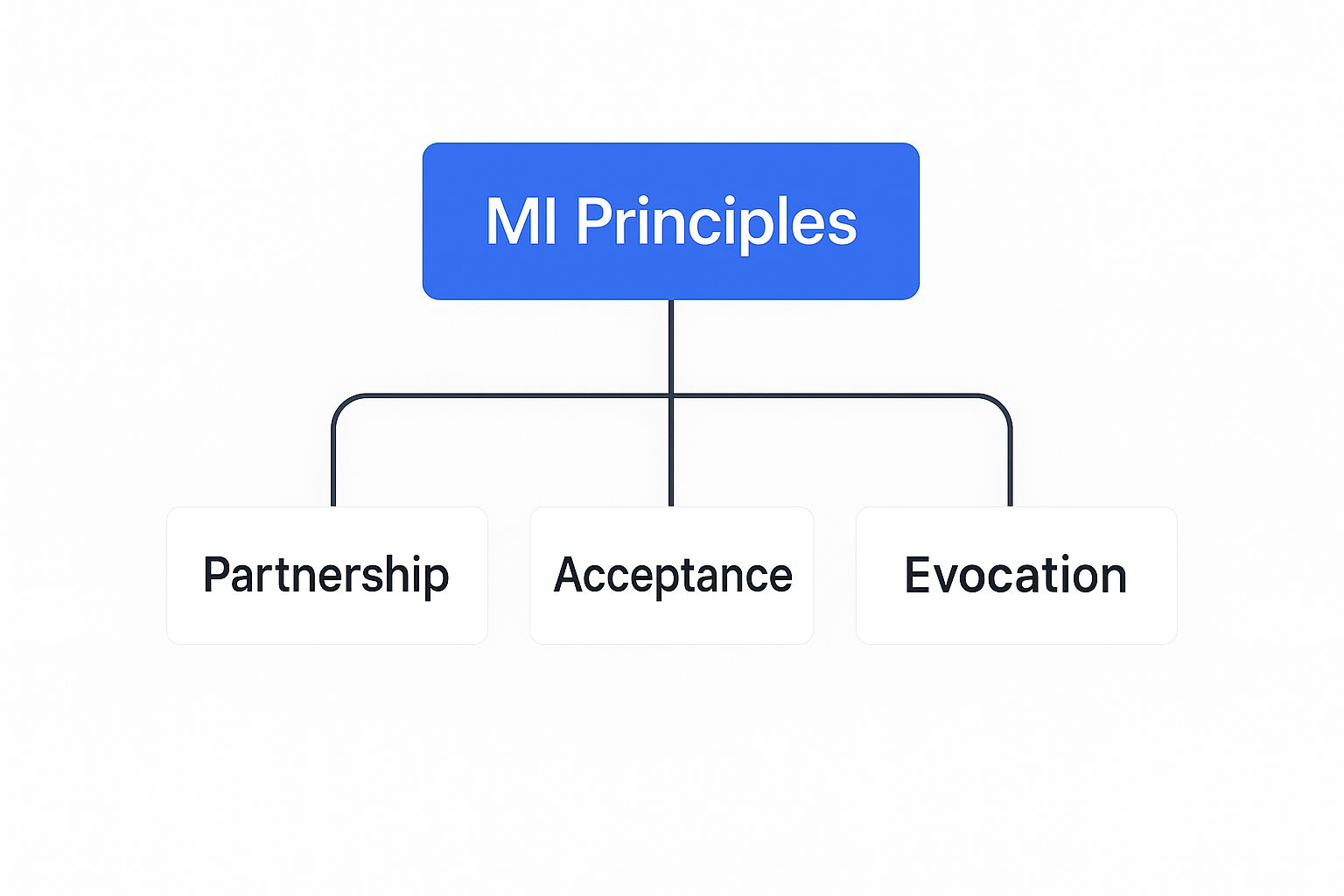
This visual really drives home that the "spirit" of MI starts with a collaborative and accepting relationship. Only from that foundation can you begin to draw out a person's own reasons to change.
To see how these principles translate from theory to practice, let's break them down. The table below shows the goal of each principle and what it actually looks like in a conversation about substance use.
The Four Principles of MI in Action
| Core Principle | Primary Goal | Example in a Substance Abuse Context |
|---|---|---|
| Express Empathy | To build trust and show genuine understanding of the client's perspective without judgment. | Instead of judging, the practitioner might say, "It sounds like using helps you cope with a lot of stress. That must be a heavy burden to carry." |
| Develop Discrepancy | To help the client see the gap between their current substance use and their core values or future goals. | A practitioner might ask, "You've said being a reliable parent is the most important thing to you. How does your current drinking fit in with that goal?" |
| Roll with Resistance | To avoid confrontation and use moments of pushback as an opportunity to understand the client's viewpoint better. | If a client says, "I don't have a problem," the practitioner responds, "So for you, the consequences haven't been serious enough to see it as a major issue." |
| Support Self-Efficacy | To build the client's confidence in their own ability to make a change, based on their strengths and past successes. | The practitioner might say, "You managed to quit smoking a few years ago. What did you learn from that experience that could help you now?" |
By keeping these four principles in mind, a practitioner can guide the conversation in a way that feels empowering, not confrontational.
Expressing Empathy to Build Trust
The first principle, Expressing Empathy, is all about trying to see the world through the client’s eyes, without judgment. This isn't about feeling sorry for them or even agreeing with their choices. It’s about being genuinely curious and wanting to understand their experience with substance use.
When someone feels truly heard and understood, their defenses start to come down. This creates the trust needed for an honest conversation and makes them far more willing to explore their mixed feelings about their habits.
A core tenet of MI is respecting a person's autonomy. By fostering a safe environment, MI allows people to weigh their choices naturally, often leading to more meaningful and lasting behavioral changes.
Developing Discrepancy to Inspire Change
Next up is Developing Discrepancy. This is the art of gently guiding someone to see the disconnect between their current behavior—their substance use—and what they truly want out of life. The crucial part here is that the client is the one who points out this gap, not the practitioner.
For instance, a therapist might say, "On one hand, you mentioned how much you value being a present father. On the other, you've said that your drinking sometimes gets in the way of that. How do you see those two things fitting together?" That gap between values and actions is where the motivation for change is born.
Rolling with Resistance as a Guide
Resistance is going to happen. In MI, it's seen as a completely normal part of the process, not a roadblock. The third principle, Rolling with Resistance, teaches practitioners to sidestep arguments and confrontation when a client pushes back.
Instead of fighting it, you treat resistance as valuable information. If someone says, "I don't have a problem," an MI practitioner avoids a power struggle by responding with something like, "It sounds like you feel this isn't a major issue for you right now." This keeps the conversation collaborative and gives the client space to think without feeling attacked.
Supporting Self-Efficacy for Lasting Success
Finally, there's Supporting Self-Efficacy. This principle is all about building a client's belief that they are actually capable of changing. After years of struggling with substance abuse and perhaps a few failed attempts to quit, many people feel utterly hopeless.
A practitioner can boost self-efficacy in a few key ways:
- Highlight past successes: Remind them of other difficult changes they've successfully made in their life.
- Affirm their strengths: Acknowledge their courage and resilience for just showing up and trying.
- Reframe "failures" as lessons: Help them see setbacks not as the end of the road, but as a learning experience on the journey.
By reinforcing the client’s own power, this principle builds the confidence they need to not only start the recovery process but, more importantly, to keep going.
Putting the Principles into Practice: A Guide to OARS
If the four principles are the heart of Motivational Interviewing, then OARS is how you bring that spirit to life in a real conversation. Think of it as your practical toolkit. OARS is a simple acronym that stands for the four core communication skills you’ll use again and again: Open-ended questions, Affirmations, Reflective listening, and Summaries.
These aren't just tricks or techniques. They're the fundamental building blocks for creating the kind of supportive, non-judgmental space where someone feels safe enough to explore the possibility of change. Let's break down how each one works.
Open-Ended Questions: Unlocking the Client's Story
The first tool, Open-ended questions, is all about inviting a real conversation, not just a one-word answer. The goal is to get people talking about their own experiences, in their own words. You're gently opening a door for them to walk through, rather than asking a question they can shut down with a simple "yes" or "no."
For instance, a closed question like, "Is your drinking causing you problems?" almost begs for a "no." But if you rephrase it as an open-ended question, you get something very different: "How have things been at home since your drinking has increased?" This shift prompts a story, not just a response, giving you real insight into their world.

A few other examples might look like:
- "Walk me through what a typical day looks like for you."
- "What are some of the good things you feel you get from using? And what about the not-so-good things?"
- "If you pictured yourself making a change, what might be different?"
Affirmations: Spotlighting Strengths
Next up are Affirmations. These are genuine statements that recognize a person's strengths, their past efforts, or their positive qualities. This isn’t about empty praise; it's about holding up a mirror to show them the good that’s already there. For someone caught in a cycle of substance use, who might only see their failures, this can be incredibly powerful.
An affirmation can be as simple as saying, "It takes real courage to even be here talking about this. That tells me a lot about how much you want a better future for yourself."
Statements like this build a person’s confidence—their belief that they can change. By focusing on what's right with them instead of what's wrong, affirmations help melt away defensiveness and build a solid, trusting relationship.
Reflective Listening: Showing You Truly Get It
Reflective listening might just be the most important skill in the entire MI toolkit. It’s a special kind of listening where you don't just hear the words; you try to understand the meaning behind the words and then reflect that understanding back to the client. This does more than just show you're paying attention—it proves you're trying to step into their shoes.
Reflections can be simple or more complex:
- Simple Reflection: A client says, "I'm sick of my parents nagging me all the time about my drug use." You might reflect, "It sounds like you're feeling a lot of pressure from them."
- Complex Reflection: This goes a step further by guessing at the underlying emotion. For the same statement, you might say, "It sounds like you’re frustrated because you feel like they just don't understand."
This simple act of reflecting helps people hear their own thoughts in a new way, often leading them to new insights about their situation.
Summaries: Tying It All Together
Finally, Summaries are where you collect and weave together the different threads of the conversation. Think of it as a brief recap. Summaries show you've been listening intently, they reinforce the important things that have been said, and they can gently highlight a person's own reasons for wanting to change.
A summary can also be a great way to transition. You might say something like, "Okay, so let me see if I've got this right. On one hand, you’re worried about your health and how this is affecting your job. On the other, using helps you unwind after a stressful day. But you also mentioned that you successfully cut back before when you put your mind to it. Given all that, where do you think we should go from here?"
Pulling everything together like this helps the client see the bigger picture. It's a key part of what makes motivational interviewing in substance abuse treatment so effective at boosting a person's engagement. In fact, a clinical trial found that clients who had MI-based intake sessions were significantly more likely to stick with treatment after 28 days compared to those who didn't. For a deeper look, you can review the details of this study and see the data on MI's impact for yourself.
Guiding the Four Processes of Change
If OARS skills are the tools you use in a conversation, then the Four Processes of Motivational Interviewing are the roadmap. Think of them as overlapping stages that give the entire dialogue a natural flow, guiding a person from a place of uncertainty toward a genuine commitment to change. These four processes are Engaging, Focusing, Evoking, and Planning.
This isn't some rigid, step-by-step formula. It's more of a dance. A practitioner might find themselves moving back and forth between these processes depending on where the client is at, always keeping their readiness for change front and center.
Let's break down how each process helps someone navigate their journey from ambivalence to action.
The First Process: Engaging
Every meaningful conversation about change starts with Engaging. This is the foundational process of building a real connection—one built on trust and mutual respect. Without this, nothing else works. The goal is to create a safe harbor where the individual feels truly heard and understood, not judged.
This is where your OARS skills, especially expressing empathy and asking open-ended questions, really shine. You're listening more than you're talking, trying to see the world through their eyes. A strong therapeutic alliance built right here is one of the single best predictors of a positive outcome.
The Second Process: Focusing
Once that solid connection is there, the conversation naturally shifts into Focusing. In this stage, you and the client work together to find a specific target for change. Someone struggling with substance use often faces a tangle of challenges, and trying to fix everything at once is a recipe for overwhelm.
The Focusing process brings clarity. A practitioner might ask something like, "Of all the things we've talked about, what feels like the most important thing to work on right now?" This collaborative agenda-setting makes sure the conversation stays on a path that actually matters to the client—a core principle of motivational interviewing for substance abuse.
By collaboratively setting the focus, MI respects the client’s autonomy. It sends a powerful message that this is their journey, and the practitioner is there to help them navigate it, not to dictate the destination.
The Third Process: Evoking
With a clear focus established, the conversation moves into its heart: Evoking. This is where you gently draw out the client’s own arguments for change. It's about listening intently for what we call "change talk"—any time the client's own words hint at a desire, ability, reason, or need to change.
To get this change talk flowing, you might ask questions like:
- Desire: "What do you hope your life looks like a year from now?"
- Ability: "What are some of your strengths that could help you make this happen?"
- Reasons: "What are the biggest reasons for you to even consider cutting back?"
- Need: "On a scale of 1 to 10, how urgent does making a change feel to you?"
The more a person hears their own voice giving reasons to change, the stronger their internal motivation becomes. This is the magic of MI—it helps people talk themselves into changing.
The Fourth Process: Planning
Finally, once that motivation feels strong and clear, the conversation shifts to Planning. This is the bridge from talking about change to actually doing it. Here, the practitioner helps the client build a concrete, actionable plan that feels both realistic and aligned with their goals.
This isn't about you handing over a pre-made plan from a clipboard. It’s a true partnership, brainstorming small, manageable steps. This process often shares common ground with other recovery frameworks where clear goals are vital. You can see these parallels when exploring the stages of the recovery process in our other guide.
A planning conversation might sound like, "Okay, so what's one realistic first step you could take this week?" By co-creating a plan, you empower the client, reinforcing their ability to take ownership of their own recovery.
Putting It All Into Practice: An MI Session in Action
https://www.youtube.com/embed/URiKA7CKtfc
It’s one thing to talk about theory, but seeing motivational interviewing work in real-time truly shows its power. Let’s imagine a session with David, a 35-year-old man who feels conflicted about his heavy drinking. He’s in a therapist’s office, and this example will show how the OARS skills and core principles come together to guide the conversation—not force it.
David walks in on the defensive, expecting to be told what to do. The therapist knows this and starts by simply Engaging, creating a safe, non-judgmental space.
- Therapist (Open-ended question): "David, thanks for coming in. To start, could you tell me a bit about what's been on your mind with your drinking?"
- David (Hesitant): "I don't know. My wife thinks it’s a problem. I think she’s overreacting, but I told her I’d come."
- Therapist (Reflective listening): "So you're here mainly because your wife is worried, but you're not quite convinced it's as big of a deal as she thinks."
This simple reflection does something powerful: it tells David he's been heard, not judged. His guard immediately starts to come down because the therapist isn’t correcting him, but simply acknowledging his point of view.
Finding the Mismatch
Now that a bit of trust is built, the therapist can gently shift into Focusing on what really matters to David. The idea isn't to talk about drinking, but to explore the gap between the life he has and the life he wants. This is where the magic of developing discrepancy happens.
- Therapist (Open-ended question): "Let's put your wife's concerns on the shelf for a moment. What are the things in your life that are most important to you?"
- David: "My kids. And my job. I’ve worked really hard to get where I am."
- Therapist (Affirmation): "It's obvious how much you value being a good father and a dedicated professional. That takes a ton of strength."
- Therapist (Developing discrepancy): "I'm curious, how does drinking fit in with being the kind of dad and professional you want to be?"
Notice the flow here. The affirmation builds David up before asking a tough question. And the question itself isn't an accusation; it's a genuine invitation for David to do the exploring himself.
This gentle exploration is the heart of MI. The therapist isn't the expert on David's life—David is. The entire session is structured to help him find that expertise within himself.
Tuning in to Change Talk
As David starts to think out loud, the therapist's job is to listen intently for any sign of change talk—any little phrase that hints at a desire, ability, reason, or need to change. This is the Evoking process.
- David: "Well… I missed my son's soccer game last Saturday because I was too hungover. I felt awful about it. I just want to be there for them."
- Therapist (Reflecting change talk): "Being a reliable, present dad is everything to you, and it sounds like you're worried drinking is starting to get in the way of that."
The therapist catches the "reason" David just offered and reflects it back, reinforcing David's own motivation. But what happens when David gets scared and pulls back? The therapist doesn't push; they "roll with the resistance."
- David: "But just quitting seems impossible. I really don't think I can do it."
- Therapist (Supporting self-efficacy): "That’s a completely understandable fear. It’s a huge step. I remember you mentioned you cut back on your own for a whole month last year. What did you learn from that experience that might be useful now?"
By pointing to a past success, the therapist helps build David’s confidence in his own ability to make a change. It’s a small step, but it’s what opens the door to the Planning process. This back-and-forth shows that motivational interviewing is more of a dance than a debate, one that empowers people to find their own rhythm for moving forward.
Actionable Takeaways for Supporting Change
As we wrap up, let's distill everything we've covered about motivational interviewing into a few key takeaways you can actually use. The real magic of this approach isn't in some dense psychological theory; it's about fundamentally changing how we talk to people about change. Think of yourself as a guide on their journey, not a director shouting orders.

At its heart, this philosophy is all about partnership. It’s a team effort where you help someone discover their own reasons to move forward, rather than trying to force your reasons on them.
Core Principles to Remember
To keep the spirit of MI alive in your conversations, hold onto these essential reminders. They’re like a compass, always pointing you back to an empathetic, person-first approach.
- Change is a partnership, not a command. You're walking alongside someone, not dragging them to the finish line.
- Listen more than you talk. The most powerful insights will come from the person you're helping, not from your well-meaning advice.
- Resistance is a signal, not a battle. When you feel pushback, it’s a cue to get curious about their point of view, not an invitation to win an argument.
Actionable Tips for Anyone Supporting Change
Whether you're a clinician, a family member, or a friend, your biggest challenge is to resist the "righting reflex"—that powerful, instinctual urge to jump in and fix someone’s problems for them. It’s a natural impulse, but it rarely works. A much better approach is to ask powerful questions and genuinely affirm their strengths.
The essence of MI is to help people talk themselves into changing. By asking the right questions and listening with intent, you create the space for their own motivation to surface and grow stronger.
One of the most impactful things you can do is to truly believe in and support their ability to succeed. Remind them of times they’ve overcome challenges before. Point out the strengths you see in them, even if they can't see them themselves.
This approach isn't just for one-on-one chats; it’s proven to be incredibly effective in group settings, too. For example, one study on veterans in outpatient treatment found that group MI led to significant reductions in binge drinking and overall alcohol consumption. You can see the data for yourself and explore the findings.
For families in particular, learning these skills can be a game-changer. Our guide on understanding recovery resources for families offers more specific strategies and support.
Frequently Asked Questions (FAQ)
When you're exploring motivational interviewing for substance abuse, questions are bound to come up. It's a nuanced approach, and whether you're a practitioner, a concerned family member, or someone thinking about recovery, you deserve clear answers.
Let's cut through the jargon and get to the heart of what MI is all about in the real world.
Does MI work for all kinds of addictions?
Yes, one of the biggest strengths of MI is its versatility. It's been shown to be effective for a whole host of substance use disorders, whether someone is struggling with alcohol, opioids, stimulants, or other drugs.
The reason it works so well is that it tackles the central problem for almost everyone: ambivalence. That's the feeling of being torn, of wanting to stop using but also wanting to continue. MI is designed specifically to help people work through that internal tug-of-war.
It can be used on its own as a short intervention or as a way to get someone ready for more structured therapies like Cognitive Behavioral Therapy (CBT). It’s especially good at getting people engaged in treatment and keeping them there, which is a huge factor in long-term success.
Isn't this just being a good listener?
That’s a common misconception, but MI is much more than just being a supportive ear. While empathy is crucial, a practitioner using MI is listening with a specific purpose: to catch and highlight the client's own arguments for change. We call this "change talk."
Motivational Interviewing isn't just a friendly chat. It's a directed, skillful conversation designed to resolve ambivalence and build a plan for change.
The process is structured. Using techniques like OARS (Open-ended questions, Affirmations, Reflections, and Summaries), the therapist guides the conversation. It’s a partnership, but one with a clear goal—building momentum toward a healthier life.
Can I try this if I'm not a therapist?
Absolutely. While becoming a certified MI practitioner takes serious training, the core principles can be learned and used by anyone to have better, more helpful conversations.
For family and friends, learning a few basics can make a world of difference. You can use elements of the OARS model to:
- Stop the arguments and sidestep resistance.
- Open the door to a real conversation about their substance use.
- Help your loved one hear their own reasons for wanting something different.
The trick is to let go of the need to "fix" them. Instead, you adopt the MI spirit of being a supportive guide on their journey.
How quickly can you see results?
One of the most surprising things about MI is how fast it can have an impact. Sometimes, a shift in perspective can happen in a single session lasting just 15-20 minutes.
Typically, it's used over one to four sessions to help someone get ready for the next step in their recovery. The goal isn't an overnight cure; it's to tip the scales from "I can't" or "I won't" to "Maybe I can."
Success is measured in those small but powerful shifts in motivation. Getting someone to willingly engage with their own recovery is a massive win and a strong sign of lasting change to come.
At StartDrugRehab.com, we know that finding the right support begins with having the right information. If you or someone you love is struggling, we're here to help you find a path forward. Check out our guides or find treatment options at https://startdrugrehab.com.
Article created using Outrank