A relapse prevention worksheet PDF is a structured, hands-on tool that helps you get ahead of the curve in your recovery. Think of it as your personal game plan—a way to identify your specific triggers, build a toolbox of coping skills, and create a solid plan to protect your sobriety. It’s all about shifting from reacting to challenges to proactively preparing for them.
Key Takeaways
- A relapse prevention worksheet is a proactive tool to identify triggers, plan coping strategies, and organize a support network.
- Honesty and specificity are crucial; vague plans are less effective under pressure. Be detailed about your triggers and the actions you'll take.
- Your worksheet is a living document. It should be reviewed and updated regularly to reflect new insights and challenges in your recovery journey.
- Integrating your plan into daily life—by scheduling coping skills and preparing your support system—turns it from a document into a practical, real-world tool.
What a Relapse Prevention Worksheet Can Do for You
Recovery isn’t a one-and-done event; it's an ongoing journey. And like any journey, having a map makes a world of difference. That’s exactly what a relapse prevention worksheet provides. It’s not just another form to fill out; it's a personalized strategy guide for getting through those tough moments that are bound to come up.
This simple tool gives you a structured way to get to know your own patterns, empowering you to feel more in control.

It’s about moving from defense to offense. Instead of just bracing for a craving to hit, you’re actively getting ready for it. This worksheet is where you’ll map out your high-risk situations, pinpoint your emotional triggers, and learn to spot the subtle warning signs that tell you trouble might be on the horizon.
Writing it all down makes it real. It takes these abstract fears and potential pitfalls out of your head and puts them on paper, where they become tangible, manageable problems you can solve.
The Core Components of Your Plan
At its heart, the worksheet takes the overwhelming complexity of recovery and breaks it down into smaller, more manageable pieces. Most are designed to help you pinpoint both internal triggers (like stress or sadness) and external ones (like seeing a specific person or going to a certain place).
These documents are often used as visual aids in therapy or as personal homework to deepen your self-awareness. Having this plan in place gives you concrete strategies to turn to when a craving strikes. To learn more, you can explore various relapse prevention strategies.
A good worksheet will prompt you to think through a few key areas. Below are the essential sections you'll typically find and a little about why each one is so important for your recovery.
Core Components of Your Relapse Prevention Worksheet
| Worksheet Section | Its Purpose in Your Recovery |
|---|---|
| Trigger Identification | This is where you get specific about the people, places, things, or even feelings that spark a craving. Knowing them is the first step to avoiding or managing them. |
| Early Warning Signs | You'll learn to spot the subtle shifts in your mood or behavior that often happen before you're in a high-risk situation. Think of it as your internal alarm system. |
| Coping Skills List | Here, you'll brainstorm a list of practical, healthy things you can do right now to manage stress or ride out a craving. No more feeling stuck. |
| Support Network | This section is for listing the names and numbers of people you can call when you need help—your sponsor, a therapist, a trusted friend. It's your lifeline. |
Each part of the worksheet builds on the others, creating a comprehensive and personalized plan that's ready when you need it most.
By taking the time to complete a relapse prevention worksheet, you're essentially creating a powerful reference guide for yourself. In a moment of crisis, it removes the guesswork and gives you a clear, pre-planned course of action to follow.
This proactive approach is a fundamental piece of building a strong recovery. It’s all about creating a solid foundation of self-awareness and preparation that can support you for the long haul.
How to Make Your Worksheet Actually Work for You
Staring at a blank relapse prevention worksheet PDF can be pretty daunting. It’s more than just a piece of paper; it’s a tool for your recovery. So, let's break down how to make it genuinely useful, using a real-world example. We'll call her 'Maria.' She's committed to her sobriety and has just downloaded her worksheet.

The very first thing to do is get brutally honest with yourself. This isn't just about listing the obvious stuff, like avoiding old friends who still use. Maria knows she has to dig deeper. She thinks about the subtle things—that quiet feeling of loneliness on a Friday night or the mounting stress from a big work deadline.
These less obvious triggers are often the most dangerous because they sneak up on you. Acknowledging them is a huge step toward building a solid plan.
From Vague Ideas to Real-Life Actions
When you get to the coping strategies section, specificity is your best friend. Vague plans fall apart under pressure. Instead of just writing "do deep breathing," Maria gets practical and creates a menu of tangible things she can do right away.
- When Boredom Hits: "I'll listen to the 30-minute comedy podcast I already have downloaded on my phone."
- For Rising Frustration: "I'll use a five-minute journaling prompt to write down exactly what’s bothering me so it doesn't fester."
- If a Craving Surfaces: "I will immediately text my friend Alex, who gets it, and ask if he has a few minutes to talk me through it."
This level of detail is a game-changer. It takes the thinking out of a high-stress moment. You’re not trying to come up with a plan; you’re just following the one you already made. If you need more inspiration, our detailed relapse prevention plan template is a great place to find more ideas.
The best worksheet is one that is authentically yours. It needs to be filled with personal, practical steps you can actually see yourself taking, not just generic advice that looks good on paper.
Putting Your Support System on Speed Dial
Finally, Maria gets to her support network. She doesn't just jot down names. Next to each one, she adds a quick note about their role. Her sponsor is for direct, no-nonsense recovery advice. Her sister is for when she just needs to vent about something completely unrelated to recovery.
This simple act transforms the relapse prevention worksheet PDF from a clinical form into a personalized roadmap for her own life. By pairing honest self-reflection with hyper-specific, actionable steps, she's building a resource that will genuinely have her back when she needs it most. The goal is to make your worksheet a true reflection of your journey—one packed with strategies that are realistic, accessible, and truly helpful for you.
Uncovering Your Triggers and Early Warning Signs
The real work in recovery begins when you get brutally honest about what puts you at risk. A trigger isn't always as dramatic as seeing an old dealer or driving past a bar. Sometimes, it’s the quiet boredom of a Tuesday night, the mounting stress from a work deadline, or even the rush of a big personal win. This is where your relapse prevention worksheet PDF becomes your best detective tool.
Getting specific is the key. You're looking to identify not just the obvious, external triggers but also the quiet, internal ones that sneak up on you. The goal is to map out the entire sequence—the thought, the feeling, the situation—that builds into a high-risk moment. When you can spot these early warning signs, you can put your coping plan into action long before a craving takes over.

External vs. Internal Triggers: Knowing the Difference
To build a solid plan, it helps to sort your triggers into two buckets. They’re both powerful, but they require different strategies.
External Triggers are the more obvious threats—the people, places, and things in your environment.
- People: This could be an old using buddy or even a family member who stresses you out.
- Places: Specific neighborhoods, houses, bars, or even a particular route home from work.
- Things: Drug paraphernalia is an easy one, but it could also be a song, a smell, or a movie.
- Situations: Holidays, concerts, and high-pressure work events are common examples.
Internal Triggers are the subtle ones that come from within. These are often harder to spot.
- Emotions: Feeling angry, lonely, sad, anxious, or even euphoric can be a major trigger.
- Thoughts: Negative self-talk ("I'm a failure"), glamorizing past use ("It wasn't that bad"), or feeling hopeless about the future.
- Physical Sensations: Chronic pain, exhaustion, or lingering withdrawal symptoms.
Think about this: relapse rates for substance use disorders are estimated to be between 40% and 60%. That's not a moral failing; it's on par with chronic physical illnesses like hypertension. A relapse prevention worksheet PDF is a practical, strategic tool designed to tackle this reality head-on by getting you prepared for these warning signs.
How to Spot Your Personal Patterns
Uncovering these patterns takes some honest reflection. Look back at past relapses or even close calls. What did they have in common? Where were you? Who were you with? How were you feeling? Sometimes, just keeping a simple daily mood journal can show you how certain feelings are connected to cravings, revealing patterns you never saw before.
I've found that a trigger is rarely just one thing. It's usually a combination. For example, feeling stressed (internal) while at a party (external) is a much riskier scenario than just feeling stressed while you're safe at home.
When you start mapping these connections, you rob them of their power to surprise you. You're no longer being ambushed by cravings; you're prepared for them. Our guide on how to prevent relapse dives even deeper into building this kind of awareness. This whole process turns your worksheet from a simple piece of paper into a personalized roadmap for protecting your hard-won recovery.
Building Your Real-World Support System
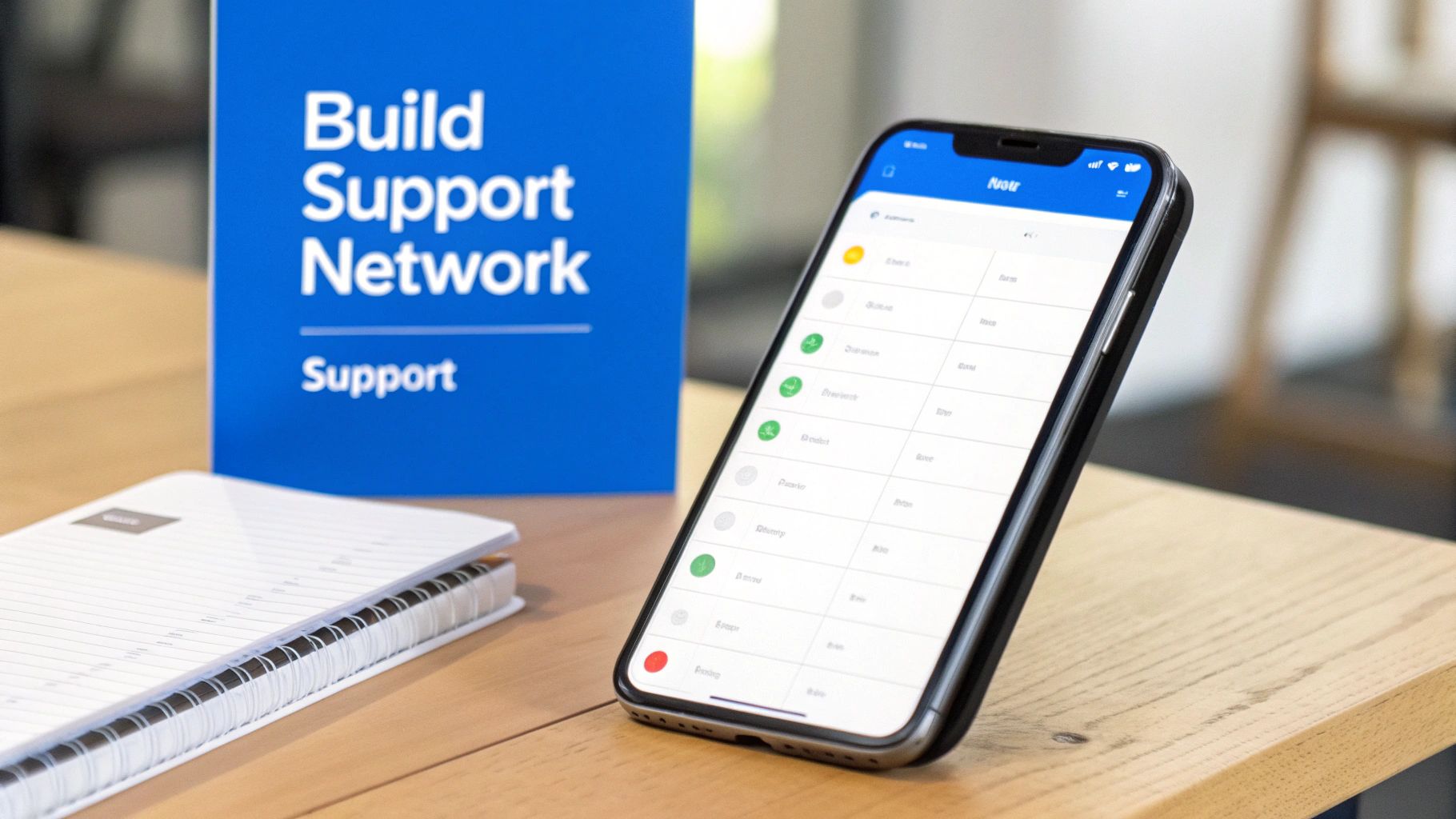
A plan on paper is a great start, but recovery happens in the real world. Your relapse prevention worksheet PDF is the blueprint; now, it's time to build the structure—your support system—that will keep you safe and strong. This is all about turning those coping skills you listed from an "in case of emergency" list into everyday, automatic habits.
A solid support system isn't just a list of people to call when you're in crisis. It's about weaving recovery-focused actions into the very fabric of your daily life. Instead of just reacting to triggers, you're getting out ahead of them by scheduling activities that build you up. This proactive stance creates a reserve of resilience you can draw on when things get tough.
Making Your Plan a Daily Practice
The only way to make your plan truly work is to bring it to life. We need to get these strategies off the page and into your routine, so they become second nature.
Here’s how to start:
- Schedule Your Skills: Don't wait until you're overwhelmed to try a coping skill. Put it on your calendar. Maybe that's a five-minute mindfulness practice every morning before you check your phone, or a standing weekly call with your sponsor.
- Prepare Your People: Talk to your key support people before you need them. Be direct. Let them know what you actually need when you're struggling. You could say something like, "If I ever call you sounding panicked, the most helpful thing you could do is just listen and remind me to breathe."
- Expand What "Support" Means: Think bigger than just people. Your network can include sober-friendly environments like a specific coffee shop, a walking trail in a park, or your gym. It's also the meetings you attend and any activity that strengthens your commitment to recovery.
Think of your support system like a safety net. It works best when you check and strengthen it regularly, not just when you notice you're falling.
Removing Barriers to Asking for Help
Sometimes the hardest part is actually making the call. Pride, fear, or just not knowing what to say can be huge roadblocks. The goal here is to make reaching out as frictionless as possible.
Research has shown time and again how powerful peer support can be for breaking down isolation. One study, for instance, found that 73% of adolescents were better off after attending group sessions. That sense of community is crucial.
This is exactly why having those "prepare your people" conversations is so vital. When your friend already knows the game plan, it removes the awkwardness and the fear of feeling like a burden. You’ve already given them the script, which makes it infinitely easier to pick up the phone when you feel vulnerable. Your worksheet is your guide, but these people are your team.
Don't Just Fill It Out—Live It
Think of your relapse prevention plan as less of a static map and more of a living, breathing guide. It's not a one-and-done task you check off a list. For this worksheet to actually work, it needs to be an active part of your daily life, evolving right along with you on your recovery journey.
The key is to keep it front and center. I've seen people have great success by making it impossible to ignore. Save the relapse prevention worksheet PDF to your phone's home screen. Stick a printed copy on your fridge or tuck one in your car's glove box. A simple but powerful trick is to set a recurring calendar reminder—say, every Sunday night—to just sit with it for 15 minutes.
Make Your Check-Ins Count
This isn't just about re-reading what you wrote; it's about actively updating it. As you move forward, you're going to learn things. You'll discover new coping skills that are surprisingly effective, and you'll start to notice subtle triggers you might have missed initially. Those moments of insight are gold—and they belong in your worksheet.
This ongoing process is so important because recovery isn't a straight line. We know from research that relapse can be a part of the story, especially in the first few months after treatment. That's not a reason to be discouraged; it's a reason to be prepared. Making your worksheet a consistent part of your routine is one of the best ways to build a strong foundation for long-term success. You can dig deeper into the data on recovery and prevention.
Pro Tip: Your worksheet is a fantastic tool to bring to your therapist, sponsor, or support group meetings. It grounds your conversations in what's really happening day-to-day and helps you get a lot more out of those check-ins.
Frequently Asked Questions
What is the main purpose of a relapse prevention worksheet?
The main purpose is to create a personalized, proactive plan to maintain sobriety. It helps you identify specific triggers, list early warning signs of a potential relapse, develop healthy coping mechanisms, and outline a strong support system you can rely on in challenging moments.
How often should I review my relapse prevention plan?
In early recovery, it's beneficial to review your worksheet weekly. This keeps the strategies top-of-mind and allows for frequent updates as you learn more about your triggers. As you become more confident in your recovery, you can transition to a monthly review. However, always update it after experiencing a high-risk situation or discovering a new, effective coping skill.
What are the most important sections to include in my worksheet?
A comprehensive worksheet should always include four key sections: 1) Trigger Identification (both internal and external), 2) Early Warning Signs (subtle changes in thoughts, feelings, or behaviors), 3) A detailed list of Coping Strategies, and 4) a Support Network with names, contact information, and how each person can help.
Where can I find a good relapse prevention worksheet PDF?
Many resources are available online through addiction treatment centers, mental health organizations, and recovery support websites. Therapists and sponsors can also provide effective templates. The key is to find a format that feels clear and usable for you, as the best worksheet is one you will consistently engage with.
At StartDrugRehab.com, our entire focus is on giving you the resources and support needed for a strong, lasting recovery. Our site is full of more tools and connections to help you take that next step.
Find the help and guidance you deserve at https://startdrugrehab.com.