Motivational Interviewing (MI) is less of a technique and more of a conversation—a collaborative way of talking with someone to help them find their own motivation to change. Think of it not as telling someone what to do, but as a guiding process that helps them discover their own reasons to move forward.
Key Takeaways
- MI is a Partnership, Not a Lecture: It's a collaborative conversation where the practitioner acts as a guide, helping the individual find their own motivation for change rather than imposing it.
- The "Spirit" is Everything: The core of MI is built on the PACE framework: Partnership, Acceptance, Compassion, and Evocation. This mindset creates a safe, judgment-free space.
- OARS are the Core Skills: The practical application of MI relies on Open-ended questions, Affirmations, Reflections, and Summaries to navigate conversations and build trust.
- Change Comes from Within: MI operates on the belief that people already possess the capacity for change. The goal is to "evoke" or draw out their internal motivation, not install it from the outside.
Unpacking the Core Idea of Motivational Interviewing
Have you ever tried to convince a friend or family member to make a change, only to be met with a wall of resistance? It's a common experience. The more you push, the more they dig in their heels. Motivational Interviewing completely flips that script. It’s not a lecture; it's a partnership.
This whole approach was pioneered back in the early 1980s by clinical psychologists William R. Miller and Stephen Rollnick. They originally developed it to help people struggling with substance use, building it on one foundational idea: lasting change has to come from within, not from external pressure. This respect for a person's autonomy is what makes it such a powerful and humane tool in addiction recovery, healthcare, and coaching.
A New Way to Talk About Change
The real magic of MI is how it shifts the dynamic. In a traditional advice-giving model, you have an "expert" telling a "client" what they need to do. MI throws that out the window and instead creates a space where the person becomes the expert on their own life.
It recognizes that being on the fence about change—that feeling of ambivalence—is completely normal. Instead of judging that uncertainty, MI helps people explore it and work through it on their own terms. You can find many real-world examples in our collection of articles on how motivational interviewing is applied in recovery.
At its heart, motivational interviewing operates on a simple but profound belief: people already possess the capacity and motivation for change. The goal is not to install motivation, but to evoke what is already there.
To see just how different this is, it helps to compare it directly with the way we often try to "help" people.
Motivational Interviewing vs. Traditional Advice-Giving
This table breaks down the fundamental shift in mindset between the two approaches.
| Aspect | Motivational Interviewing (MI) | Traditional Approach |
|---|---|---|
| Role of Practitioner | A collaborative partner or guide | An expert or authority figure |
| Client's Role | The expert on their own life | A passive recipient of advice |
| Approach to Change | Evokes motivation from within | Tells the person what to do |
| Handling Resistance | Rolls with it and explores it | Confronts or argues against it |
Simply put, the traditional approach often triggers a defensive reaction, while MI invites an open, honest exploration of what's possible.
Embracing the Four Principles of MI
To truly get what makes motivational interviewing work, you have to look beyond the techniques and understand its "spirit." This isn't just a clinical term; it's the fundamental mindset that shapes every interaction. Think of it as the foundation upon which everything else is built.
This spirit is guided by four core principles that, when woven together, create a powerful environment for change. They shift the conversation from a one-sided lecture to a genuine, collaborative journey. This entire approach is often captured by the handy acronym PACE.
The following infographic gives a great visual of how these principles come together, with the handshake at the center representing the partnership that is so crucial.
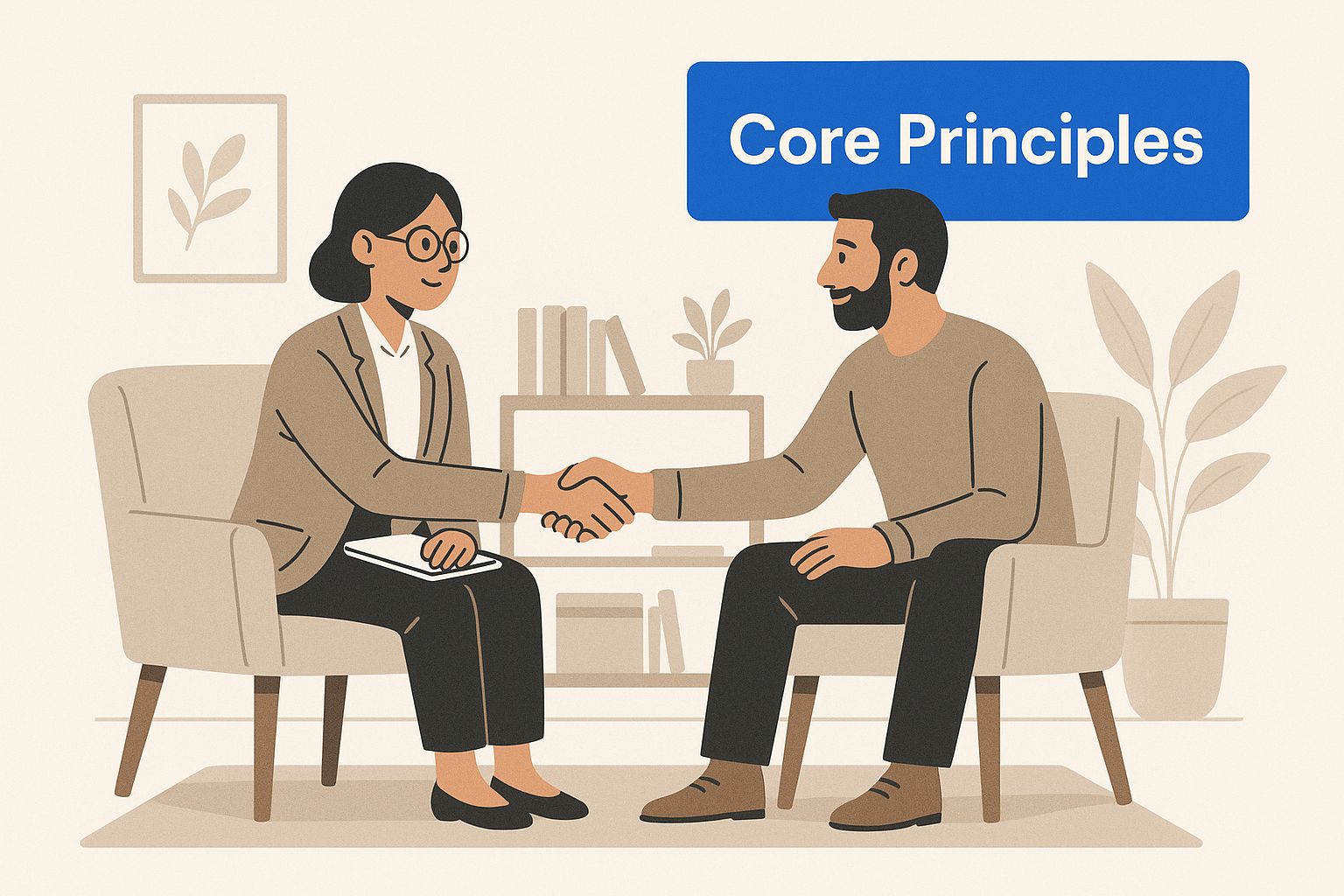
As you can see, these ideas aren't separate pillars but interconnected parts of a whole, reinforcing one another to support the person seeking help.
The PACE Framework Explained
So, what do these principles actually look like when you're sitting across from someone? Let's break down the PACE framework into simple, real-world terms.
-
Partnership: This is about working with someone, not on them. The therapist or counselor isn't the all-knowing expert who has all the answers. Instead, they form a team with the individual, recognizing that the person is the real expert on their own life.
-
Acceptance: You have to honor the person for who they are, right now, without judgment. This means respecting their autonomy and their right to make their own choices—even if you don't agree with them. True acceptance creates a safe space where someone can be honest without fear of being shamed.
-
Compassion: This goes beyond simple empathy. It's an active commitment to prioritizing the other person's well-being. Every question asked and every reflection offered comes from a genuine desire to help, not to advance an agenda or prove a point.
-
Evocation: This is the real magic of MI. The core belief here is that the motivation and reasons for change are already inside the person. The practitioner's job isn't to install motivation from the outside but to skillfully draw it out—to evoke it.
The central idea is simple but profound: you aren't giving someone something they're missing. You're helping them tap into the strength, wisdom, and drive they already have.
By truly living the PACE framework, a practitioner moves from just doing MI to being a motivational interviewer. This is how you build a relationship where people feel seen, respected, and empowered to find their own way forward.
Putting the OARS Skills into Practice
If the four principles are the “spirit” of motivational interviewing, then the core skills are how you actually put that spirit into action. These are the practical, day-to-day tools you’ll use, and they’re easy to remember with the acronym OARS: Open-ended questions, Affirmations, Reflections, and Summaries.
Think of it this way: the principles are your destination, but OARS are the actual tools you use to row the boat. Without them, you’re just drifting. Each one plays a critical role in building trust and helping someone find their own reasons to change.
Open-Ended Questions
First up, Open-ended questions. This is all about inviting someone to tell their story instead of just giving a “yes” or “no” answer. It’s a subtle but powerful shift that completely changes the dynamic of a conversation.
Instead of boxing someone in with a closed question, you open the door for them to explore their own thoughts.
- Rather than asking, "Do you want to change?" try, "What would you like to see change in your life?"
- Instead of, "Was this week hard?" you could ask, "Tell me about some of the challenges you faced this week."
See the difference? You’re not leading them to a specific answer; you’re giving them the space to think out loud and share what’s really on their mind.
Affirmations, Reflections, and Summaries
The other skills in OARS are what really build that sense of partnership and show you're listening.
Affirmations are all about genuinely noticing and acknowledging someone's strengths and efforts. This isn't about empty praise like "good job." It's about being specific. Saying, "It took a lot of courage to come here today," validates their effort in a way that generic encouragement never could.
Reflections are probably the most crucial skill in the entire MI toolkit. This is where you listen intently and then essentially mirror back what you heard, either by rephrasing it or guessing at the underlying meaning. It shows you're paying attention and, more importantly, helps the person hear their own thoughts from a new perspective.
Finally, Summaries are like pulling together several reflections into a coherent whole. By gathering the key points of the conversation, you show you've understood the bigger picture. A well-timed summary can feel like a turning point, wrapping up one part of the discussion and setting the stage for what comes next.
How to Listen for and Encourage Change Talk
The magic moment in any motivational interviewing conversation is when you hear it—the person starts voicing their own reasons for wanting something different. We call this change talk, and learning to recognize it is like finding the golden thread of motivation. Once you find it, you can gently pull on it to help unravel their desire for change.
This isn't just someone vaguely saying, "I should probably do something." Change talk has a specific feel to it. It’s the sound of a person trying on a new reality for size, out loud. Your job is to tune your ears to this specific language and use your OARS skills to draw more of it out.
Spotting Change Talk with DARN-CAT
So, what does this actually sound like? A fantastic tool for this is the DARN-CAT framework. It helps you catch the subtle signals by breaking them down into two phases: the early thoughts and the later, more concrete intentions.
Preparatory Change Talk (DARN): Think of these as the first whispers of change.
- Desire: "I wish I had more energy in the mornings."
- Ability: "I think I could probably start walking once or twice a week."
- Reason: "My doctor said my blood pressure would improve if I made a change."
- Need: "I have to do something, or things are just going to get worse."
When you hear these DARN statements, that's your cue. Use reflections and open-ended questions to explore them. You're helping the person build their own argument for change, without a hint of pressure from you.
The goal is not to convince, but to create a space where the person convinces themselves. By reflecting their desire, ability, reason, and need, you amplify their own motivation.
Mobilizing Change Talk (CAT): This is where the rubber starts to meet the road. Thoughts are becoming intentions.
- Commitment: "I will start packing a healthy lunch for work."
- Activation: "I'm ready to look up local support groups this afternoon."
- Taking Steps: "I went for that walk we talked about yesterday."
Handling Sustain Talk and Resistance
Of course, it’s never that simple. People are ambivalent, so you’ll also hear sustain talk—all the reasons to keep things exactly as they are. You might hear something like, "I know I should change, but I just don't have the time."
The trick here is to avoid the trap of arguing. Don't push back; roll with it. A great response would be something like, "It sounds like your schedule is completely packed, and finding even a minute for yourself feels impossible right now."
This simple act of validation shows you're listening. It takes the pressure off, reduces their need to defend their position, and often, it’s what opens the door to explore the problem from a whole new angle.
Why Motivational Interviewing Actually Works
It's one thing to talk about a counseling method in theory, but it's another to see it work in the real world. Motivational interviewing isn't just a collection of good ideas; it's a practice backed by decades of research proving just how effective it can be.
While it started in addiction counseling, its success has rippled out into chronic disease management, mental health, and even general lifestyle coaching. The results are consistently positive.

So, what’s the secret sauce? It comes down to one simple but powerful concept: resistance. MI is masterful at reducing it. By refusing to argue, confront, or pressure someone, the approach respects their autonomy. This fosters a genuine, internal desire to change—and that’s the kind of motivation that actually sticks.
The Evidence Behind the Approach
Since its development, MI has been put through the wringer in hundreds of controlled clinical trials. The data is clear. Some studies have found that this method can lead to 60% greater success in starting and sticking with a change compared to more traditional counseling styles.
It’s also not an "either/or" approach. MI pairs incredibly well with other therapeutic models, like Cognitive Behavioral Therapy (CBT). Think of it this way: MI helps a person find their "why" for changing, while CBT gives them the "how" by providing practical tools to manage thoughts and behaviors. It’s a powerful one-two punch.
The real magic of MI is that it never forces a decision. Instead, it creates the perfect environment for a person to arrive at their own conclusions, which naturally leads to stronger commitment and more sustainable change.
For many people, this collaborative style is the crucial first step on a much longer path. Getting a clear picture of the stages of the recovery process can show you exactly where MI fits into the bigger picture. By empowering individuals to find their own way forward, motivational interviewing builds a rock-solid foundation for lasting growth.
Bringing It All Together: Your MI Starting Points
Feeling ready to put this all into practice? Let's boil it all down to the essentials. Think of these four core ideas as your foundation for every conversation you have using motivational interviewing.
And remember, MI isn't about convincing someone to change. It’s about building a genuine partnership.
The Four Pillars of Practice
Keep these principles in mind, and you’ll naturally stay grounded in the MI spirit.
-
You're a Guide, Not a Director: See yourself as a collaborator. You’re walking alongside the person, not dragging them to a destination. They are the true expert on their own life; your job is to help them tap into that expertise.
-
Live the PACE Spirit: This is the heart of it all. Every conversation should be infused with Partnership, Aceptance, Compassion, and Evocation. This mindset is what creates a safe, judgment-free space where real change can be considered.
-
Your OARS Keep You Moving: Think of your core skills—Open-ended questions, Affirmations, Reflections, and Summaries—as the tools you use to navigate the conversation. They are how you put the spirit of MI into action.
-
Evoke, Don't Install: Your goal is never to give someone your reasons for changing. It’s to help them find their own. You're drawing out the motivation that's already there, deep down.
The most powerful thing you can do is trust that the person across from you holds the keys to their own transformation. Your role is simply to help them find the right lock.
These foundational ideas are also central to similar supportive roles. You can see how they overlap in our guide on what is recovery coaching.
Frequently Asked Questions (FAQ)
To give you a clearer picture of how motivational interviewing works in practice, let's walk through some of the questions we hear most often.
Who is motivational interviewing for?
While MI got its start helping people with substance use, it has since branched out in some incredible ways. You’ll now find it used by doctors, life coaches, teachers, and even managers in the workplace. If your role involves helping someone find their own path to a positive change, MI has something to offer.
Is motivational interviewing just a nicer way of talking to people?
Not quite. While being kind and supportive is a huge part of the process, MI is much more deliberate than just being friendly. It's a specific, goal-focused style of conversation. A practitioner is actively listening for "change talk" and using specific skills (like OARS) to gently guide the person toward resolving their own internal conflict about making a change.
What if someone seems to have zero motivation?
This is exactly where MI shines. The entire approach is built on the idea that feeling two ways about something—what we call ambivalence—is completely normal. A lack of obvious motivation doesn't mean the desire for change is gone; it just needs to be drawn out. The MI practitioner's job is to explore the person’s world without judgment, helping them find those little sparks of motivation, even if they seem tiny at first.
Does motivational interviewing always work?
There's no magic bullet in therapy, and that includes MI. Its success really hinges on the practitioner’s skill and where the individual is on their personal journey. However, a mountain of evidence shows that it's often far more effective than direct, confrontational approaches, especially for people who are hesitant or resistant to the idea of change.
At StartDrugRehab.com, we're committed to providing clear, practical information to support you on every step of the recovery journey. If you or someone you care about needs help, explore our resources to find the right path forward. Learn more by visiting our official website.