When you're searching for support for families of addicts, you're looking for a lifeline. Addiction doesn't just hijack the person using; it throws the entire family into a state of chaos, fear, and confusion. To get through it, you'll need a mix of emotional support, peer connections, and professional guidance to find your footing again.
This guide is designed to show you exactly where to find those resources and how to make them work for you and your family.
Key Takeaways
- You Are Not Alone: Addiction is a family disease affecting millions. Connecting with peer support groups like Al-Anon or Nar-Anon can provide a vital sense of community and understanding.
- Boundaries Are an Act of Love: Learning to stop enabling behaviors and set firm, healthy boundaries is crucial. This protects your well-being and encourages your loved one to take responsibility.
- Professional Help is a Strength: Family therapy, individual counseling, and interventions are powerful tools for healing communication and guiding everyone toward recovery. Seeking expert help is a proactive step.
- Prioritize Your Own Well-Being: You cannot pour from an empty cup. Taking care of your own mental and emotional health is not selfish; it's a necessary foundation for providing sustainable support to others.
Why Addiction Is a Family Disease
Think of addiction like a stone tossed into a calm pond. The person struggling is the initial splash, but the ripples extend to every edge of the water—affecting parents, partners, children, and siblings. The constant worry, broken promises, and unpredictable behavior wear everyone down, completely changing how a family functions.
That’s why so many experts call addiction a "family disease." It's not about blame; it's about acknowledging that everyone is impacted and that healing has to involve the whole family, not just one person.
The scale of this problem is staggering. In 2023, nearly 19 million children in the U.S. were living with at least one parent or caregiver struggling with a substance use disorder. That's roughly 1 in 4 kids growing up in a home shadowed by addiction. You can dig deeper into these statistics on the NIH website.
Understanding the Ripple Effect
Living with the daily strain of addiction forces families into survival mode, often leading to unhealthy coping patterns. You might find yourself making excuses for your loved one's behavior (enabling) or maybe you've emotionally shut down just to get through the day. These reactions are normal, but they build walls of secrecy and anxiety that make honest conversations feel impossible.
Addiction creates a ripple effect, where the initial splash of substance use sends waves of emotional turmoil, financial strain, and broken trust across the entire family system. Healing begins when the family learns to navigate these waves together.
To get started, it helps to understand the different kinds of help available. This table gives a quick overview of the main support pillars we'll be covering.
Types of Support Available for Families of Addicts
| Support Category | What It Is | Who It Helps |
|---|---|---|
| Emotional Support | Personal counseling or therapy focused on your individual mental health. | Family members who need a private space to process their own trauma, grief, and stress. |
| Peer Support | Group meetings with others who share your experience. | Anyone feeling isolated and wanting to connect with people who truly "get it." |
| Professional Support | Structured programs led by addiction specialists, like family therapy or educational workshops. | Families who need expert guidance to improve communication, set boundaries, and support recovery. |
| Financial Support | Resources that help manage the costs of treatment and the financial strain caused by addiction. | Families struggling with the economic burden of addiction and recovery. |
Each of these pillars plays a crucial role in building a strong foundation for recovery—for your loved one and for the entire family.
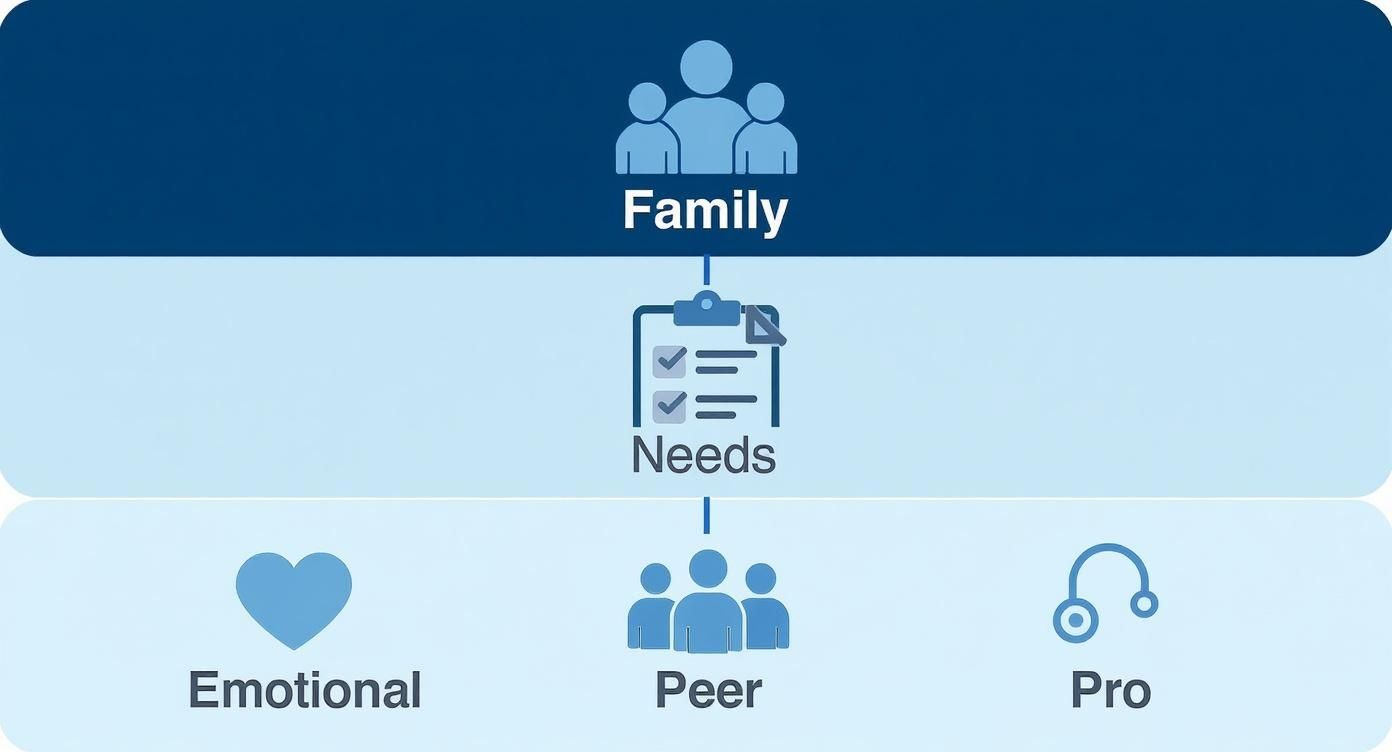
As the visual above shows, you don't have to pick just one. The most powerful approach combines all three: tending to your own emotional health, finding strength in shared experiences, and learning practical strategies from professionals. This is how you start to build a support system that can truly weather the storm.
Finding Strength Through Peer Support Groups

Loving someone with an addiction can be one of the most isolating experiences a person can go through. You might feel like you're running a marathon you never signed up for, and you're doing it completely alone. Peer support groups change that. They introduce you to a team of people who are running the exact same race.
This is a unique kind of support for families of addicts because it connects you with people who just get it. They don't need a lengthy explanation to understand your fears and frustrations. Sharing your story in a room full of empathetic listeners helps dismantle the shame and secrecy that addiction thrives on. It’s a space where you can finally be honest without fear of judgment.
Instead of feeling lost in the dark, you find a community that offers practical advice, emotional validation, and unwavering encouragement. That shared experience is an incredibly powerful tool for healing, reminding you that you are not, and have never been, alone on this journey.
What to Expect in Your First Meeting
Walking into your first meeting can feel intimidating. I get it. But knowing what to expect can ease some of that anxiety. Most peer support meetings follow a simple, welcoming format designed to make everyone feel safe. And here’s the most important part: you don't have to speak. You can just listen until you feel comfortable.
Meetings usually start with a welcome and a reading of the group’s principles, which almost always emphasize confidentiality and mutual respect. The real heart of the meeting, though, is when members share their personal experiences—their challenges, their breakthroughs, their moments of despair and hope. This is where the magic happens. Hearing your own secret fears echoed in someone else's story is one of the most validating feelings in the world.
"The first time I went to a Nar-Anon meeting, I just listened. Hearing another mother describe the same sleepless nights and constant worry I was experiencing made me realize I had finally found a place where I belonged. It was the first time in years I didn't feel completely alone."
Finding the Right Group for You
There are several incredible, long-standing organizations dedicated to supporting families and friends of those struggling with addiction. Each has a slightly different philosophy, so you might want to explore a few to see which one feels like the right fit for you.
Here are some of the most common options:
- Al-Anon/Alateen: This is the original group, primarily focused on families and friends affected by someone's alcoholism. Al-Anon is for adults, while Alateen provides a safe, supportive space for teenagers dealing with a loved one's drinking.
- Nar-Anon: Built on a similar 12-step model as Al-Anon, this group is specifically for those affected by another person's drug addiction.
- SMART Recovery Family & Friends: If you're looking for a more science-based approach, this is it. It uses tools from Cognitive Behavioral Therapy (CBT) to help you manage your own emotional responses and build healthier coping strategies.
- Parents of Addicted Loved Ones (PAL): This is a Christian-run organization offering meetings that provide education and support specifically for parents, helping them find healthy ways forward.
Most of these groups offer both in-person and online meetings, making support accessible no matter where you live. Finding a local chapter is usually as simple as checking the organization's website and using their meeting locator.
Overcoming Hesitation and Getting Started
It’s completely normal to feel hesitant about attending your first meeting. You might worry about privacy, feel anxious about opening up, or wonder if it will even help. Remember, these groups are built on a foundation of anonymity and non-judgment. They exist because someone just like you needed a safe place to land.
To make that first step a little easier, try these simple tips:
- Start Online: If an in-person meeting feels like too much, join a virtual session from the comfort of your own home. It’s a great way to get a feel for the format without the pressure.
- Bring a Friend: You don’t have to do it alone. Ask a trusted friend or another family member to go with you for moral support.
- Keep it Simple: You don't need a prepared speech. Simply saying, "Hi, my name is [Your Name], and I'm here because my [son, daughter, partner] is struggling," is more than enough.
The goal isn't to solve everything in one night. The goal is just to show up. By taking that single step, you are choosing to prioritize your own well-being, which is one of the most powerful things you can do for yourself and everyone you love.
Navigating Professional Help for Families
While connecting with peers is a powerful and necessary step, some situations are just too complex to navigate on your own. When the family dynamic is frayed and communication has broken down, it’s often time to bring in a professional. This isn't a sign that you've failed; it's a sign that you're taking the situation seriously.
Bringing in an expert provides a structured, guided path forward. They act as an objective third party who can help untangle the complicated knots of resentment, codependency, and pain that addiction often weaves into a family. Think of it as an act of strength—a commitment to healing for everyone involved.
The scale of the problem is staggering. The World Health Organization attributes over 3 million deaths worldwide each year to the harmful use of drugs and alcohol. Here in the U.S., an estimated 48.5 million people had a substance use disorder in 2023. These aren't just numbers; they represent families just like yours. You can explore more addiction statistics on TherapyRoute.
Understanding Different Types of Professional Support
Once you start looking, you'll realize "professional help" isn't a one-size-fits-all solution. There are a few key approaches, each designed to address different aspects of the family crisis. Knowing the difference will help you find the right fit for your situation.
- Family Therapy: This is where the whole family, or at least several members, meet together with a therapist. The goal isn't to point fingers or place blame. Instead, it’s about rebuilding communication, learning healthier ways to interact, and creating a supportive environment for recovery.
- Individual Counseling: Sometimes, the weight is just too much to carry. Individual therapy gives you a private, confidential space to unpack your own trauma, grief, and anxiety. Taking care of your own mental health is one of the most important things you can do to support your loved one.
- Interventions: When your loved one is in deep denial and won’t accept help, a professional intervention can be a game-changer. A trained interventionist guides the family through a structured, compassionate conversation designed to break through the denial and motivate the person to finally enter treatment.
How to Find a Qualified Professional
Knowing you need help is one thing; actually finding it can feel overwhelming. Where do you even begin? The key is to take it one step at a time. Your goal isn’t to find the "perfect" therapist overnight but to find a qualified person your family can connect with.
Here’s a simple checklist to get you started:
- Start with Trusted Directories: Begin your search with a reliable national resource like the SAMHSA National Helpline. You can call them at 1-800-662-HELP for free, confidential referrals to local therapists, treatment centers, and support groups.
- Verify Credentials: Not all therapists specialize in addiction. Look for specific licenses like LMFT (Licensed Marriage and Family Therapist), LCSW (Licensed Clinical Social Worker), or CADC (Certified Alcohol and Drug Counselor). This ensures they have the right training.
- Prepare Your Questions: Before you make that first call, jot down a few questions. Ask about their specific experience with families and addiction, their general approach to therapy, and practical details like cost and insurance.
Seeking therapy is like hiring a skilled guide to help you navigate a treacherous mountain pass. You wouldn't attempt it alone without a map or expertise; a therapist provides the map, the tools, and the experience to help your family reach the other side safely.
Overcoming Barriers to Getting Help
Two of the biggest roadblocks that stop families from getting help are cost and stigma. It’s completely normal to worry about affordability or to feel a sense of shame about needing outside support. But these are obstacles you can overcome.
To address costs, many therapists offer sliding-scale fees based on income. You can also look into community mental health centers or university training clinics, which often provide excellent, low-cost counseling.
As for the stigma, try to reframe the situation. This isn't about admitting defeat; it's about making a proactive investment in the health and future of your entire family. The rise of telehealth has also made therapy more discreet and accessible than ever before. Taking that first step is often the hardest part, but it's a vital one.
Setting Boundaries and Avoiding Enabling Behaviors
When you love someone with an addiction, walking the line between helping and enabling can feel like navigating a minefield. It’s a confusing, emotionally draining place where your best intentions might actually be making things worse. A huge part of finding effective support for families of addicts is learning this new, and often counterintuitive, way of showing you care.
This is where boundaries come into play. Think of them not as punishments, but as clear, protective lines you draw to safeguard your own well-being. Ultimately, they also encourage your loved one to finally take responsibility for their own life. Setting a boundary is an act of profound love—for yourself and for the person struggling.
Enabling, in contrast, is like putting a cushion under them every time they fall. It feels like helping in the moment, but it robs them of the chance to feel the real-world consequences of their actions, which is often the very thing that motivates change. Getting this distinction right is a massive turning point for any family on the healing journey.
From Enabling to Empowering
The first real step is learning to spot the difference between genuine help and harmful enabling. Enabling behaviors usually spring from a place of fear, guilt, or just a desperate need to keep the peace. But they end up feeding a cycle that makes it much easier for the addiction to thrive.
Recognizing these patterns in your own actions isn't about blaming yourself. It's about becoming aware so you can make a different, more effective choice next time.
Here are a few classic examples of enabling:
- Making excuses: Calling their boss to say they have the flu when they’re actually hungover or high.
- Financial bailouts: Covering their rent, car payment, or legal fees that piled up because of their substance use.
- Minimizing the problem: Acting like the issue isn't as bad as it is, just to sidestep a fight or avoid feeling embarrassed.
- Taking over their life: Doing their laundry, cleaning up their messes, or managing their appointments for them.
Making the shift away from these habits is incredibly tough, I know. But it's absolutely necessary. It moves your family's focus from just managing one crisis after another to building a foundation for long-term, sustainable recovery.
How to Create Healthy Boundaries
Setting a boundary isn’t about delivering an angry ultimatum. It’s about calmly, lovingly, and consistently communicating your limits. The best boundaries are specific, actionable, and tied to a consequence that you have full control over.
It helps to think of it as creating an "if-this, then-that" plan for how you'll interact. This approach takes the emotional guesswork out of the equation and gives everyone a clear, predictable structure to work with.
A boundary isn't a wall to shut people out. It's a guidepost that shows them how to stay in a healthy relationship with you while pushing them to find their own path forward. It’s where your responsibility ends and theirs begins.
Here are some practical examples of what healthy boundaries can look like:
- Financial Boundaries: "I love you, and I will always support your recovery. From now on, I will no longer give you cash or pay your bills. I am more than happy to pay a treatment center or a therapist directly on your behalf."
- Behavioral Boundaries: "You are always welcome in my home, but if you are high or drunk, I will have to ask you to leave. We can try again when you are sober."
- Logistical Boundaries: "I can give you a ride to a 12-step meeting or a job interview, but I won't drive you to go buy drugs or alcohol."
Notice how these statements are clear, firm, and non-negotiable.
Let's be honest: saying "no" is one of the hardest things for a parent, spouse, or child to do. You’ll probably be met with anger, manipulation, or guilt trips. This is precisely why having your own support system—like the peer groups and therapists we’ve been talking about—is so vital. They will be the ones to remind you that holding your boundary is an act of strength, not cruelty.
Managing Financial and Legal Challenges

The fallout from addiction rarely stays contained; it almost always spills over into a family's finances and can create a tangled mess of legal problems. One person's substance use can drain savings, rack up debt, and lead to serious legal trouble before you even realize what's happening. Learning to manage these practical crises is one of the most important forms of support for families of addicts.
Let's be clear: getting your family’s finances in order and preparing for legal issues isn’t about distrust. It’s about survival. You’re building a financial firewall to protect your family's future and create a stable foundation from which your loved one can launch a real recovery.
The financial strain is staggering, especially when you realize how few people get the help they need. In 2021, a shocking 6.3% of people in the U.S. with a substance use disorder got any treatment at all. This leaves millions of families trying to pick up the pieces on their own. You can see more on this treatment gap at DrugAbuseStatistics.org.
Navigating Insurance for Treatment Coverage
Your health insurance policy is usually the first place to turn. Many families don't know that laws like the Mental Health Parity and Addiction Equity Act mean most health plans have to cover addiction treatment just like they would surgery or a hospital stay. But knowing your rights and actually getting the company to pay can feel like two different worlds.
Your best first step is to call the number on the back of the insurance card. Ask to speak with a behavioral health case manager. They are the specialists who can cut through the jargon, explain your benefits, help you find treatment centers that are in-network, and walk you through getting pre-authorization.
A word of hard-won advice: Don’t take the first "no" for an answer. Insurance companies often deny claims initially. You have the right to appeal. Keep a log of every single call—date, time, who you spoke with, and what they said. This paper trail is your best weapon if you need to fight their decision.
Creating a Financial Stability Plan
Addiction is a financial black hole. Between the cost of treatment, lost wages, and other unexpected expenses, money disappears fast. You need an emergency family budget to regain some control. This isn't about cutting off your loved one financially; it's about protecting the family unit so you can continue to be a source of healthy support.
Here’s where to start:
- Assess the Damage: You have to know what you’re up against. Make a list of all debts, drained accounts, and new bills related to the addiction.
- Separate Finances: If you have joint bank accounts, it may be time to separate them. This is a tough but necessary step to protect your own income and savings.
- Prioritize the Essentials: Make sure the mortgage, rent, utilities, and groceries are paid first. The core of your household must remain secure.
- Look for Low-Cost Help: Check out community mental health centers, which often offer counseling on a sliding scale based on income. You can also dive deeper into insurance coverage for rehab in our detailed guide.
When to Seek Legal Advice
If addiction leads to legal problems—like a DUI, theft, or other arrest—you need to act fast. Trying to navigate the court system alone can have devastating, long-term consequences that stand in the way of recovery and a stable future.
This doesn't always mean hiring an expensive lawyer right away. Most communities have free legal aid clinics, and local bar associations often have pro bono (free) services. An initial consultation can help you understand the situation and your options. Getting sound legal advice early on can make all the difference in protecting your loved one's future.
Frequently Asked Questions (FAQ)
What is the first step I should take to get help for my family?
The very first step is acknowledging that you cannot handle this alone and reaching out for support for yourself. Find a local or online Al-Anon, Nar-Anon, or SMART Recovery Family & Friends meeting. Prioritizing your own support system gives you the strength and clarity needed to address your loved one's addiction effectively.
How do I talk to my loved one about their addiction without causing a fight?
Approach the conversation from a place of love and concern, not blame. Use "I" statements to express how their behavior affects you (e.g., "I feel scared when I see you…"). Choose a calm, private moment when they are sober, and focus on your desire to see them healthy and safe. Avoid ultimatums unless you are fully prepared to follow through.
What’s the difference between helping and enabling?
Helping promotes recovery and responsibility, while enabling protects the person from the consequences of their actions, allowing the addiction to continue. Helping might look like driving them to a therapy appointment or paying a treatment center directly. Enabling is making excuses for their behavior, giving them cash you suspect will be used for substances, or bailing them out of trouble repeatedly.
Can I force my loved one into rehab?
In most states, you cannot force an adult into treatment against their will unless they are a clear danger to themselves or others, which may allow for an involuntary commitment through the court system. A more constructive approach is often a professionally-led intervention, which creates a structured opportunity for the family to express their concerns and motivate their loved one to accept help voluntarily.
At StartDrugRehab.com, we guide you through every twist and turn of this journey. From evidence-backed advice to trusted treatment referrals, we’re here to help your family build a recovery plan that truly works. Visit us to get started.