When someone asks, "How long does drug detox take?" the most honest answer is: it's different for everyone. It’s less of a fixed schedule and more of a personal recovery process. While the most intense physical part of withdrawal usually lasts about 7-10 days, that's really just the starting line.
Key Takeaways
- Detox Timelines Vary Widely: The duration of detox is not one-size-fits-all. It's influenced by the type of substance, length of use, and individual health factors. Acute withdrawal typically lasts from 5 days to several weeks.
- Medical Supervision is Crucial: For substances like alcohol and benzodiazepines, detoxing without medical supervision can be life-threatening. A professional medical detox ensures safety, manages severe symptoms, and increases comfort.
- Detox is the First Step, Not a Cure: Detoxification addresses the body's physical dependence on a drug. It is the essential first phase but does not treat the underlying psychological aspects of addiction.
- Aftercare is Essential for Long-Term Sobriety: Continuing with treatment like inpatient or outpatient rehab after detox is critical. Studies show that aftercare significantly increases the chances of maintaining long-term recovery and preventing relapse.
What to Expect from Your Drug Detox Timeline
Detox is the body’s natural process of getting a substance out of its system, but your personal timeline is a unique blueprint. It’s shaped by a whole host of individual factors, making the experience different from one person to the next. This first phase of recovery is absolutely critical, but it's important to see it for what it is—the first step, not the whole journey.
The time it takes to detox depends heavily on the specific drug, how it was used, and your own health. For instance, substances like opioids and cocaine are often out of the body in about 1 to 3 days. On the other hand, things like benzodiazepines and meth can stick around longer, closer to 1 to 7 days. Some substances, including certain antidepressants or barbiturates, can even be detected for up to three weeks. You can get more specific insights into these timelines from the experts at Socal Sunrise Recovery Center.

Setting Realistic Expectations
Having a general idea of your potential timeline can make a world of difference. It helps you set realistic expectations and can quiet some of the anxiety you might feel about the whole process.
When people talk about "detox," they're usually referring to the acute withdrawal phase—that's when the physical symptoms are at their peak.
Detox is the essential first step that addresses the body's physical dependence on a substance. It paves the way for deeper psychological healing, but it does not "cure" addiction on its own.
To give you a clearer picture, let's break down what you can generally expect during this most intense phase of detox for different substances.
Average Acute Detox Timelines by Substance
Here's a summary of the typical duration for the acute withdrawal phase for some commonly used substances. Remember, these are just averages—your personal timeline can and will vary based on your own unique situation.
| Substance Type | Typical Acute Detox Duration | Peak Withdrawal Period |
|---|---|---|
| Alcohol | 5-7 Days | 24-72 Hours |
| Opioids | 7-10 Days | 72 Hours |
| Benzodiazepines | 2-4 Weeks (or longer) | Around Week 2 |
| Stimulants | 5-7 Days | 24-72 Hours |
As you can see, the timelines really do differ. This is why a one-size-fits-all approach to detox simply doesn't work.
The Three Essential Phases of Medical Detox
When you're facing detox, the whole process can feel like a huge, intimidating unknown. But it’s not a chaotic free-for-all; it's a carefully managed medical procedure designed to get you safely from one point to another. The question "how long does drug detox take?" really comes down to understanding what happens at each step.
Think of it less like a sprint and more like a guided expedition through challenging terrain. Your clinical team has a map, and the journey is broken down into three distinct phases to ensure you navigate withdrawal safely and are prepared for the road ahead.

Phase 1: Evaluation
Your detox journey begins the moment you walk through the door with a thorough evaluation. This first step is all about creating a personalized game plan. It’s not just a quick chat and a form to fill out; it's an in-depth assessment where the medical team gets to know you, your history, and your specific needs.
During this phase, the team will:
- Check Your Physical Health: They'll run blood tests and other screenings to get a clear picture of your overall health and see how substance use has impacted your body.
- Explore Your Mental Health: Clinicians will also screen for co-occurring conditions like anxiety, depression, or PTSD, which often go hand-in-hand with substance use and can affect your detox experience.
- Map Your Substance Use: You'll discuss which substances you've been using, for how long, and at what doses. This information is crucial for anticipating the type and severity of withdrawal symptoms.
This isn't about judgment. It's about gathering all the necessary information to create a detox plan that is built specifically for you, prioritizing your safety and comfort above all else.
Phase 2: Stabilization
This is the phase people usually think of when they hear "detox." It's the core of the process, where your body works to clear the substance from your system, and the medical team works to keep you stable and as comfortable as possible. This is where the real work of managing withdrawal symptoms happens.
The stabilization phase is when the timeline can vary the most, depending entirely on the substance you’re detoxing from and your unique physiology. Medical staff are on hand around the clock to monitor you. If withdrawal becomes too intense or poses a risk, they can provide medications to ease symptoms, manage cravings, and prevent serious complications. This is often a component of what is medication assisted treatment, a proven approach to making withdrawal safer and more manageable.
The goal here isn't to just "white-knuckle" it. Stabilization is about using proven medical and emotional support to help your body rebalance while keeping you safe, secure, and focused on recovery.
Phase 3: Transition
Getting through withdrawal is a massive accomplishment, but it’s just the first step. Detox takes care of the physical dependency, but the underlying reasons for the addiction are still there. The final phase, transition, is all about getting you ready for what comes next.
Here, the focus shifts from physical stabilization to long-term planning. Your treatment team will sit down with you to discuss ongoing care options that fit your life, whether that’s an inpatient rehab program, outpatient therapy, or support groups. The idea is to build a solid bridge from the safety of detox to a sustainable, long-term recovery. This phase ensures you leave not just sober, but with a clear plan and the right tools to keep moving forward.
Key Factors That Influence Your Detox Timeline
Ever wonder why detox takes five days for one person and two weeks for someone else, even if they used the same drug? There’s no simple answer or magic number for "how long does drug detox take," because the timeline is as individual as you are. It’s a lot like recovering from a serious illness—everyone’s body heals at its own pace, and a handful of personal factors shape that journey.
A one-size-fits-all schedule just isn't a reality in recovery. Getting a handle on what influences your personal timeline helps set realistic expectations, which makes the whole process feel more manageable. Instead of staring at a generic calendar, it’s far more productive to understand the building blocks of your own detox blueprint.
The Substance and Your History With It
The biggest piece of the puzzle is, without a doubt, the substance itself. Different drugs interact with the body in profoundly different ways. A key concept here is half-life, which is simply the time it takes for your system to clear out half of the substance.
-
Type of Substance: Think about the difference between heroin and Valium. A short-acting opioid like heroin often brings on a fast and furious withdrawal, while a long-acting benzodiazepine like Valium can lead to a withdrawal that lingers for weeks, sometimes even months.
-
How Long and How Much: It stands to reason that someone who has used a substance heavily for years is going to have a longer, more difficult detox than a person with a much shorter history. When your body has been physically dependent for a long time, it needs more time to find its equilibrium again.
-
Using Multiple Substances: When more than one substance is involved, the detox process gets a lot more complicated. Withdrawal symptoms can become unpredictable, and it almost always requires a longer period of close medical supervision to navigate safely.
Detox is not a race. Your body is healing from a significant strain, and giving it the time it needs—based on your specific history—is the foundation of a safe and successful recovery.
Your Individual Health Profile
Putting the substance aside for a moment, your unique physical and mental health are huge factors in how your detox unfolds. You could have two people with the exact same substance use history, but their timelines could look completely different because of their personal health.
Your own biology really dictates how your body not only processes substances but also how it copes with the stress of withdrawal.
-
Age and Metabolism: A younger person with a naturally faster metabolism might clear toxins out of their system more quickly than an older individual. This can sometimes shorten that initial, acute phase of detox.
-
Overall Physical Health: Any underlying medical issues, especially those affecting the liver, kidneys, or heart, can slow things down. These organs are your body's filtration system, and if they're not working at 100%, the detox process can take longer. Being in good physical shape can give you a stronger foundation to work from.
-
Co-Occurring Mental Health Conditions: If you’re also dealing with anxiety, depression, or PTSD, the psychological side of withdrawal can feel much more intense. Mood swings, agitation, and deep sadness can be amplified. It's crucial to address these conditions at the same time as the detox, which can naturally influence the overall duration.
Withdrawal Timelines for Common Drug Categories
The one question on everyone’s mind is, "How long is this going to take?" There's no single, simple answer. The detox timeline shifts dramatically based on the substance you’re dealing with.
While your personal health and history are huge factors, each category of drugs follows a generally predictable pattern of withdrawal. Knowing what to expect can take some of the fear out of the process and highlight why having a medical team on your side is so important.
This infographic breaks down how your drug use history, the substance itself, and your overall health all come together to shape your detox journey.
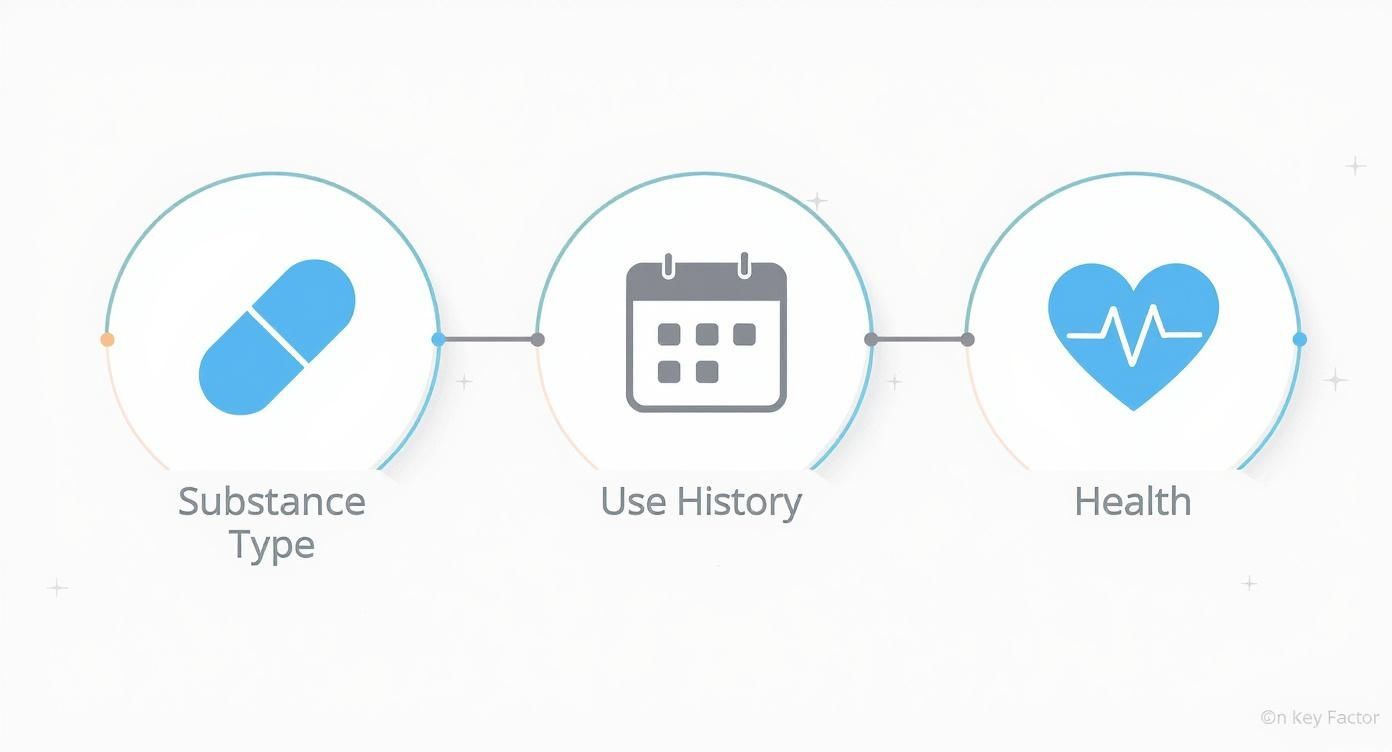
As you can see, these pieces create a unique puzzle for every person. That's why a one-size-fits-all approach just doesn't work.
Opioids (Heroin and Fentanyl)
With short-acting opioids like heroin, withdrawal kicks in fast—often within just 6 to 12 hours of the last dose. Things tend to get most intense around day three, when you're hit with severe muscle aches, nausea, and powerful cravings.
While it’s not typically life-threatening, the discomfort is so extreme that the risk of giving up and using again is incredibly high without professional support.
Stimulants (Cocaine and Meth)
Detoxing from stimulants is less of a physical fight and more of a psychological war. The initial "crash" can happen within hours, bringing on a tidal wave of exhaustion, depression, and irritability.
The worst of the physical feelings usually fade within a week, but the mental and emotional fallout—like intense cravings and unpredictable mood swings—can stick around for much longer. This is where ongoing support becomes crucial.
Alcohol and Benzodiazepines
We group these two together for one very important reason: stopping them on your own can be deadly. Quitting cold turkey can trigger severe, life-threatening complications, including seizures and hallucinations. For alcohol withdrawal, there's the added risk of a terrifying condition called delirium tremens (DTs).
For alcohol and benzodiazepines, medically supervised detox isn't just a good idea—it's a non-negotiable for your safety. The risk of seizures and other severe neurological events is far too great to handle alone.
Detoxification isn't a niche problem; it's a global health issue. Studies show that among adults who engage in heavy episodic drinking, about 18.4% experience withdrawal symptoms. When left untreated, alcohol withdrawal can progress to delirium tremens, which has a mortality rate as high as 5%.
The experience of what are withdrawal symptoms can be overwhelming and frightening, which is precisely why a safe, medically monitored environment is the standard of care.
Withdrawal Symptom Progression
The journey through withdrawal looks different for each substance. This table offers a general timeline of what you might expect as symptoms progress from their initial onset to their peak and beyond.
| Substance | Initial Symptoms (First 24-48 hours) | Peak Symptoms (Days 3-5) | Lingering Symptoms (Week 2+) |
|---|---|---|---|
| Opioids | Anxiety, muscle aches, sweating, insomnia, runny nose. | Intense body aches, nausea, vomiting, diarrhea, goosebumps. | Cravings, depression, sleep disturbances, fatigue. |
| Stimulants | "Crash" with deep depression, extreme fatigue, increased appetite. | Agitation, paranoia, intense cravings, vivid dreams. | Lingering depression, anxiety, mood swings, ongoing cravings. |
| Alcohol | Anxiety, tremors, nausea, headaches, insomnia. | Hallucinations, high blood pressure, seizures, fever. | Protracted Withdrawal (PAWS), anxiety, sleep issues. |
| Benzos | Rebound anxiety, insomnia, irritability, sweating. | Seizures, panic attacks, tremors, perceptual distortions. | Severe anxiety, cognitive deficits, depression, cravings. |
Keep in mind, these timelines are just a guide. For alcohol, symptoms can appear within six hours and peak within 72 hours. With long-acting benzodiazepines like Valium, withdrawal might not even start for a few days but can stretch on for weeks, requiring a slow, carefully managed taper. This expert medical oversight is the key to getting through detox safely and building a solid foundation for recovery.
Why Detox Is Only the First Step in Recovery
Making it through detox is a massive accomplishment, a real turning point. But it’s easy to think that once the physical storm has passed, the fight is over. That’s a common and dangerous misunderstanding.
The truth is, detox is just the first, crucial step. It addresses the body's physical dependence, but it doesn't touch the psychological roots of addiction.
Think of it like this: detox is the emergency response. It's the paramedic stabilizing a patient after a serious accident. They've stopped the bleeding and addressed the immediate, life-threatening crisis. But the patient still has a deep wound that needs stitches, physical therapy, and a long-term care plan to truly heal and prevent reinjury.
Detox gets the substance out of your system. True recovery is about healing the mind, addressing the triggers, and learning to live without it. That's the real work, and it happens after the physical withdrawal is over.
Dependence vs. Addiction: What's the Difference?
It’s important to understand what detox actually does. It breaks physical dependence—that's when your body has become so used to a substance that it goes into shock (withdrawal) without it. Detox manages this process safely.
But psychological addiction is a whole different beast. Addiction is about the compulsive behaviors, the deep-seated emotional triggers, and the mental cravings that drove you to use in the first place.
Getting the drug out of your body doesn't magically erase the reasons you started using. That’s why comprehensive treatment after detox is non-negotiable for lasting success.
Why Aftercare Is Everything
The numbers don't lie: detox by itself rarely leads to long-term sobriety. The risk of relapse for people who stop after detox is sky-high.
One powerful study highlighted this gap. It found that people who completed detox but had no formal aftercare plan had a grim 6% abstinence rate nine months later.
But look at the difference for those who continued with treatment. Success rates shot up to 50% for those in outpatient programs and 67% for those in inpatient care. You can dig into the data yourself in this study on long-term recovery outcomes published by Frontiers in Psychiatry.
Moving from detox straight into a structured treatment program gives you the tools to manage cravings, work through co-occurring mental health issues like anxiety or depression, and build a solid support system. This is what transforms a successful detox into a sustainable recovery. Without that follow-through, you’re left facing the psychological side of addiction alone and unprepared.
Your Path to a Successful Detox and Recovery
Trying to figure out "how long does drug detox take?" can feel like navigating a maze without a map. But getting clear on what to expect is the first step toward getting your life back. While everyone's journey is different, a few fundamental truths can help guide you toward a safe, successful recovery.
Think of these points as your compass for the road ahead. Recovery is a long-term commitment built on the foundation laid during detox and early treatment. True change happens when you address the behaviors and triggers that underlie substance use. Lasting sobriety is built day by day, through continued care long after detox is over. Finding the right program to support you is the single most important decision you can make. When you're ready to take that step, you can find help locating the best detox centers near me and truly begin your path forward.
Frequently Asked Questions About Drug Detox
Stepping into recovery is a huge decision, and it’s completely normal to have a lot of questions. Getting clear, straightforward answers can make all the difference, helping you feel more confident and less anxious about what lies ahead. Let's tackle some of the most common things people ask.
Is it dangerous to detox from drugs at home?
For certain substances, yes, it is extremely dangerous. Detoxing from alcohol or benzodiazepines (like Xanax and Valium) without medical supervision can lead to life-threatening complications like seizures, hallucinations, or delirium tremens. A medically supervised detox provides 24/7 monitoring to manage these risks and keep you safe.
What medications are used during detox?
Medications are used to make the detox process safer and more comfortable by easing withdrawal symptoms and cravings. This is often called medication-assisted treatment (MAT). The specific medication depends on the substance; for example, buprenorphine may be used for opioid withdrawal, while benzodiazepines are standard for alcohol withdrawal to prevent seizures. Other comfort medications can also be provided for symptoms like nausea or insomnia.
What is the difference between detox and rehab?
Detox and rehab are two distinct and essential stages of recovery.
- Detox is the first, short-term phase (usually 5-10 days) focused on safely managing physical withdrawal symptoms and getting the substance out of your body.
- Rehab is the longer-term phase that follows detox. It addresses the psychological aspects of addiction through therapy, counseling, and skill-building to help you maintain sobriety. Detox stabilizes the body, while rehab heals the mind.
Will my insurance cover drug detox?
In most cases, yes. The Mental Health Parity and Addiction Equity Act (MHPAEA) requires most health insurance plans to cover substance use disorder treatment just as they would any other medical condition. However, the extent of coverage varies by plan. It is crucial to contact your insurance provider directly to understand your specific benefits, what facilities are in-network, and any out-of-pocket costs.
At StartDrugRehab.com, our goal is to give you the resources you need to find your way forward. We help people and their families connect with treatment centers they can trust and provide clear guidance for every part of the recovery process. Visit us to see what your options are and start building a foundation for a new life. Find help with StartDrugRehab.com