A relapse prevention plan is more than just a document; it's a personalized guide you create to navigate the realities of recovery. Think of it as your own strategic roadmap, designed to help you spot potential trouble, build effective coping skills, and lean on your support system to keep your sobriety on solid ground. It shifts you from simply reacting to crises to proactively managing your long-term well-being.
This isn't about setting rigid rules. It’s about cultivating deep self-awareness and building the resilience you need for the journey ahead.
Key Takeaways
- Proactive vs. Reactive: A relapse prevention plan shifts your recovery from a reactive stance (dealing with crises as they happen) to a proactive one (preparing for challenges before they arise).
- Deeply Personal: An effective plan must be tailored to your unique triggers, warning signs, and coping mechanisms. Generic templates are a starting point, not a final solution.
- A Living Document: Your plan is not a one-and-done task. It must be reviewed and updated regularly, especially after major life changes or close calls, to remain relevant and effective.
- Support is a Strategy: Your support network is a critical, active component of your plan. Share your plan with key individuals (sponsor, therapist, trusted friend) so they can provide informed support.
Why a Relapse Prevention Plan Is Your Most Powerful Tool

Making the commitment to recovery is a monumental step, but the real work lies in maintaining it day after day. That's where a relapse prevention plan becomes indispensable. It helps you view addiction for what it is: a chronic condition that, like diabetes or hypertension, requires ongoing management. A relapse isn't a moral failure—it's a manageable part of the process.
By taking the time to outline your personal strategy, you put yourself firmly in the driver's seat of your recovery. You’re no longer just reacting to difficult situations; you’re equipped with the foresight and tools to navigate them confidently before they have a chance to escalate.
Understanding the Reality of Relapse
Let's be real for a moment. Statistics show that relapse is a very common part of the recovery process, which is precisely why a solid plan is so crucial. The relapse rates for addiction often hover between 40-60%, which is surprisingly similar to the rates for other chronic health conditions. In fact, some studies show that nearly 50% of individuals may relapse within the first three months after leaving an intensive treatment program.
These numbers aren't here to scare you—they're here to empower you. They underscore the fact that addiction is a persistent disease that needs a long-term management strategy. A well-crafted relapse prevention plan is a core part of that strategy.
Shifting From Reactive to Proactive Sobriety
Trying to navigate recovery without a plan means you're often caught off guard, reacting to triggers and cravings as they hit. It’s exhausting and can quickly become overwhelming. A relapse prevention plan template lets you get out in front of these challenges by preparing for them ahead of time.
It forces you to sit down and get specific about:
- Your Personal Triggers: Who are the people, what are the places, and which emotions put your sobriety on shaky ground?
- Your Early Warning Signs: What are those subtle changes in your thinking, mood, or behavior that signal you might be slipping?
- Your Coping Mechanisms: What healthy, positive things can you do when you feel stressed, bored, or anxious?
- Your Support System: Who are the people you can call at a moment's notice for real-talk and encouragement?
By writing these things down, you’re creating a practical reference guide for your most vulnerable moments. It's your personal playbook for recovery, giving you clear instructions when your head is clouded and you need them most.
The Pillars of an Effective Plan
A strong relapse prevention plan isn't just one thing; it's built on several core components that work together to keep you safe and supported. Before we dive into building a full template, let's look at the foundational pillars that give your plan its strength.
Key Components of an Effective Relapse Prevention Plan
This table offers a quick snapshot of the essential elements that form a comprehensive plan. Each one plays a unique and vital role in protecting your hard-won sobriety.
| Component | Purpose in Your Recovery |
|---|---|
| Trigger Identification | To build self-awareness about specific high-risk situations, people, and feelings that could jeopardize your sobriety. |
| Coping Skills Development | To create a toolbox of healthy, constructive strategies to manage stress, cravings, and difficult emotions without substance use. |
| Support Network Mapping | To list trusted individuals and resources you can contact for immediate help, making it easier to reach out in a crisis. |
| Emergency Action Steps | To provide a clear, step-by-step guide for what to do during an intense craving or a potential lapse. |
These pillars are the bedrock of your plan, giving you a sturdy structure to rely on when things get tough.
Recognizing where you are in your journey can also make your plan much more effective. Recovery happens in phases, and each one brings its own set of challenges. To learn more, check out our guide on understanding the stages of the recovery process. This insight will help you tailor your plan to your current needs, making it a living document that grows with you.
Putting Pen to Paper: How to Build Your Relapse Prevention Plan

Alright, this is where a blank page becomes one of your most powerful allies in recovery. Creating a relapse prevention plan isn't just about filling in some boxes on a template; it's about crafting a living, breathing document that gets you. Think of it as your personal roadmap for navigating the tough spots in sobriety.
Forget generic advice. We're going to walk through how to build each critical section of your plan with practical, real-world examples. The whole point is to make this plan something you can actually turn to when things get turbulent—a reliable anchor.
Getting Honest About Your Triggers
First things first: you have to get brutally honest about what your triggers are. These are the specific people, places, feelings, or situations that spark that urge to use. It’s not enough to just write down "stress." We need to go deeper.
What does "stress" actually look like for you? Let's break it down:
- Is it situational? Maybe it's a looming deadline at work or a tense conversation you know you need to have with your partner.
- Is it emotional? That creeping feeling of loneliness on a Friday night or a wave of social anxiety before a party.
- Is it environmental? Driving past a certain bar, hearing a song from your using days, or even a particular time of day.
The more detail you can pour into this section, the better. Specificity is your best friend here because it allows you to see the high-risk moments coming before they have a chance to take hold.
Assembling Your Coping Skills "Toolbox"
Once you know what your triggers are, you need a plan for how to respond. This is your toolbox of healthy coping skills—the concrete actions you can take to ride out a craving or manage a difficult emotion. This is your "in case of emergency, break glass" list.
A good toolbox has a variety of tools for different jobs. You want options, so you're never caught without the right strategy for the moment.
Your plan should include a mix of distraction, grounding, and self-soothing techniques. This ensures you have a strategy whether you need to redirect your thoughts, calm your nervous system, or offer yourself comfort.
Here are a few ideas to get you started:
- For distraction: Pick up your guitar, lose yourself in a video game, put on a comedy special, or call a friend and talk about anything but recovery.
- For grounding: Try the 5-4-3-2-1 method. Name 5 things you see, 4 things you can touch, 3 things you can hear, 2 things you can smell, and 1 thing you can taste.
- For self-soothing: Draw a warm bath, put on a calming playlist, make a great cup of herbal tea, or just do 5 minutes of deep, slow breathing.
The most important thing? List skills you will actually use. If you despise running, putting "go for a jog" on your list is setting yourself up for failure. Be real with yourself.
Mapping Out Your Support Network
Recovery is not a solo mission. This section of your plan is where you map out your entire support system. Don't just list names; include their contact info and a quick note about why they're on the list.
It's about knowing who to call for what. Your network might include:
- A sponsor or mentor: The person you call for guidance on recovery principles.
- A trusted friend: The one you can vent to without any judgment.
- A family member: The person who offers that unconditional support.
- A therapist or counselor: For professional help working through the deeper stuff.
- A recovery coach: Someone to help you set and achieve practical life goals and keep you accountable.
Having a structured layer of support, like a coach, can make a huge difference. If you're curious about this role, you might want to look into understanding what recovery coaching entails. This proactive step ensures your team is ready to go before a crisis ever hits.
Designing Your Emergency Action Plan
Think of this as the "red button" section of your plan. Your emergency action plan provides clear, simple, step-by-step instructions for what to do the moment you feel a powerful craving or think a relapse is about to happen. In that high-stress state, your thinking can get fuzzy. This plan does the thinking for you.
Keep it direct and simple. Something like this:
- Pause: Stop. Take 3 deep breaths.
- Acknowledge: Say out loud, "This is a craving. It's temporary. It will pass."
- Consult: Open my plan and read my coping skills list.
- Act: Pick one skill from the list and do it for at least 15 minutes.
- Connect: Call someone from my support network.
This structured approach can take a moment that feels completely overwhelming and break it down into a series of manageable actions, giving you a clear path back to solid ground. By building out these four key areas—your triggers, coping skills, support network, and emergency plan—you're not just filling out a template. You're creating a personalized, powerful tool that truly works for you.
Identifying Your Unique Triggers and Warning Signs
Let's get real for a moment. A solid relapse prevention plan isn't something you can just download off the internet. It has to be built on a foundation of radical honesty with yourself. To create a plan that actually works when you need it most, you have to dig deep and figure out what puts you personally at risk.
This means pinpointing your specific high-risk situations, the emotions that send you spiraling, and even the subtle thought patterns that signal trouble is brewing.
Learning to recognize these signals early is like seeing storm clouds on the horizon long before the rain starts. It buys you precious time—time to use your coping skills, call for backup, and get grounded before a craving takes over.
What's the Difference Between Triggers and Warning Signs?
First, it’s helpful to get clear on the language. People often use "triggers" and "warning signs" interchangeably, but they're not quite the same.
Triggers are the immediate cues—a specific person, a familiar place, a certain feeling—that can spark a craving almost instantly. Think of them as the landmines.
Warning signs are more subtle. They are the gradual shifts in your behavior or attitude that show your defenses are down, making you more likely to step on one of those landmines.
This image breaks it down pretty well, showing how triggers are often external events while warning signs are internal changes in your own behavior.
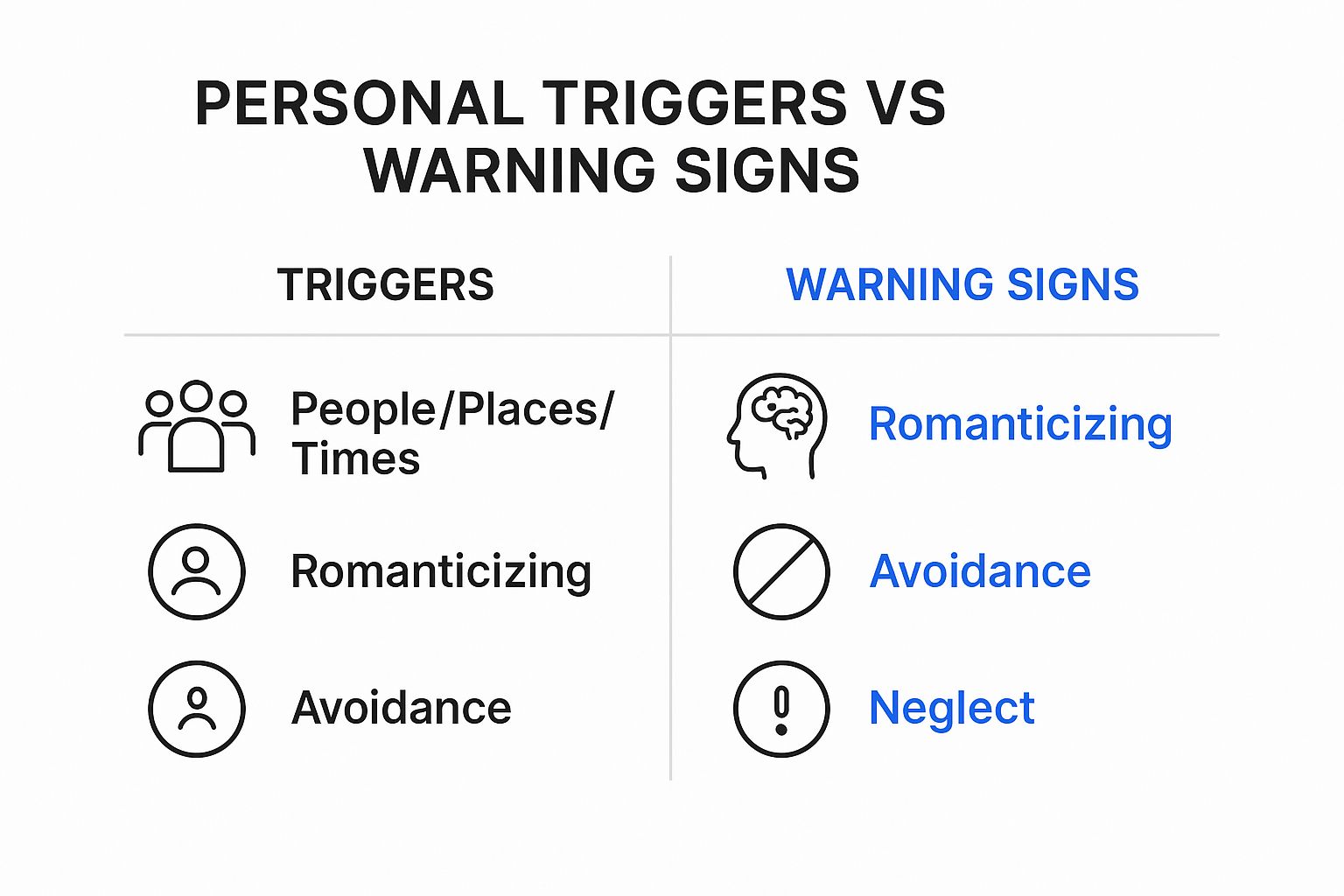
Spotting a warning sign gives you the chance to correct your course before you even encounter a trigger.
Uncovering Your Personal Triggers
Triggers are sneaky and often tied to powerful memories. They can be broken down into a few main types, but the devil is always in the details—your details.
- Environmental Triggers: These are the people, places, and things that your brain connects with using. It could be driving down a certain street, hearing a particular song, or even just the smell of rain if that’s when you used to use.
- Emotional Triggers: This is a big one. These are the feelings you used to numb with substances. Stress, anger, and anxiety are the usual suspects, but don't forget boredom and loneliness. Even intensely positive feelings, like a big celebration or a surge of excitement, can be a trigger for some.
- Withdrawal-Related Triggers: Sometimes, just feeling physically or mentally off can create a powerful urge to use again for relief. It's crucial to know what are withdrawal symptoms so you can recognize them for what they are—your body healing, not a sign you need to relapse.
To help you get started, the table below provides some common examples of internal versus external triggers.
| Internal vs External Triggers Common Examples |
| :— | :— |
| Trigger Category | Example |
| Internal (Feelings, Thoughts) | Feeling anxious about a deadline at work |
| External (People, Places, Things) | Driving past your old dealer's neighborhood |
| Internal (Feelings, Thoughts) | A sudden wave of intense loneliness on a Friday night |
| External (People, Places, Things) | Seeing an old friend you used to get high with |
| Internal (Feelings, Thoughts) | Thinking "Just one time won't hurt" |
| External (People, Places, Things) | Hearing a specific song that reminds you of partying |
Seeing them laid out like this can help you start connecting the dots in your own life.
Learning to Spot the Early Warning Signs
Warning signs are arguably more dangerous than triggers because they creep in so slowly, eroding your recovery from the inside out. They're the subtle changes in thinking and behavior that tell you you're getting complacent.
Pay close attention to these common red flags:
- Romanticizing Past Use: You catch yourself daydreaming about the "good times" of using, conveniently forgetting all the chaos and pain it caused.
- Isolating Yourself: You start dodging calls from your sponsor, skipping meetings, or making excuses to avoid the very people who support your recovery.
- Neglecting Self-Care: Your healthy routines fall apart. You stop exercising, your sleep schedule is a mess, and you're living on junk food. These things kept you grounded, and now they're gone.
- Developing a "Recovery-Proof" Attitude: This is the "I got this" trap. You start thinking you've graduated from recovery and don't need to be so vigilant anymore. Overconfidence is a classic setup for a fall.
Make no mistake, staying sober long-term is a challenge. That's why having this plan is so non-negotiable. One major review of alcoholism studies found that over 75% of people relapsed within a year of treatment when they didn't have strategies like this in place. Recognizing your warning signs is your best defense against becoming a statistic.
Making Your Plan a Living Document
Getting your relapse prevention plan down on paper is a massive accomplishment. But its true power isn't in the writing; it's in the using. A plan that gets filed away in a drawer is just a piece of paper. For it to actually work, you have to treat it as a living, breathing tool that grows and changes with you.
Life isn’t static, and neither is recovery.
Think of your plan like a map for a long road trip. You wouldn't just look at it once when you leave the driveway. You’d have it right there on the passenger seat, checking it at intersections and updating your route when you hit a surprise detour. Your plan needs that same hands-on approach.
When to Review and Revise Your Plan
As you move through recovery, what you need will change. That means your plan has to adapt. Regular check-ins are crucial to make sure it's still relevant and doing its job. You don't have to rewrite it every week, but setting aside specific times to review it is one of the best things you can do for your sobriety.
It's a really good idea to schedule a review session whenever you face:
- A Major Life Change: Think a new job, a big move, or the end of a relationship. These events can throw a whole new set of triggers and stressors your way that your old plan might not account for.
- A Close Call: If you found yourself on the edge of a lapse, that’s not a failure—it’s data. Digging into what happened can show you exactly where your plan needs reinforcement.
- Milestones in Recovery: Hitting 90 days, six months, or a year sober is the perfect opportunity to reflect on what's working and what you can tweak for the road ahead.
- Scheduled Check-ins: At the very least, put it on your calendar to sit down with your plan every three to four months. This ensures it always reflects where you are right now.
Integrating Your Plan into Daily Life
The best relapse prevention plans are the ones that are woven into the fabric of your day. The goal is to make it so easy and natural to access that reaching for it in a tough moment is a reflex, not a chore.
Self-compassion is absolutely vital here. A lapse isn't the end of the world. It’s a chance to learn something new about your triggers and strengthen your plan to make it even more solid for the future.
You need to make your plan work for you. Choose a format that actually fits your life:
- Go Digital: Keep it in a notes app on your phone. This puts your coping skills and support contacts in your pocket, ready at a moment's notice.
- Keep a Physical Copy: For some, something tangible is more powerful. A small, wallet-sized card with your emergency contacts or a journal you can review with your sponsor can be a grounding, physical reminder.
- Share It Strategically: Give a copy to a trusted person in your support system. They can be an incredible ally, helping to hold you accountable and reminding you of your own strategies when stress makes it hard to think straight.
By making your plan a constant companion, you're actively reinforcing the healthy habits you’ve worked so hard to build. It stops being just a document and starts feeling like an extension of your commitment to yourself. This ongoing practice is what builds a truly resilient, long-term recovery.
Frequently Asked Questions (FAQ)
Putting together a relapse prevention plan is a huge step, and it’s completely normal to have a few questions pop up as you go. This is an important tool, and you want to make sure you're getting it right.
What is the main purpose of a relapse prevention plan?
The main purpose is to help you identify high-risk situations (triggers and warning signs) and develop healthy coping strategies to navigate them without turning to substance use. It's a proactive tool that shifts you from reacting to crises to being prepared for the challenges of long-term recovery.
How often should I update my relapse prevention plan?
You should review and update your plan every 3-6 months, or whenever you experience a major life change such as a new job, a move, or a change in a significant relationship. It's a living document that should evolve as your recovery journey progresses.
What if I relapse even with a plan?
A relapse is not a sign of failure but an opportunity to learn. It does not erase your progress. If you relapse, the most important step is to reach out to your support network immediately. Afterward, analyze what led to the relapse and use that information to strengthen your plan and identify any previously unknown triggers or gaps in your coping strategies.
Who should I share my plan with?
While your plan is personal, sharing it strategically can significantly strengthen your support system. Consider sharing key parts of your plan with your sponsor, therapist, counselor, or a trusted family member or partner. This allows them to understand your specific challenges and provide more effective and targeted support.
At StartDrugRehab.com, we are dedicated to providing the resources and support you need at every stage of your recovery. Our goal is to empower you with knowledge and connect you with the right care. Explore our comprehensive guides and find personalized support for your journey at https://startdrugrehab.com.